
Catalogue Search | MBRL


Are you sure you want to remove the book from the shelf?

{{itemTitle}}
1,220
result(s) for
"United Nations Convention on the Law of the Sea"
Sort by:

The law of the sea in the Caribbean
\"This book is about the Law of the Sea in the Caribbean and the contribution of that law to economic development in the region. The most important legal instrument for that discussion is undoubtedly the United Nations Convention on the Law of the Sea which entered into force on 16 November 1994, some twelve years after it was adopted in December 1982, and following more than nine years of negotiations, which began in 1973\"-- Provided by publisher.
BOOK
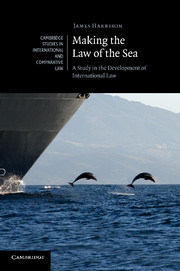
Making the Law of the Sea
The law of the sea is an important area of international law which must be able to adapt to the changing needs of the international community. Making the Law of the Sea examines how various international organizations have contributed to the development of this law and what kinds of instruments and law-making techniques have been used. Each chapter considers a different international institution - including the International Maritime Organization and the United Nations - and analyses its functions and powers. Important questions are posed about the law-making process, including what actors are involved and what procedures are followed. Potential problems for the development of the law of the sea are considered and solutions are proposed. In particular, James Harrison explores and evaluates the current methods employed by international institutions to coordinate their law-making activities in order to overcome fragmentation of the law-making process.
eBook

Marine scientific research and the regulation of modern ocean data collection activities under UNCLOS
\"The scope of marine scientific research has long been debated due to a lack of definition of the term in the United Nations Convention on the Law of the Sea (UNCLOS). The introduction of new forms and methods of ocean data collection adds another layer of legal uncertainty in this field. Marine Scientific Research and the Regulation of Modern Ocean Data Collection Activities Under UNCLOS thus strives to identify the possible limits of the existing legal framework, mainly the UNCLOS marine scientific research regime, and the ways in which the identified gaps can be bridged. In the analysis, Chuxiao Yu carries out two case studies: one on access to marine genetic resources and the other on operational oceanographic activities\"-- Provided by publisher.
BOOK

Marine Protected Areas in International Law
Marine Protected Areas in International Law - an Arctic perspective by Ingvild Ulrikke Jakobsen, examines the legal rights and obligations of states under international law using Marine Protected Areas to protect marine biodiversity, with a particular emphasis on the Arctic region.
eBook


The Law of the Sea Convention
The Law of the Sea Convention: US Accession and Globalization, provides valuable insight into a number of contemporary and pressing issues concerning the world's oceans and their management . Brought together at the 34th Annual Conference of the Center for Oceans Law and Policy, University of Virginia School of Law (COLP), Part l reports on the work of international experts which considers the impact of the lack of US participation in UNCLOS, evaluating topics such as energy and economic development as well as ramifications for U.S. national security and navigational rights. The second section examines key trends in commercial shipping, piracy and terrorism, islands and rocks, safety and navigational freedom, marine scientific research, and emerging global oceans policy issues. Presented by a diverse group of leading academics and policy makers, the work included in Part ll brings together the results of an international meeting co-sponsored by the Korea Maritime Institute, the Netherlands Institute for the Law of the Sea and COLP. Collectively, the work included in this important volume contributes to the existing literature and will be of interest to scholars, practitioners and the policy community.
eBook

The environmental rule of law for oceans : designing legal solutions
\"Our oceans need a strong and effective environmental rule of law to protect them against increased pressures and demands, including climate change, pollution, fisheries, shipping and more. The environmental rule of law for oceans requires the existence of a set of rules and policies at multiple governance levels that appropriately regulate human activities at sea and ensure that pressures on the marine ecosystem are tackled effectively. Adhering to the rule of law through clear, predictable, coherent, and legitimate rules, and their implementation and enforcement, is timely and urgent. In this book, we are searching for ways to improve, strengthen and further develop the environmental rule of law for oceans. The book provides future-oriented perspectives on how law should evolve to better preserve the oceans. All chapters incorporate novel insights and ideas for legal solutions that might inspire scholars, actors, authorities, citizens and communities around the globe. This title is Open Access\"-- Provided by publisher.
Book
The Marine Environment and United Nations Sustainable Development Goal 14
In The Marine Environment and United Nations Sustainable Development Goal 14, leading marine experts assess the scope, achievements, and limitations of UN SDG 14 for the conservation and sustainable use of marine resources.
eBook