
Catalogue Search | MBRL


Are you sure you want to remove the book from the shelf?

{{itemTitle}}
8
result(s) for
"United States -- Foreign relations -- 1977-1981 -- Decision making"
Sort by:

Geographic mental maps and foreign policy change : re-mapping the Carter Doctrine
\"In recent years geographic mental maps have made a comeback into the spotlight of scholarly inquiry in the area of International Relations (IR), particularly Foreign Policy Analysis (FPA). The book is framed within the mental map research agenda. It seeks to contribute and expand the theoretical and empirical development and application of geographic mental maps as an analytical concept for international politics. More precisely, it presents a theoretical framework for understanding how mental maps are employed in foreign policy decision-making and highlights the mechanisms involved in their transformation. The theoretical framework presented in this book employs the latest conceptual and theoretical insight from numerous other scientific fields such as social psychology and organizational theory. In order to test the theoretical propositions outlined in the initial chapters, the book assesses how the Carter Administration's changing mental maps impacted its Middle East policy. In other words, the book applies geographic mental maps as an analytical tool to explain the development of the Carter Doctrine. The book is particularly targeted at academics, students, and professionals involved in the fields of Human Geography, IR, Political Geography, and FPA. The book will also be of interest to individuals interested in Political Science more generally. While the book has is academic in nature, its qualitative and holistic approach is accessible to all readers interested in geography and international politics. Luis da Vinha, PhD, is Assistant Professor of Geography & Political Science at Valley City State University\"-- Provided by publisher.
Book
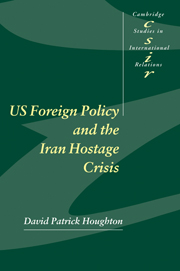
US Foreign Policy and the Iran Hostage Crisis
Why did a handful of Iranian students seize the American embassy in Tehran in November 1979? Why did most members of the US government initially believe that the incident would be over quickly? Why did the Carter administration then decide to launch a rescue mission, and why did it fail so spectacularly? US Foreign Policy and the Iran Hostage Crisis examines these puzzles and others, using an analogical reasoning approach to decision-making, a theoretical perspective which highlights the role played by historical analogies in the genesis of foreign policy decisions. Using interviews with key decision-makers on both sides, Houghton provides an analysis of one of the United States' greatest foreign policy disasters, the events of which continue to poison relations between the two states. The book will be of interest to students and scholars of foreign policy analysis and international relations.
eBook

Carter's conversion : the hardening of American defense policy
\"Examining Carter's dramatic shift from advocating defense budget cuts early in his administration to supporting development of the MX missile and modernization of NATO's Long-Range Theater Nuclear Force by the end of his presidency, the author argues, counter to common interpretations, that the shift was a \"self-correcting\" policy change in response to the prevailing international military environment\"--Provided by publisher.
Book

An Outsider in the White House
Jimmy Carter entered the White House with a desire for a collegial staff that would aid his foreign-policy decision making. He wound up with a \"team of rivals\" who contended for influence and who fought over his every move regarding relations with the USSR, the Peoples' Republic of China, arms control, and other crucial foreign-policy issues.
In two areas-the Camp David Accords and the return of the Canal to Panama-Carter's successes were attributable to his particular political skills and the assistance of Secretary of State Cyrus Vance and other professional diplomats. The ultimate victor in the other battles was Carter's national security advisor, Zbigniew Brzezinski, a motivated tactician. Carter, the outsider who had sought to change the political culture of the executive office, found himself dependent on the very insiders of the political and diplomatic establishment against whom he had campaigned.
Based on recently declassified documents in the Carter Library, materials not previously noted in the Vance papers, and a wide variety of interviews, Betty Glad'sAn Outsider in the White Houseis a rich and nuanced depiction of the relationship between policy and character. It is also a poignant history of damaged ideals. Carter's absolute commitment to human rights foundered on what were seen as national security interests.
New data from the archives reveal how Carter's government sought the aid of Pope John Paul II to undercut the human-rights efforts of the El Salvadoran Archbishop Oscar Romero. A moralistic approach toward the Soviet Union undermined Carter's early desire to reduce East-West conflicts and cut nuclear arms. As a result, by 1980 the Strategic Arms Limitation Treaty (SALT) was in limbo, and a nuclear counterforce doctrine had been adopted.
Near the end of Carter's single term in office Vance stepped down as secretary of state, in part because Brzezinski's \"muscular diplomacy\" had come to dominate Carter's foreign policy. When Vance's successor, Edmund Muskie, took over, the State Department was reduced to implementing policies made by Brzezinski and his allies. For Carter, the rivalry for influence in the White House was concluded and the results, as Glad shows, were a mixed record and an uncertain presidential legacy.
eBook

A superpower transformed : the remaking of American foreign relations in the 1970s
\"During the 1970s, American foreign policy faced a predicament of clashing imperatives--U.S. decision makers, already struggling to maintain stability and devise strategic frameworks to guide the exercise of American power during the Cold War, found themselves hampered by the emergence of dilemmas that would come to a head in the post-Cold War era. Their choices proved to be of enormous consequence for the development of American foreign policy in the final decades of the twentieth century and beyond. In A Superpower Transformed, historian Daniel J. Sargent chronicles how policymakers across three administrations worked to manage complex international changes in a tumultuous era. Drawing on many newly-released archival documents and interviews with key figures, including President Jimmy Carter and Dr. Zbigniew Brzezinski, Sargent explores the collision of geopolitics and globalization that pervaded the decade. From the Nixon administration's efforts to stabilize a faltering Pax Americana; to Henry Kissinger's attempts to devise new strategies to manage or mitigate the consequences of economic globalization after the oil crisis of 1973-74; to the Carter administration's embrace of human rights promotion as a central task for foreign policy, Sargent explores the challenges that afflicted US policymakers in the 1970s, offering new insights into the complexities that emerged as the new forces of globalization and human rights transformed the United States as a superpower. A sweeping reinterpretation of a pivotal era, A Superpower Transformed is a must-read for anyone interested in U.S. foreign relations, American politics, globalization, economic policy, human rights, and contemporary American history\"-- Provided by publisher.
Book

Geographic mental maps and foreign policy change : re-mapping the Carter Doctrine
In recent years geographic mental maps have made a comeback into the spotlight of scholarly inquiry in the area of International Relations (IR), particularly Foreign Policy Analysis (FPA).The book is framed within the mental map research agenda.
eBook

Reagan on war : a reappraisal of the Weinberger doctrine, 1980-1984
Even at the time it was announced near the end of the first term of the Reagan administration, such luminaries as William Safire mischaracterized the Weinberger Doctrine as a conservative retreat from the use of force in U.S. international relations. Since that time, scholars have largely agreed with Safire that the six points spelled out in the statement represented a reaction to the Vietnam War and were intended to limit U.S. military action to “only the fun wars” that could be relatively easily won or those in response to direct attack.
In this work of extensive original scholarship, military historian Gail Yoshitani argues that the Weinberger Doctrine was intended to legitimize the use of military force as a tool of statecraft, rather than to reserve force for a last resort after other instruments of power have failed. This understanding sheds much clearer light on recent foreign policy decisions, as well as on the formulation and adoption of the original doctrine.
With the permission of the family of former Defense Secretary Caspar Weinberger, Yoshitani gained access to Weinberger’s papers at the Library of Congress. She is the first scholar granted access to General (ret.) John Vessey’s archive at the Library, and her security clearance has made it possible for her to read and use a large number of materials still classified as secret or top secret.
Yoshitani uses three case studies from the Reagan administration’s first term in office—Central America and two deployments in Lebanon—to analyze how the administration grappled with using military force in pursuit of national interests. Ultimately, the administration codified the lessons it learned during its first term in the Weinberger Doctrine promulgated by Secretary of Defense Weinberger in a speech on November 28, 1984, two weeks after Reagan won reelection in a landslide. Yoshitani carefully considers the Weinberger Doctrine’s six tests to be applied when considering the use of military force as a tool of statecraft.
Just as the Reagan administration was forced to dance an intricate step in the early 1980s as it sought to use force as a routine part of statecraft, current and future administrations face similar challenges. Yoshitani’s analysis facilitates a better understanding of the Doctrine and how it might be applied by American national security managers today.
This corrective to the common wisdom about the Weinberger Doctrine’s goals and applicability to contemporary issues will appeal not only to diplomatic and military historians, but also to military leaders and general readers concerned about America’s decision making concerning the use of force.
eBook

Carter's conversion : the hardening of American defense policy
When presidential candidate Jimmy Carter advocated defense budget cuts, he did so not only to save money but also with the hope of eventual nuclear abolition. Three years later, when President Carter announced his support of full-scale development of the MX missile and modernization of NATO's Long-Range Theater Nuclear Force, it marked a dramatic policy shift for his administration. Auten provides a historical analysis of defense policy transformation over the first three years of the Carter administration and a detailed examination of how Carter and his national security team addressed challenges posed by the expansion of Soviet military power.
eBook