
Catalogue Search | MBRL


Are you sure you want to remove the book from the shelf?

{{itemTitle}}
753
result(s) for
"United States -- Foreign relations -- 21st century"
Sort by:

The Cuba-U.S. bilateral relationship : new pathways and policy choices
\"This book brings together experts from across three disciplines--politics, economics, and law--to address the key issues that affect Cuba-U.S. bilateral relations today. The chapters identify the opportunities and challenges presented to both nations in each of their respective disciplines while staking out what the future may hold\"-- Provided by publisher.
Book

The Evolving Relationship between China, the EU and the USA
This book closely scrutinizes the individual and collective roles played by China, the EU and the USA in contemporary world politics.
Examining the three actors’ respective strategic and policy positions on and behaviour towards the flux of the contemporary global order, the analysis focuses on three major issues and challenges: foreign and security policy; economics and trade; and climate change and energy. Discussing their relative power, as well as their interests, beliefs and positions on a set of decisive issues, this book explores bilateral relations between the three powers and the ways in which they may interact trilaterally in a broader global context to shape international politics.
Written by a stellar line-up of experts from the fields of politics and international relations, The Evolving Relationship between China, the EU and the USA will be of huge interest to students and scholars from within these fields, as well as policy-makers and practitioners more generally.
eBook
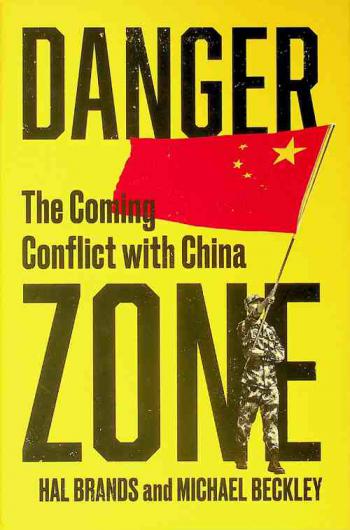
Danger zone : the coming conflict with China
\"A provocative and urgent analysis of the U.S.-China rivalry. It has become conventional wisdom that America and China are running a \"superpower marathon\" that may last a century. Yet Hal Brands and Michael Beckley pose a counterintuitive question: What if the sharpest phase of that competition is more like a decade-long sprint? The Sino-American contest is driven by clashing geopolitical interests and a stark ideological dispute over whether authoritarianism or democracy will dominate the 21st century. But both history and China's current trajectory suggest that this rivalry will reach its moment of maximum danger in the 2020s. China is at a perilous moment: strong enough to violently challenge the existing order, yet losing confidence that time is on its side. Numerous examples from antiquity to the present show that rising powers become most aggressive when their fortunes fade, their difficulties multiply, and they realize they must achieve their ambitions now or miss the chance to do so forever. China has already started down this path. Witness its aggression toward Taiwan, its record-breaking military buildup, and its efforts to dominate the critical technologies that will shape the world's future. Over the long run, the Chinese challenge will most likely prove more manageable than many pessimists currently believe-but during the 2020s, the pace of Sino-American conflict will accelerate, and the prospect of war will be frighteningly real. America, Brands and Beckley argue, will still need a sustainable approach to winning a protracted global competition. But first, it needs a near-term strategy for navigating the danger zone ahead\"-- Provided by publisher.

America's mission
America's Missionargues that the global strength and prestige of democracy today are due in large part to America's impact on international affairs. Tony Smith documents the extraordinary history of how American foreign policy has been used to try to promote democracy worldwide, an effort that enjoyed its greatest triumphs in the occupations of Japan and Germany but suffered huge setbacks in Latin America, Vietnam, and elsewhere. With new chapters and a new introduction and epilogue, this expanded edition also traces U.S. attempts to spread democracy more recently, under presidents Clinton, Bush, and Obama, and assesses America's role in the Arab Spring.
eBook

Prospects for the American age : sovereignty and influence in the new world order
\"The main premise of the book is that the United States of America may be considered the dominant pole in the new world order, and that the world will continue to exist in an American age that is expected to extend for at least a further five decades. The qualitative supremacy of the United States of America has proven inescapable according to the data, statistics and information presented in this book, as well as the scales and variables of comparison adopted by the author in terms of economics, military advancement, energy resources, transportation, education, culture, and technological progress. According to these standards, the structure of the new world order may be described as a hierarchy, with the United States of America alone at the top, followed by a second tier comprising Russia, China and the European Union, a third tier consisting of Japan, India and Brazil, followed by the rest of world. The introduction to this book may be considered a basic foundation for the analysis presented in the following seven chapters, which examine the emergence, current status, and future of the new world order in its various dimensions.\"-- Provided by publisher.
Book

New Public Diplomacy in the 21st Century
This book examines the concept of new public diplomacy against empirical data derived from three country case studies, in order to offer a systematic assessment of policy and practice in the early 21st century.
The new public diplomacy (PD) is a major paradigm shift in international political communication. Globalisation and a new media landscape challenge traditional foreign ministry 'gatekeeper' structures, and foreign ministries can no longer lay claim to being sole or dominant actors in communicating foreign policy. This demands new ways of elucidating foreign policy to a range of nongovernmental international actors, and new ways of evaluating the influence of these communicative efforts.
The author investigates the methods and strategies used by five foreign ministries and cultural institutes in three countries as they attempt to adapt their PD practices to the demands of the new public diplomacy environment. Drawing upon case studies of US, British, and Swedish efforts, each chapter covers national policy, current activities, evaluation methods, and examples of individual campaigns.
This book will be of much interest to students of public diplomacy, foreign policy, political communication, media studies and international relations in general.
eBook

American foreign policy and forced regime change since World War II : forcing freedom
\"This book explores the motivations behind American military interventions in the Post-World War II era that purported to replace autocratic regimes with democratic ones. It delves into the Forced Democracy (FD) phenomenon, focusing on its intellectual roots and previous attempts to study it in the academic literature. The author examines five American interventions that attempted to replace autocratic regimes with democratic ones - the Dominican Republic, Grenada, Panama, Afghanistan, and Iraq. Each chapter includes a history of the intervention and an assessment of whether America's intentions and actions toward that particular country were actually focused on delivering a democratic outcome.\"--Back cover.
Book

Gender, Agency and War
This book traces practices of militarization and resistance that have emerged under the sign of motherhood in US Foreign Policy.
Gender, Agency and War examines this discourse against the background of three key moments of American foreign policy formation: the anti-nuclear movement of the 1980s, the Gulf War of the early 1990s, and the recent invasion of Iraq. For each of these moments the author explores the emergence of a historically specific and emblematic maternalized mode of female embodiment (ranging from the ‘hysterical’ antinuclear protester to the figure of ‘Supermom’), in order to shed light onto the various practices which define and enable expressions of American sovereignty. In so doing, the text argues that the emergence of particular raced, gendered, and maternalized bodies ought not to be read as merely tangential to affairs of state, but as instantiations of global politics. This work urges an approach that rereads the body as an ‘event’ – with significant implications for the ways in which international politics and gender are currently understood.
This book will be of much interest to students of gender politics, critical security studies, US foreign policy and IR in general.
eBook

Cycles in US foreign policy since the Cold War
\"This book describes how American international policy alternates between engagement and disengagement cycles in world affairs. These cycles provide a unique way to understand, assess, and describe fluctuations in America's involvement or non-involvement overseas. In addition to its basic thesis, the book presents a fair-minded account of four presidents' foreign policies in the post-Cold War period: George H.W. Bush, Bill Clinton, George W. Bush, and Barack Obama. It suggests recurring sources of cyclical change, along with implications for the future. An engaged or involved foreign policy entails the use of military power and diplomatic pressure against other powers to secure American ends. A disengaged on noninvolved policy relies on normal economic and political interaction with other states, which seeks to disassociation from entanglements.\"--Back cover.
Book

Great Delusion
A major theoretical statement by a distinguished political scholar explains why a policy of liberal hegemony is doomed to failIn this major statement, the renowned international-relations scholar John Mearsheimer argues that liberal hegemony, the foreign policy pursued by the United States since the Cold War ended, is doomed to fail. It makes far more sense, he maintains, for Washington to adopt a more restrained foreign policy based on a sound understanding of how nationalism and realism constrain great powers abroad.It is widely believed in the West that the United States should spread liberal democracy across the world, foster an open international economy, and build institutions. This policy of remaking the world in America's image is supposed to protect human rights, promote peace, and make the world safe for democracy. But this is not what has happened. Instead, the United States has ended up as a highly militarized state fighting wars that undermine peace, harm human rights, and threaten liberal values at home. Mearsheimer tells us why this has happened.
eBook