
Catalogue Search | MBRL


Are you sure you want to remove the book from the shelf?

{{itemTitle}}
549
result(s) for
"United States -- Foreign relations -- Europe, Western"
Sort by:
Beyond chinoiserie : artistic exchange between China and the West during the late Qing dynasty (1796-1911)
\"The complex interweaving of different Western visions of China had a profound impact on artistic exchange between China and the West during the nineteenth century. Beyond Chinoiserie addresses the complexity of this exchange. While the playful Western \"vision of Cathay\" formed in the previous century continued to thrive, a more realistic vision of China was increasingly formed through travel accounts, paintings, watercolors, prints, book illustrations, and photographs. Simultaneoulsy, the new discipline of sinology led to a deepening of the understanding of Chinese cultural history. Leading and emerging scholars in the fields of art history, literary studies and material culture, have authored the ten essays in this book that deal with artistic relations between China and the West at a time when Western powers' attempts to extend a sphere of influence in China led to increasingly hostile political interactions\"-- Provided by publisher.
Book

The United States and Western Europe since 1945 : from \Empire\ by invitation to transatlantic drift
Based on new and existing research by a world‐class scholar, this is the first book in twenty years to examine the dynamics of the entire American–Western European relationship since 1945. The relationship between the US and Western Europe has always been crucial, and current events dictate that it is becoming ever more so. In this book, the author analyses the balance between the cooperation and conflict that has characterized this relationship in the post‐war period. He examines talk of transatlantic drift, and the strain now apparent between the US and the nation states of Western Europe. The first nine chapters are, for the most part, arranged as a chronological account of the relationship. In the concluding Ch. 10 section, the author offers a topical view of the future of transatlantic interaction. Throughout the work, the author's much cited ‘“Empire” by invitation’ thesis is both put into practice and extended in time and scope. This book is essential reading for anyone interested in one of the most important and enduring international relationships of the last sixty years.
eBook

Europe, America, Bush
Europe, America, Bush is the first study of underlying elements of continuity in the transatlantic relationship, as well as new and powerful forces for change.
It offers a definitive assessment of whether, and how much, the election of George W. Bush, the events of 11 September, and conflict over Iraq mark genuine and lasting change in transatlantic relations.
American and European experts assess transatlantic relations on matters of foreign and security policy, economic diplomacy, justice and internal security cooperation, environmental policy and relations with Russia, the Balkans and the Middle East. This is essential reading for all students with an interest in this key relationship in world affairs.
eBook

Qing travellers to the Far West : diplomacy and the information order in late imperial China
\"Prior to the mid-nineteenth century, the countries of Europe were populated by untamable barbarians and unearthly immortals in the Chinese imagination. Firsthand Chinese accounts of Europe unraveled this perception\"-- Provided by publisher.
Book
Europe, America and Bush: transatlantic relations after 2000
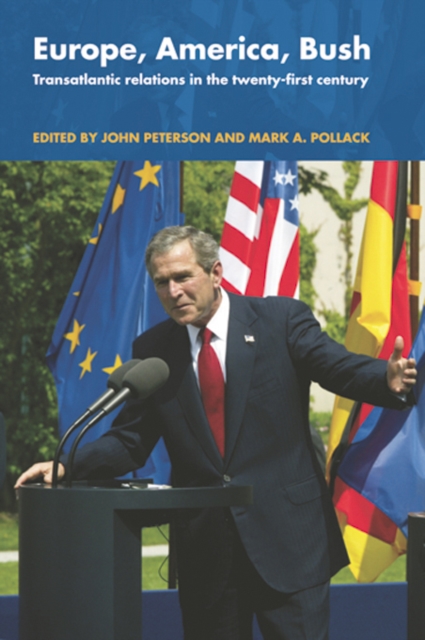
Europe, America, Bushis the first study of underlying elements of continuity in the transatlantic relationship, as well as new and powerful forces for change. It offers a definitive assessment of whether, and how much, the election of George W. Bush, the events of 11 September, and conflict over Iraq mark genuine and lasting change in transatlantic relations. American and European experts assess transatlantic relations on matters of foreign and security policy, economic diplomacy, justice and internal security cooperation, environmental policy and relations with Russia, the Balkans and the Middle East. This is essential reading for all students with an interest in this key relationship in world affairs.
eBook

1989
1989explores the momentous events following the fall of the Berlin Wall and the effects they have had on our world ever since. Based on documents, interviews, and television broadcasts from Washington, London, Paris, Bonn, Berlin, Warsaw, Moscow, and a dozen other locations,1989describes how Germany unified, NATO expansion began, and Russia got left on the periphery of the new Europe.
This updated edition contains a new afterword with the most recent evidence on the 1990 origins of NATO's post-Cold War expansion.
eBook

European-American Relations and the Middle East
This book examines the evolution of European-American relations with the Middle East since 1945.
Placing the current transatlantic debates on the Middle East into a broader context, this work analyses how, why, and to what extent European and US roles, interests, threat perceptions, and policy attitudes in the region have changed, relating to both the region as a whole and the two main issues analysed: Gulf Security and the Arab-Israeli Conflict. The contributors then go on to discuss the implications of these developments for Western policymaking.
The volume makes four key contributions. First, it examines the subject matter from a truly transatlantic perspective, with all chapters adopting a bi- or multilateral approach, taking into account the views from both the US and individual European countries or the EC/EU collectively. Second, the book takes a long-term view, covering a series of crises and developments over the past six decades. Third, it has a systematic structure, with the predominantly chronological order of the chapters being geared towards depicting trends and evolutions with regard to the key themes of the book. Finally, the book builds bridges between historians and political scientists/analysts, as well as between experts of transatlantic relations and Middle East scholars.
This book will be of great interest to students of transatlantic relations, the Middle East, US foreign policy, European politics, international history and IR in general.
Daniel Möckli is a Senior Researcher at the Center for Security Studies (CSS), ETH Zurich. He is also the editor of CSS Analyses in Security Policy.
Victor Mauer is Deputy Director and Head of Research of the Center for Security Studies (CSS), ETH Zurich, and Lecturer in the Department of Social Sciences and Humanities at ETH Zurich.
Daniel Möckli is a Senior Researcher at the Center for Security Studies (CSS), ETH Zurich. He is also the editor of CSS Analyses in Security Policy.
Victor Mauer is the Deputy Director and Head of Research of the Center for Security Studies (CSS), ETH Zurich, and Lecturer in the Department of Social Sciences and Humanities at ETH Zurich.
Introduction Daniel M öckli and Victor Mauer Part 1: Changing Roles and Interests: From Suez to Iraq 1. Suez 1956: European Colonial Interests and US Cold War Prerogatives Tore T. Petersen 2. Iraq 2003: Regime Change and Its European Discontents Victor Mauer Part 2: The Arab-Israeli Conflict and the West 3. Anglo-American Relations and the Palestine Question, 1945-56 John Sakkas 4. At Odds in the Middle East: Paris, Washington, and the Six-Day War, 1967 Garret Martin 5. The EC-Nine and Transatlantic Conflict During the October War and the Oil Crisis, 1973/74 Daniel Möckli 6. The Euro-Arab Dialogue, the Venice Declaration, and Beyond: The Limits of a Distinct EC Policy, 1974-89 David Allen and Andrin Hauri 7. From Madrid to Camp David: Europe, the US, and the Middle East Peace Process in the 1990s Patrick Müller and Claire Spencer 8. The Middle East Quartet: A New Role for Europe? Constanza Musu Part 3: Gulf Security and Transatlantic Relations 9. Dealing with Iran: The US, Britain, and Regime Change 1951-3 Malcolm Byrne 10. Securing Gulf Oil: Britain, NATO, and the Question of Military Intervention East of Suez, 1949-68 Stephen Blackwell 11. Subcontracting Security: The US, Britain, and Gulf Security Before the Carter Doctrine Roland Popp 12. Great Game Redux: The US, Europe, and Gulf Security in the Late Cold War Peter John Brobst 13. Europe, the US, and the Gulf After the Cold War Gerd Nonneman 14. Iran and the Bomb: Washington, the EU, and Iranian Nuclear Ambitions Harsh V. Pant. Conclusion: Major Trends in European-American Relations and the Middle East since 1945 Daniel Möckli and Victor Mauer
eBook

The Politics of Secularism in International Relations
Conflicts involving religion have returned to the forefront of international relations. And yet political scientists and policymakers have continued to assume that religion has long been privatized in the West. This secularist assumption ignores the contestation surrounding the category of the \"secular\" in international politics. The Politics of Secularism in International Relations shows why this thinking is flawed, and provides a powerful alternative. Elizabeth Shakman Hurd argues that secularist divisions between religion and politics are not fixed, as commonly assumed, but socially and historically constructed. Examining the philosophical and historical legacy of the secularist traditions that shape European and American approaches to global politics, she shows why this matters for contemporary international relations, and in particular for two critical relationships: the United States and Iran, and the European Union and Turkey.
eBook

Uncouth Nation
No survey can capture the breadth and depth of the anti-Americanism that has swept Europe in recent years. From ultraconservative Bavarian grandmothers to thirty-year-old socialist activists in Greece, from globalization opponents to corporate executives--Europeans are joining in an ever louder chorus of disdain for America. For the first time, anti-Americanism has become a European lingua franca.
In this sweeping and provocative look at the history of European aversion to America, Andrei Markovits argues that understanding the ubiquity of anti-Americanism since September 11, 2001, requires an appreciation of such sentiments among European elites going back at least to July 4, 1776.
While George W. Bush's policies have catapulted anti-Americanism into overdrive, particularly in Western Europe, Markovits argues that this loathing has long been driven not by what America does, but by what it is. Focusing on seven Western European countries big and small, he shows how antipathies toward things American embrace aspects of everyday life--such as sports, language, work, education, media, health, and law--that remain far from the purview of the Bush administration's policies. Aggravating Europeans' antipathies toward America is their alleged helplessness in the face of an Americanization that they view as inexorably befalling them.
More troubling, Markovits argues, is that this anti-Americanism has cultivated a new strain of anti-Semitism. Above all, he shows that while Europeans are far apart in terms of their everyday lives and shared experiences, their not being American provides them with a powerful common identity--one that elites have already begun to harness in their quest to construct a unified Europe to rival America.
eBook