
Catalogue Search | MBRL


Are you sure you want to remove the book from the shelf?

{{itemTitle}}
4
result(s) for
"United States -- History -- 1945-1953 -- Historiography"
Sort by:

Harry S. Truman and the Cold War revisionists
\"Ferrell argues that revisionists are often hasty and argumentative in their judgments, understanding neither the times nor the players. These essays challenge the revisionists' perception of President Harry Truman by going below surface appearances of history to examine how this presidency actually functioned in response to unprecedented problems and crises\"--Provided by publisher.
Book

Harry S. Truman and the Cold War revisionists
The idea of revising what is known of the past constitutes an essential procedure in historical scholarship, but revisionists are often hasty and argumentative in their judgments. Such, argues Robert H. Ferrell, has been the case with assessments of the presidency of Harry S. Truman, who was targeted by historians and political scientists in the 1960s and '70s for numerous failings in both domestic and foreign policy, including launching the cold war—perceptions that persist to the present day.
Widely acknowledged as today's foremost Truman scholar, Ferrell turns the tables on the revisionists in this collection of classic essays. He goes below the surface appearances of history to examine how situations actually developed and how Truman performed sensibly—even courageously—in the face of unforeseen crises.
While some revisionists see Truman as consumed by a blind hatred of the Soviet Union and adopting an unrestrainedly militant stance, Ferrell convincingly shows that Truman wished to get along with the Soviets and was often bewildered by their actions. He interprets policies such as the Truman Doctrine, the Marshall Plan, and support for NATO as prudent responses to perceived threats and credits the Truman administration for the ways in which it dealt with unprecedented problems.
What emerges most vividly from Ferrell's essays is a sense of how weak a hand the United States held from 1945 to1950, with its conventional forces depleted by the return of veterans to civil pursuits after the war and with its capacity for delivery of nuclear weapons in a sorry state. He shows that Truman regarded the atomic bomb as a weapon of last resort, not an instrument of policy, and that he took America into a war in Korea for the good of the United States and its allies. Although Truman has been vindicated on many of these issues, there still remains a lingering controversy over the use of atomic weapons in Japan—a decision that Ferrell argues is understandable in light of what Truman faced at the start of his presidency.
Ferrell argues that the revisionists who attacked Truman understood neither the times nor the man—one of the most clearheaded, farsighted presidents ever to occupy the Oval Office. Harry S. Truman and the Cold War Revisionists shows us that Truman's was indeed a remarkable presidency, as it cautions historians against too quickly appraising the very recent past.
eBook
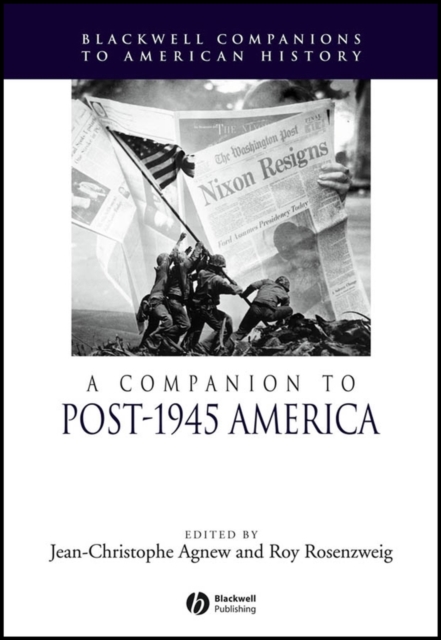
A companion to post-1945 America
A Companion to Post-1945 America is an original collection of 34 essays by key scholars on the history and historiography of Post-1945 America.Covers society and culture, people and movements, politics and foreign policySurveys and evaluates the best scholarship on every important era and topicIncludes book review section on essential readings.
eBook

Roosevelt's Lost Alliances
In the spring of 1945, as the Allied victory in Europe was approaching, the shape of the postwar world hinged on the personal politics and flawed personalities of Roosevelt, Churchill, and Stalin. Roosevelt's Lost Alliances captures this moment and shows how FDR crafted a winning coalition by overcoming the different habits, upbringings, sympathies, and past experiences of the three leaders. In particular, Roosevelt trained his famous charm on Stalin, lavishing respect on him, salving his insecurities, and rendering him more amenable to compromise on some matters.
eBook