
Catalogue Search | MBRL


Are you sure you want to remove the book from the shelf?

{{itemTitle}}
257
result(s) for
"United States -- Politics and government -- 1861-1865"
Sort by:


Politics
\"In an alphabetical almanac format, describes the issues, speeches, movements, and political events that helped spur on and end the U.S. Civil War\"--Provided by publisher.
Book

Lincoln, Seward, and US Foreign Relations in the Civil War Era
The Civil War marked a significant turning point in American
history-not only for the United States itself but also for its
relations with foreign powers both during and after the conflict.
The friendship and foreign policy partnership between President
Abraham Lincoln and Secretary of State William Henry Seward shaped
those US foreign policies. These unlikely allies, who began as
rivals during the 1860 presidential nomination, helped ensure that
America remained united and prospered in the aftermath of the
nation's consuming war.
In Lincoln, Seward, and US Foreign Relations in the Civil
War Era , Joseph A. Fry examines the foreign policy decisions
that resulted from this partnership and the legacy of those
decisions. Lincoln and Seward, despite differences in upbringing,
personality, and social status, both adamantly believed in the
preservation of the union and the need to stymie slavery. They made
that conviction the cornerstone of their policies abroad, and
through those policies, such as Seward threatening war with any
nation that intervened in the Civil War, they prevented European
intervention that could have led to Northern defeat. The Union
victory allowed America to resume imperial expansion, a dynamic
that Seward sustained beyond Lincoln's death during his tenure as
President Andrew Johnson's Secretary of State.
Fry's analysis of the Civil War from an international
perspective and the legacy of US policy decisions provides a more
complete view of the war and a deeper understanding of this crucial
juncture in American history.
eBook
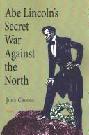
Abe Lincoln's secret war against the North
\"Abraham Lincoln is an American icon. As 'Honest Abe' and the 'Great Emancipator,' today he is viewed as a demigod whose grand virtues far outweigh his miniscule human failings. Yet he wasn't always viewed this way. During his presidency, he was feared and hated, not only by Southerners, but also by his political rivals, the Democrats, and to a surprising degree, by the rank and file of his own Republican Party. They recognized that he had become a brutal dictator and was turning the USA into a permanently militarized nation. Today, much of this has been swept under the rug, but through this investigation of three Northern states that opposed Abraham Lincoln's policies, and one state that fervently supported him, the true reality will be kept alive\"--Provided by publisher.
Book

Lincoln and Leadership:Military, Political, and Religious Decision Making
A book that does something truly remarkable: says something new about Lincoln! Lincoln and Leadership offers fresh perspectives on the 16th president-making novel contributions to the scholarship of one of the more studied figures of American history. The book explores Lincoln's leadership through essays focused, respectively, on Lincoln as commander-in-chief, deft political operator, and powerful theologian. Taken together, the essays suggest the interplay of military, political, and religious factors informing Lincoln's thought and action and guiding the dynamics of his leadership. The contributors, all respected scholars of the Civil War era, focus on several critical moments in Lincoln's presidency to understand the ways Lincoln understood and dealt with such issues and concerns as emancipation, military strategy, relations with his generals, the use of black troops, party politics and his own re-election, the morality of the war, the place of America in God's design, and the meaning and obligations of sustaining the Union. Overall, they argue that Lincoln was simultaneously consistent regarding his commitments to freedom, democratic government, and Union but flexible, and sometimes contradictory, in the means to preserve and extend them. They further point to the ways that Lincoln's decision making defined the presidency and recast understandings of American \"exceptionalism.\" They emphasize that the \"real\" Lincoln was an unabashed party man and shrewd politician, a self-taught commander-in-chief, and a deeply religious man who was self-confident in his ability to judge men and to persuade them with words but unsure of what God demanded from America for its collective sins of slavery. Randall Miller's Introduction in particular provides essential weight to the notion that Lincoln's presidential leadership must be seen as a series of interlocking stories. In the end, the contributors collectively remind readers that the Lincoln enshrined as the \"Great Emancipator\" and \"savior of the Union\" was in life and practice a work-in-progress. And they insist that \"getting right with Lincoln\" requires seeing the intersections of his-and America's-military, political, and religious interests and identities.
eBook


The Cacophony of Politics
The Cacophony of Politics charts the trajectory of the
Democratic Party as the party of opposition in the North during the
Civil War. A comprehensive overview, this book reveals the myriad
complications and contingencies of political life in the Northern
states and explains the objectives of the nearly half of eligible
Northern voters who cast a ballot against Abraham Lincoln in
1864.
The party's famous slogan \"The Union as it was, the Constitution
as it is\" was meant to have broad appeal and promote solidarity
among Northern Democrats by invoking their core ideological
commitments to nationalism, law and order, tradition, and strict
construction. But, as J. Matthew Gallman shows, the slogan was a
poor reflection of the volatile, fluid, messy, and improvisational
reality of political life for men and women, across the public and
private spheres. Democrats experienced the war as a cascading
series of dilemmas, for which their slogan did not always offer
guidance or resolution. Offering a definitive account of the
Democratic Party in the North, The Cacophony of Politics
shows the limits of ideology and the ways the Civil War-and the
nature of nineteenth-century political culture-confounded the
Democrats' self-image and exacerbated their divisions, especially
over the central issue of slavery.
A Nation Divided: Studies in the Civil War Era
eBook