
Catalogue Search | MBRL


Are you sure you want to remove the book from the shelf?

{{itemTitle}}
366
result(s) for
"United States -- Politics and government -- 1945-1989"
Sort by:


The American President
The American President is an enthralling account of American presidential actions from the assassination of William McKinley in 1901 to Bill Clinton's last night in office in January 2001. William Leuchtenburg, a prize-winning historian, portrays each of the presidents in a chronicle sparkling with anecdote and wit.
eBook


Right Moves
From the middle of the twentieth century, think tanks have played an indelible role in the rise of American conservatism. Positioning themselves against the alleged liberal bias of the media, academia, and the federal bureaucracy, conservative think tanks gained the attention of politicians and the public alike and were instrumental in promulgating conservative ideas. Yet, in spite of the formative influence these institutions have had on the media and public opinion, little has been written about their history. Here, Jason Stahl offers the first sustained investigation of the rise and historical development of the conservative think tank as a source of political and cultural power in the United States.What we now know as conservative think tanks--research and public-relations institutions populated by conservative intellectuals--emerged in the postwar period as places for theorizing and \"selling\" public policies and ideologies to both lawmakers and the public at large. Stahl traces the progression of think tanks from their outsider status against a backdrop of New Deal and Great Society liberalism to their current prominence as a counterweight to progressive political institutions and thought. By examining the rise of the conservative think tank, Stahl makes invaluable contributions to our historical understanding of conservatism, public-policy formation, and capitalism.
eBook


Mandarins of the future : modernization theory in Cold War America
Because it provided the dominant framework for \"development\" of poor, postcolonial countries, modernization theory ranks among the most important constructs of twentieth-century social science. In Mandarins of the Future: Modernization Theory in Cold War America Nils Gilman offers the first intellectual history of a movement that has had far-reaching and often unintended consequences. After a survey of the theory's origins and its role in forming America's postwar sense of global mission, Gilman offers a close analysis of the people who did the most to promote it in the United States and the academic institutions they came to dominate. He first explains how Talcott Parsons at Harvard constructed a social theory that challenged the prevailing economics-centered understanding of the modernization process, then describes the work of Edward Shils and Gabriel Almond in helping Parsonsian ideas triumph over other alternative conceptions of the development process, and finally discusses the role of Walt Rostow and his colleagues at M.I.T. in promoting modernization theory during the Kennedy and Johnson administrations. By connecting modernization theory to the welfare state liberalism programs of the New Deal order, Gilman not only provides a new intellectual context for America's Third World during the Cold War, but also connects the optimism of the Great Society to the notion that American power and good intentions could stop the postcolonial world from embracing communism.
eBook

Beyond the New Deal order : U.S. politics from the Great Depression to the Great Recession
\"Beyond the New Deal Order offers a historicized analysis of the degree to which the original understanding of that order still holds. The unifying thematic among the essays lies not in their subject matter - politics, political economy, social thought, and legal scholarship are all well represented - but in a quest to bring fresh twenty-first-century perspective to the historic meaning and significance of an extended New Deal moment. Along the way, the contributors to this volume also ascertain the degree to which that old order itself has been displaced or even overthrown by a different, more market-centered reform logic that became the basis of shifting electoral and policy coalitions in the 1970s and beyond. Various contributors identify elements of a distinctively new order arising from the political economic, ideological, institutional, and electoral currents of post 1970s politics\"-- Provided by publisher.
Book
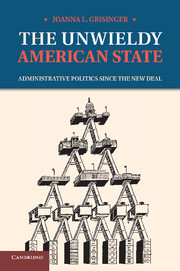
The Unwieldy American State
The Unwieldy American State offers a political and legal history of the administrative state from the 1940s through the early 1960s. After Progressive Era reforms and New Deal policies shifted a substantial amount of power to administrators, the federal government's new size and shape made one question that much more important: how should agencies and commissions exercise their enormous authority? In examining procedural reforms of the administrative process in light of postwar political developments, Grisinger shows how administrative law was shaped outside the courts. Using the language of administrative law, parties debated substantive questions about administrative discretion, effective governance and national policy, and designed reforms accordingly. In doing so, they legitimated the administrative process as a valid form of government.
eBook

American empire : the rise of a global power, the Democratic revolution at home, 1945-2000
A compelling look at the movements and developments that propelled America to world dominance beginning in 1945 and moving through McCarthyism and Vietnam, from the Great Society to Morning in America.
Book

Seeking a New Majority
The rise of the Republican Party from its mid-twentieth-century
minority status between 1960 and 1980 had a profound impact on
American politics that is still being felt in the second decade of
the twenty-first century. The GOP would move to the right in its
pursuit of electoral ascendancy, but considerable debate within the
party surrounded this shift and its success was far from certain.
Ultimately, however, this development would culminate in the
transformational election of Ronald Reagan as president in 1980.
Seeking a New Majority assembles an international group of
scholars to move beyond the ideas and activities of party leaders
who have hitherto received the bulk of historical attention. It
illuminates how the Republican Party expanded its regional base,
especially in the South, appealed to new constituencies ranging
from blue-collar workers to Christian fundamentalists, and enhanced
the political appeal of conservatism. It also examines how
Republicans engaged in a remarkable organizational and intellectual
mobilization to challenge Democratic Party dominance--in search of
a new majority.
eBook