
Catalogue Search | MBRL


Are you sure you want to remove the book from the shelf?

{{itemTitle}}
1,295
result(s) for
"United States -- Race relations -- Political aspects"
Sort by:

Shifting the meaning of democracy : race, politics, and culture in the United States and Brazil
\"This book offers a historical analysis of one of the most striking and dramatic transformations to take place in Brazil and the United States during the twentieth century--the redefinition of the concepts of nation and democracy in racial terms. The multilateral political debates that occurred between 1930 and 1945 pushed and pulled both states towards more racially inclusive political ideals and nationalisms. Both countries utilized cultural production to transmit these racial political messages. At times working collaboratively, Brazilian and U.S. officials deployed the concept of \"racial democracy\" as a national security strategy, one meant to suppress the existential threats perceived to be posed by World War II and by the political agendas of communists, fascists, and blacks. Consequently, official racial democracy was limited in its ability to address racial inequities in the United States and Brazil. Shifting the Meaning of Democracy helps to explain the historical roots of a contemporary phenomenon: the coexistence of widespread antiracist ideals with enduring racial inequality\"--Provided by publisher.
Book

Top Down
At first glance, the Ford Foundation and the black power movement would make an unlikely partnership. After the Second World War, the renowned Foundation was the largest philanthropic organization in the United States and was dedicated to projects of liberal reform. Black power ideology, which promoted self-determination over color-blind assimilation, was often characterized as radical and divisive. But Foundation president McGeorge Bundy chose to engage rather than confront black power's challenge to racial liberalism through an ambitious, long-term strategy to foster the \"social development\" of racial minorities. The Ford Foundation not only bankrolled but originated many of the black power era's hallmark legacies: community control of public schools, ghetto-based economic development initiatives, and race-specific arts and cultural organizations. InTop Down, Karen Ferguson explores the consequences of this counterintuitive and unequal relationship between the liberal establishment and black activists and their ideas. In essence, the white liberal effort to reforge a national consensus on race had the effect of remaking racial liberalism from the top down-a domestication of black power ideology that still flourishes in current racial politics. Ultimately, this new racial liberalism would help foster a black leadership class-including Barack Obama-while accommodating the intractable inequality that first drew the Ford Foundation to address the \"race problem.\"
eBook

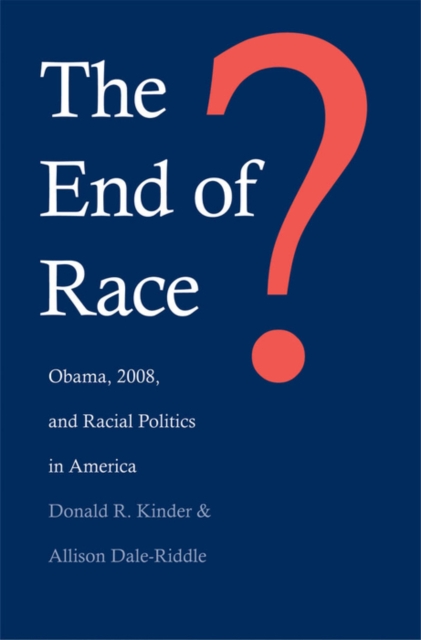
The end of race? : Obama, 2008, and racial politics in America
How did race affect the election that gave America its first African American president? This book offers some fascinating, and perhaps controversial, findings. Donald R. Kinder and Allison Dale-Riddle assert that racism was in fact an important factor in 2008, and that if not for racism, Barack Obama would have won in a landslide. On the way to this conclusion, they make several other important arguments.In an analysis of the nomination battle between Obama and Hillary Clinton, they show why racial identity matters more in electoral politics than gender identity. Comparing the 2008 election with that of 1960, they find that religion played much the same role in the earlier campaign that race played in 08. And they argue that racial resentmenta modern form of racism that has superseded the old-fashioned biological varietyis a potent political force.
eBook


Race Appeal
In our evolving American political culture, whites and blacks continue to respond very differently to race-based messages and the candidates who use them.Race Appealexamines the use and influence such appeals have on voters in elections for federal office in which one candidate is a member of a minority group.Charlton McIlwain and Stephen Caliendo use various analysis methods to examine candidates who play the race card in political advertisements. They offer a compelling analysis of the construction of verbal and visual racial appeals and how the news media covers campaigns involving candidates of color.Combining rigorous analyses with in-depth case studies-including an examination of race-based appeals in the historic 2008 presidential election-Race Appealis a groundbreaking work that represents the most extensive and thorough treatment of race-based appeals in American political campaigns to date.
eBook


Winning While Losing
During the four decades separating the presidencies of Lyndon B. Johnson and Barack Obama, the meaning of civil rights has become increasingly complex. Civil rights leaders made great strides in breaking down once-impermeable racial barriers, but they also suffered many political setbacks in their attempts to remedy centuries of discrimination and oppression as race and the ascendancy of conservatism in America became inextricably intertwined.
This pioneering collection of essays chronicles the ways in which presidential politics have shaped black experiences in the aftermath of the civil rights legislation passed in the 1960s, from the experimental and transitional nature of Richard Nixon's policies and the transformative aspect of Ronald Reagan's presidency to the constraints that Reagan's legacy placed on Bill Clinton and the continued efforts to disenfranchise black and poor people in the twenty-first century.
eBook


Still a house divided
Why have American policies failed to reduce the racial inequalities still pervasive throughout the nation? Has President Barack Obama defined new political approaches to race that might spur unity and progress? Still a House Divided examines the enduring divisions of American racial politics and how these conflicts have been shaped by distinct political alliances and their competing race policies. Combining deep historical knowledge with a detailed exploration of such issues as housing, employment, criminal justice, multiracial census categories, immigration, voting in majority-minority districts, and school vouchers, Desmond King and Rogers Smith assess the significance of President Obama's election to the White House and the prospects for achieving constructive racial policies for America's future.
eBook