
Catalogue Search | MBRL


Are you sure you want to remove the book from the shelf?

{{itemTitle}}
1,288
result(s) for
"United States -- Relations -- Great Britain -- History"
Sort by:


Anglicizing America
The thirteen mainland colonies of early America were arguably never more British than on the eve of their War of Independence from Britain. Though home to settlers of diverse national and cultural backgrounds, colonial America gradually became more like Britain in its political and judicial systems, material culture, economies, religious systems, and engagements with the empire. At the same time and by the same process, these politically distinct and geographically distant colonies forged a shared cultural identityone that would bind them together as a nation during the Revolution.
Anglicizing Americarevisits the theory of Anglicization, considering its application to the history of the Atlantic world, from Britain to the Caribbean to the western wildernesses, at key moments before, during, and after the American Revolution. Ten essays by senior historians trace the complex processes by which global forces, local economies, and individual motives interacted to reinforce a more centralized and unified social movement. They examine the ways English ideas about labor influenced plantation slavery, how Great Britain's imperial aspirations shaped American militarization, the influence of religious tolerance on political unity, and how Americans' relationship to Great Britain after the war impacted the early republic's naval and taxation policies. As a whole,Anglicizing Americaoffers a compelling framework for explaining the complex processes at work in the western hemisphere during the age of revolutions.
Contributors: Denver Brunsman, William Howard Carter, Ignacio Gallup-Diaz, Anthony M. Joseph, Simon P. Newman, Geoffrey Plank, Nancy L. Rhoden, Andrew Shankman, David J. Silverman, Jeremy A. Stern.
eBook

Gardening across the pond : Anglo-american exchanges from the settlers in Virginia to prairie gardens in England
For four hundred years there has been a special relationship between Britain and what is now the United States of America in many aspects of life, not least in gardening. From the early settlers taking their familiar English plants to the New World and early plant-hunters bringing back exciting new plants for English gardens to the twenty-first-century English infatuation with 'prairie gardening', ideas and plants have been crossing and re-crossing the Atlantic. In 'Gardening Across the Pond', Richard Bisgrove explores four centuries of transatlantic influences.
Book
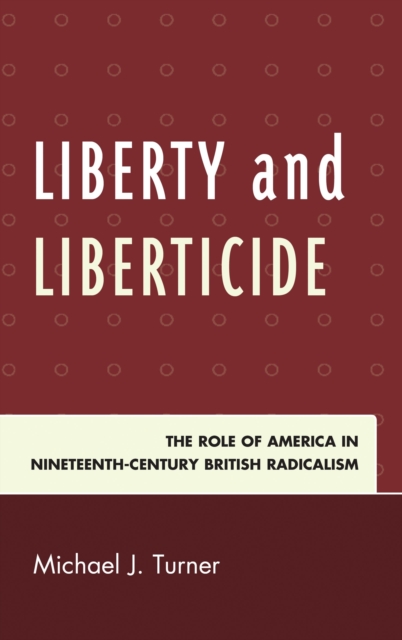
Liberty and liberticide
America was important to many British radicals. It was a model, an exemplar, a source of inspiration, and American events were believed to have a bearing on reform debates in Britain. Many scholars focus on the positive impressions of the United States that prominent British radicals entertained, developed, and propagated, but it is necessary also to explore the reasons why some radicals condemned rather than praised America, and to explain how America was conceptualized and used by them, and to what purpose. Liberty and Liberticide focuses on the influence America exerted over the ideas and activities of nineteenth-century British radicals. While some looked on America as the model of liberty, others associated it with the destruction of liberty. Turner shows how radicals’ views about the United States and the course of Anglo-American relations shaped their domestic reform agenda and their assumptions about British political values and Britain’s place in the world.
eBook


Britain and Ballistic Missile Defence, 1942-2002
Britain was the first country to come under sustained ballistic missile attack, during 1944-45. Defence against ballistic missiles has been a persistent, if highly variable, subject of political policy and technical investigation ever since. The British Second World War experience of trying to counter the V-2 attacks contained many elements of subsequent responses to ballistic missile threats. After the war, a reasonably accurate picture of Soviet missile capabilities was not achieved until the early 1960s, by which time the problem of early warning had largely been solved. From the mid-1960s on, British attention shifted away from the development of the country's own defences towards the wider consequences of US and Soviet deployments. After the end of the Cold War there was renewed interest in a limited active-defence capability against Third World missile threats. This well-researched book is primarily aimed at students of post-war British foreign and defence policies, but will also be of interest to informed general readers.
1. Introduction 2. The Wartime V-2 Experience 3. The Emerging Soviet Threat 4. Early Efforts at Active Defence 5. Ballistic Missile Early Warning 6. American ABM Deployment 7. Soviet ABM Deployment 8. Britain and the Strategic Defense Initiative 9. After the Cold War 10. Britain and US National Missile Defense 11. Conclusions and Prospects
Jeremy Stocker is Director of Studies at the Centre for Defence and International Security Studies (CDISS), a British independent defence think tank. He served in the Royal Navy for twenty years, specialising in air defense, before transferring to the Royal Naval Reserve in 1996. Dr. Stocker is the author of Britain and Ballistic Missile Defense 1942-2002 and is a regular contributor to academic and professional journals on both sides of the Atlantic.
eBook

In the Cause of Freedom
In this intellectual history, Minkah Makalani reveals how early-twentieth-century black radicals organized an international movement centered on ending racial oppression, colonialism, class exploitation, and global white supremacy. Focused primarily on two organizations, the Harlem-based African Blood Brotherhood, whose members became the first black Communists in the United States, and the International African Service Bureau, the major black anticolonial group in 1930s London,In the Cause of Freedomexamines the ideas, initiatives, and networks of interwar black radicals, as well as how they communicated across continents.Through a detailed analysis of black radical periodicals and extensive research in U.S., English, Dutch, and Soviet archives, Makalani explores how black radicals thought about race; understood the ties between African diasporic, Asian, and international workers' struggles; theorized the connections between colonialism and racial oppression; and confronted the limitations of international leftist organizations. Considering black radicals of Harlem and London together for the first time,In the Cause of Freedomreorients the story of blacks and Communism from questions of autonomy and the Kremlin's reach to show the emergence of radical black internationalism separate from, and independent of, the white Left.
eBook

Patterns of empire : the British and American empires, 1688 to the present
\"Patterns of empire comprehensively examines the two most powerful empires in modern history: the United States and Britain. Challenging the popular theory that the American empire is unique, Patterns of empire shows how the policies, practices, forms, and historical dynamics of the American empire repeat those of the British, leading up to the present climate of economic decline, treacherous intervention in the Middle East, and overextended imperial confidence. A critical exercise in revisionist history and comparative social science, this book also offers a challenging theory of empire that recognizes the agency of non-Western peoples, the impact of global fields, and the limits of power\"-- Provided by publisher.
Book

The Cold War in South Asia
The Cold War in South Asia provides the first comprehensive and transnational history of Anglo-American relations with South Asia during a seminal period in the history of the Indian Subcontinent, between independence in the late 1940s, and the height of the Cold War in the late 1960s. Drawing upon significant new evidence from British, American, Indian and Eastern bloc archives, the book re-examines how and why the Cold War in South Asia evolved in the way that it did, at a time when the national leaderships, geopolitical outlooks and regional aspirations of India, Pakistan and their superpower suitors were in a state of considerable flux. The book probes the factors which encouraged the governments of Britain and the United States to work so closely together in South Asia during the two decades after independence, and suggests what benefits, if any, Anglo-American intervention in South Asia's affairs delivered, and to whom.
eBook