
Catalogue Search | MBRL


Are you sure you want to remove the book from the shelf?

{{itemTitle}}
37
result(s) for
"United States Civilization European influences."
Sort by:

Before the Revolution : America's ancient pasts
Exploring a vast range of original stories, this book spans more than seven centuries and ranges across North America, Europe, and Africa. Richter recovers the lives of a stunning array of peoples as they struggled with one another and with their own people for control of land and resources.
Book
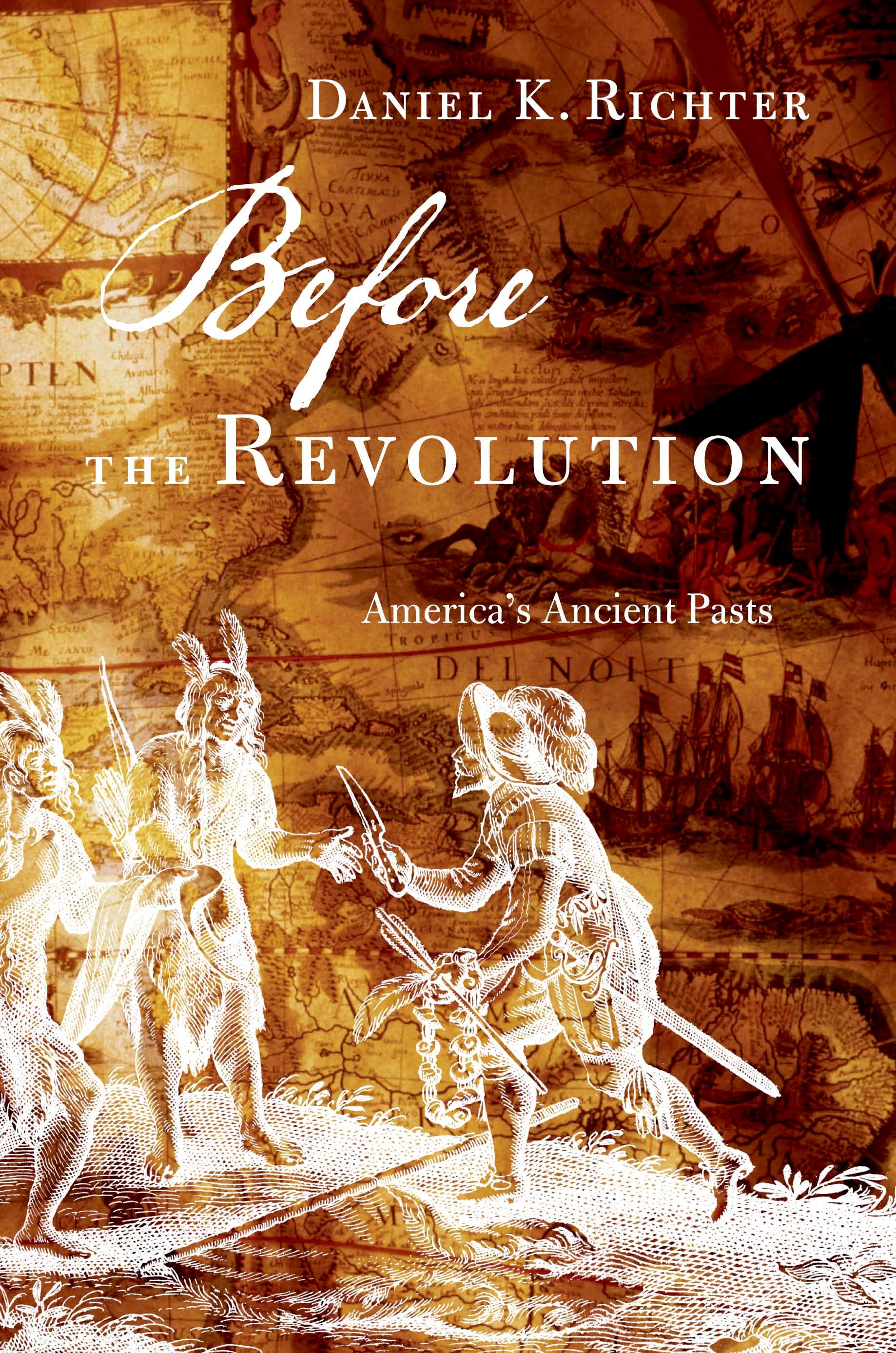
Before the Revolution : America's ancient pasts
America began, we are often told, with the Founding Fathers, the men who waged a revolution and created a unique place called the United States. We may acknowledge the early Jamestown and Puritan colonists and mourn the dispossession of Native Americans, but we rarely grapple with the complexity of the nation's pre-revolutionary past. In this pathbreaking revision, Daniel Richter shows that the United States has a much deeper history than is apparent—that far from beginning with a clean slate, it is a nation with multiple pasts that stretch back as far as the Middle Ages, pasts whose legacies continue to shape the present. Exploring a vast range of original sources, Before the Revolution spans more than seven centuries and ranges across North America, Europe, and Africa. Richter recovers the lives of a stunning array of peoples—Indians, Spaniards, French, Dutch, Africans, English—as they struggled with one another and with their own people for control of land and resources. Their struggles occurred in a global context and built upon the remains of what came before. Gradually and unpredictably, distinctive patterns of North American culture took shape on a continent where no one yet imagined there would be nations called the United States, Canada, or Mexico. By seeing these trajectories on their own dynamic terms, rather than merely as a prelude to independence, Richter's epic vision reveals the deepest origins of American history.
eBook

The transatlantic century : Europe and America, 1890-2010
\"This is a fascinating new overview of European-American relations during the long twentieth century. Ranging from economics, culture and consumption to war, politics and diplomacy, Mary Nolan charts the rise of American influence in Eastern and Western Europe, its mid-twentieth century triumph and its gradual erosion since the 1970s. She reconstructs the circuits of exchange along which ideas, commodities, economic models, cultural products and people moved across the Atlantic, capturing the differing versions of modernity that emerged on both sides of the Atlantic and examining how these alternately produced co-operation, conflict and ambivalence toward the other. Attributing the rise and demise of American influence in Europe not only to economics but equally to wars, the book locates the roots of many transatlantic disagreements in very different experiences and memories of war. This is an unprecedented account of the American Century in Europe that recovers its full richness and complexity\"-- Provided by publisher.
Book
The Transatlantic Century
This is a fascinating new overview of European-American relations during the long twentieth century. Ranging from economics, culture and consumption to war, politics and diplomacy, Mary Nolan charts the rise of American influence in Eastern and Western Europe, its mid-twentieth century triumph and its gradual erosion since the 1970s. She reconstructs the circuits of exchange along which ideas, commodities, economic models, cultural products and people moved across the Atlantic, capturing the differing versions of modernity that emerged on both sides of the Atlantic and examining how these alternately produced co-operation, conflict and ambivalence toward the other. Attributing the rise and demise of American influence in Europe not only to economics but equally to wars, the book locates the roots of many transatlantic disagreements in very different experiences and memories of war. This is an unprecedented account of the American Century in Europe that recovers its full richness and complexity.
eBook
Beyond chinoiserie : artistic exchange between China and the West during the late Qing dynasty (1796-1911)
\"The complex interweaving of different Western visions of China had a profound impact on artistic exchange between China and the West during the nineteenth century. Beyond Chinoiserie addresses the complexity of this exchange. While the playful Western \"vision of Cathay\" formed in the previous century continued to thrive, a more realistic vision of China was increasingly formed through travel accounts, paintings, watercolors, prints, book illustrations, and photographs. Simultaneoulsy, the new discipline of sinology led to a deepening of the understanding of Chinese cultural history. Leading and emerging scholars in the fields of art history, literary studies and material culture, have authored the ten essays in this book that deal with artistic relations between China and the West at a time when Western powers' attempts to extend a sphere of influence in China led to increasingly hostile political interactions\"-- Provided by publisher.
Book

Golden Cables of Sympathy
An intricate network of contacts developed among women in Europe and North America over the course of the nineteenth century. These women created virtual communities through communication, support, and a shared ideology. Forged across boundaries of nationality, language, ethnic origin, and even class, these connections laid the foundation for the 1888 International Council of Women and formed the beginnings of an international women's movement. This matrix extended throughout England and the Continent and included Scandinavia and Finland. In a remarkable display of investigative research, Margaret McFadden describes the burgeoning avenues of communication in the nineteenth century that led to an explosion in the number of international contacts among women. This network blossomed because of increased travel opportunities; advances in women's literacy and education; increased activity in the temperance, abolitionist, and peace reform movements; and the emergence of female evangelicals, political revolutionaries, and expatriates. Particular attention is paid to five women whose decades of work helped give birth to the women's movement by century's end. These \"\"mothers of the matrix\"\" include Lucretia Mott and Elizabeth Cady Stanton of the United States, Anna Doyle Wheeler of Ireland, Fredrika Bremer of Sweden, and Frances Power Cobbe of England. Despite their philosophic differences, these leaders recognized the value of friendship and advocacy among women and shared an affinity for bringing together people from different cultural settings. McFadden demonstrates without question that the traditions of transatlantic female communication are far older than most historians realize and that the women's movement was inherently international. No other scholar has painted so complete a picture of the golden cables that linked the women who saw the Atlantic and the borders within Europe as bridges rather than barriers to improving their status.
eBook


The Biocultural Consequences of Contact in Mexico
Examining the long-lasting effects of European
colonization on Mexican populations
The Biocultural Consequences of Contact in Mexico
explores how Mexican populations have been shaped both culturally
and biologically by the arrival of Spanish conquistadors and the
years following the defeat of the Aztec empire in 1521.
Contributors to this volume draw on a diverse set of methods from
archaeology, bioarchaeology, genetics, and history to examine the
response to European colonization, providing evidence for the
resilience of the Mexican people in the face of tumultuous
change.
Essays focus on Central Mexico, Yucatan, and Oaxaca, providing a
cross-regional perspective, and they highlight Mexican scholars'
work and viewpoints. They examine the effects of the
castas system-which the colonizers used to organize
society according to parentage and the social construction of
race-on individuals' and groups' access to power, social mobility,
health, and mate choice. Contributors illuminate the poorly
understood extent that this system-and the national identity of
mestizaje that replaced it-caused inequality and the
structural violence of stress and health disparities, as well as
genetic admixture.
Five hundred years after the Spanish first clashed with Aztec
forces and began to influence modern Mexico, this volume adds to
discussions of colonialism, the reconstruction of biosocial
relationships, and the work of decolonization. Students and
scholars in anthropology and history will gain insights into how
human populations transform and adapt in the wake of major
historical events that result in migration, demographic change, and
social upheaval.
Contributors: Josefina Bautista Martínez |
Alfredo Coppa | Andrea Cucina | Heather J. H. Edgar | Blanca Z.
González-Sobrino | María Teresa Jaén Esquivel | Haagen D. Klaus |
Michaela Lucci | Abigail Meza-Peñaloza | Emily Moes | Corey S.
Ragsdale | Katelyn M. Rusk | Robert C. Schwaller | Julie K. Wesp |
Cathy Willermet
A volume in the series Bioarchaeological Interpretations of the
Human Past: Local, Regional, and Global Perspectives, edited by
Clark Spencer Larsen
eBook

Anglicizing America
The thirteen mainland colonies of early America were arguably never more British than on the eve of their War of Independence from Britain. Though home to settlers of diverse national and cultural backgrounds, colonial America gradually became more like Britain in its political and judicial systems, material culture, economies, religious systems, and engagements with the empire. At the same time and by the same process, these politically distinct and geographically distant colonies forged a shared cultural identityone that would bind them together as a nation during the Revolution.
Anglicizing Americarevisits the theory of Anglicization, considering its application to the history of the Atlantic world, from Britain to the Caribbean to the western wildernesses, at key moments before, during, and after the American Revolution. Ten essays by senior historians trace the complex processes by which global forces, local economies, and individual motives interacted to reinforce a more centralized and unified social movement. They examine the ways English ideas about labor influenced plantation slavery, how Great Britain's imperial aspirations shaped American militarization, the influence of religious tolerance on political unity, and how Americans' relationship to Great Britain after the war impacted the early republic's naval and taxation policies. As a whole,Anglicizing Americaoffers a compelling framework for explaining the complex processes at work in the western hemisphere during the age of revolutions.
Contributors: Denver Brunsman, William Howard Carter, Ignacio Gallup-Diaz, Anthony M. Joseph, Simon P. Newman, Geoffrey Plank, Nancy L. Rhoden, Andrew Shankman, David J. Silverman, Jeremy A. Stern.
eBook

The Spanish Element in Our Nationality
“The Spanish Element in Our Nationality” delves beneath the traditional “English-only” narrative of U.S. history, using Spain’s participation in a series of international exhibitions to illuminate more fully the close and contested relationship between these two countries.
Written histories invariably record the Spanish financing of Columbus’s historic voyage of 1492, but few consider Spain’s continuing influence on the development of U.S. national identity. In this book, M. Elizabeth Boone investigates the reasons for this problematic memory gap by chronicling a series of Spanish displays at international fairs. Studying the exhibition of paintings, the construction of ephemeral architectural space, and other manifestations of visual culture, Boone examines how Spain sought to position itself as a contributor to U.S. national identity, and how the United States—in comparison to other nations in North and South America—subverted and ignored Spain’s messages, making it possible to marginalize and ultimately obscure Spain’s relevance to the history of the United States.
Bringing attention to the rich and understudied history of Spanish artistic production in the United States, “The Spanish Element in Our Nationality” recovers the “Spanishness” of U.S. national identity and explores the means by which Americans from Santiago to San Diego used exhibitions of Spanish art and history to mold their own modern self-image.
eBook