
Catalogue Search | MBRL


Are you sure you want to remove the book from the shelf?

{{itemTitle}}
3,631
result(s) for
"United States Civilization."
Sort by:

Al' America : travels through America's Arab and Islamic roots
Four out of ten Americans say they dislike Muslims, according to a Gallup poll. \"Muslims,\" a blogger wrote on www.freerepublic.com, \"don't belong in America.\" In a lively, funny, and revealing riposte to these sentiments, journalist Jonathan Curiel offers a tour through the little-known Islamic past, and present, of American culture. From highbrow to pop, from lighthearted to profound, this book reveals the Islamic and Arab influences before our eyes, under our noses, and ringing in our ears. Curiel demonstrates that many of America's most celebrated places retain vestiges of Arab and Islamic culture. Likewise, some of America's most recognizable music is indebted to Arab music. And some of America's leading historical figures, from Ralph Waldo Emerson to Elvis Presley, relied on Arab or Muslim culture for intellectual sustenance. Part travelogue, part cultural history, this book confirms a continuous pattern of give-and-take between America and the Arab-Muslim world.--From publisher description.
Book

This Violent Empire
This Violent Empiretraces the origins of American violence, racism, and paranoia to the founding moments of the new nation and the initial instability of Americans' national sense of self.Fusing cultural and political analyses to create a new form of political history, Carroll Smith-Rosenberg explores the ways the founding generation, lacking a common history, governmental infrastructures, and shared culture, solidified their national sense of self by imagining a series of \"Others\" (African Americans, Native Americans, women, the propertyless) whose differences from European American male founders overshadowed the differences that divided those founders. These \"Others,\" dangerous and polluting, had to be excluded from the European American body politic. Feared, but also desired, they refused to be marginalized, incurring increasingly enraged enactments of their political and social exclusion that shaped our long history of racism, xenophobia, and sexism. Close readings of political rhetoric during the Constitutional debates reveal the genesis of this long history.
eBook

America the Great and Its Self-Destruction
The accelerating self-destruction of the United States cannot be hidden when the loss of productivity, loss of faith in government, enflamed identity politics and social fragmentation are constant and are clearly documented. Here the author, a professor at , draws on a general theory on socioeconomic evolution by viewing it under an alternative ethical system (ancient Confucianism), with insights from chaos theory, to provide some insights into America's evolution. Any national assessment should be grounded in facts, and Prof. Zhang provides a plethora of economic data as a baseline for discussion. The figures and graphs reveal many sides of America that we may generally miss. In addition, Chinese and other Asians familiar with ancient Confucianism have their own sources of wisdom and commentary to guide them in assessing how they and their neighbors think and behave. Here, a Chinese academic familiar with both worlds shares his impressions and his conclusions. Prof. Zhang juxtaposes the political, economic and cultural behavior of America with sparkling quotes from Confucius, Mencius, Xun Zi, as well as Western classical thinkers from Plato to Quesnay and Weber. The book gives us a new perspective on our country - with insights as well from Chaos Theory. In this book we explore how the basic concepts of the yin-yang vision, and socioeconomic chaos theory, can help us understand American civilization, what it represents, and the natural cycles it is going through. Confucianism is more rationalist and sober, in the sense of the absence and the rejection of all non-utilitarian yardsticks, than any other ethical system, with the possible exception of J. Bentham's. The author presents data on American economic and social trends, and systematically compares the basic ideas of Confucius and Adam Smith. These are interwoven with hundreds of
pithy observations on America from a wide spectrum of commentators, from intellectual luminaries to Hollywood stars. The aim of studying the history of human societies, the author says, is to find the equations, i.e., mechanisms, of historical evolution; by stepping back to view events from different perspectives he seeks to present America as an organic whole, going beyond a partial, one-sided view of history - neither the patrician perspective nor that of the workers and the poor.
eBook


In Search of Brightest Africa
In the decades between the Berlin Conference that partitioned Africa and the opening of the African Hall at the American Museum of Natural History, Americans in several fields and from many backgrounds argued that Africa had something to teach them. Jeannette Eileen Jones traces the history of the idea of Africa with an eye to recovering the emergence of a belief in \"Brightest Africa\"-a tradition that runs through American cultural and intellectual history with equal force to its \"Dark Continent\" counterpart. Jones skillfully weaves disparate strands of turn-of-the-century society and culture to expose a vivid trend of cultural engagement that involved both critique and activism. Filmmakers spoke out against the depiction of \"savage\" Africa in the mass media while also initiating a countertradition of ethnographic documentaries. Early environmentalists celebrated Africa as a pristine continent while lamenting that its unsullied landscape was \"vanishing.\" New Negro political thinkers also wanted to \"save\" Africa but saw its fragility in terms of imperiled human promise. Jones illuminates both the optimism about Africa underlying these concerns and the racist and colonial interests these agents often nevertheless served. The book contributes to a growing literature on the ongoing role of global exchange in shaping the African American experience as well as debates about the cultural place of Africa in American thought.
eBook

Before the Revolution : America's ancient pasts
Exploring a vast range of original stories, this book spans more than seven centuries and ranges across North America, Europe, and Africa. Richter recovers the lives of a stunning array of peoples as they struggled with one another and with their own people for control of land and resources.
Book

Philosophy Americana
In this engaging book, Douglas Anderson begins with the assumption that philosophy—the Greek love of wisdom—is alive and well in American culture. At the same time, professional philosophy remains relatively invisible. Anderson traverses American life to find places in the wider culture where professional philosophy in the distinctively American tradition can strike up a conversation. How might American philosophers talk to us about our religious experience, or political engagement, or literature—or even, popular music? Anderson’s second aim is to find places where philosophy happens in nonprofessional guises—cultural places such as country music, rock’n roll, and Beat literature. He not only enlarges the tradition of American philosophers such as John Dewey and William James by examining lesser-known figures such as Henry Bugbee and Thomas Davidson, but finds the theme and ideas of American philosophy in some unexpected places, such as the music of Hank Williams, Tammy Wynette, and Bruce Springsteen, and the writings of Jack Kerouac. The idea of “philosophy Americana\" trades on the emergent genre of “music Americana,\" rooted in traditional themes and styles yet engaging our present experiences. The music is “popular\" but not thoroughly driven by economic considerations, and Anderson seeks out an analogous role for philosophical practice, where philosophy and popular culture are co-adventurers in the life of ideas. Philosophy Americana takes seriously Emerson’s quest for the extraordinary in the ordinary and James’s belief that popular philosophy can still be philosophy.
eBook

The transatlantic century : Europe and America, 1890-2010
\"This is a fascinating new overview of European-American relations during the long twentieth century. Ranging from economics, culture and consumption to war, politics and diplomacy, Mary Nolan charts the rise of American influence in Eastern and Western Europe, its mid-twentieth century triumph and its gradual erosion since the 1970s. She reconstructs the circuits of exchange along which ideas, commodities, economic models, cultural products and people moved across the Atlantic, capturing the differing versions of modernity that emerged on both sides of the Atlantic and examining how these alternately produced co-operation, conflict and ambivalence toward the other. Attributing the rise and demise of American influence in Europe not only to economics but equally to wars, the book locates the roots of many transatlantic disagreements in very different experiences and memories of war. This is an unprecedented account of the American Century in Europe that recovers its full richness and complexity\"-- Provided by publisher.
Book
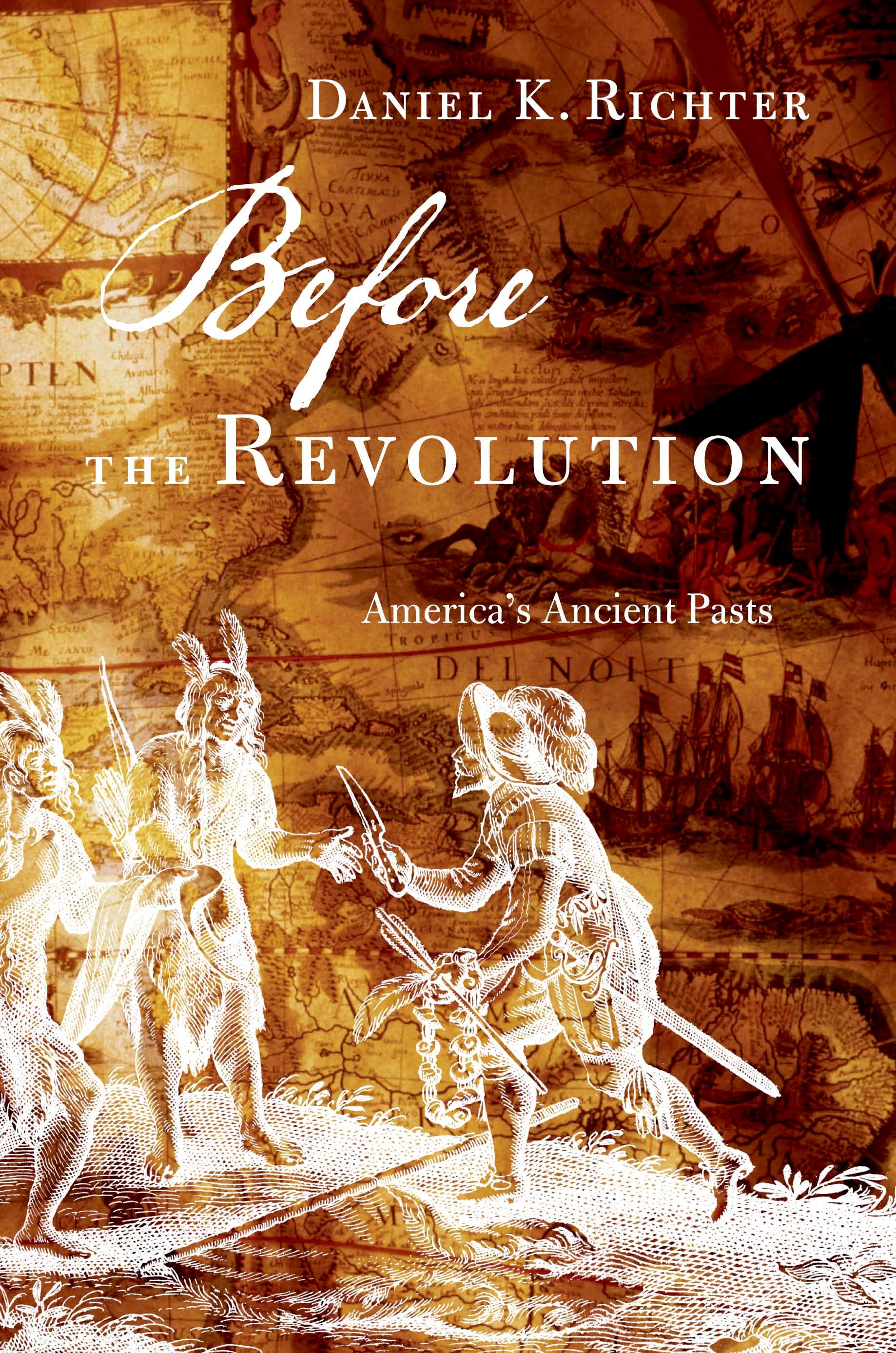
Before the Revolution : America's ancient pasts
America began, we are often told, with the Founding Fathers, the men who waged a revolution and created a unique place called the United States. We may acknowledge the early Jamestown and Puritan colonists and mourn the dispossession of Native Americans, but we rarely grapple with the complexity of the nation's pre-revolutionary past. In this pathbreaking revision, Daniel Richter shows that the United States has a much deeper history than is apparent—that far from beginning with a clean slate, it is a nation with multiple pasts that stretch back as far as the Middle Ages, pasts whose legacies continue to shape the present. Exploring a vast range of original sources, Before the Revolution spans more than seven centuries and ranges across North America, Europe, and Africa. Richter recovers the lives of a stunning array of peoples—Indians, Spaniards, French, Dutch, Africans, English—as they struggled with one another and with their own people for control of land and resources. Their struggles occurred in a global context and built upon the remains of what came before. Gradually and unpredictably, distinctive patterns of North American culture took shape on a continent where no one yet imagined there would be nations called the United States, Canada, or Mexico. By seeing these trajectories on their own dynamic terms, rather than merely as a prelude to independence, Richter's epic vision reveals the deepest origins of American history.
eBook