
Catalogue Search | MBRL


Are you sure you want to remove the book from the shelf?

{{itemTitle}}
99,987
result(s) for
"United States Economic conditions."
Sort by:

The servant economy : where America's elite is sending the middle class
\"Renowned economist Jeff Faux explains why neither party's leaders have a plan to remedy America's unemployment, inequality, or long economic slide. America's political and economic elite spent so long making such terrible decisions that they caused the collapse of 2008. So how can they continue down the same road? The simple answer, that no one in charge wants to publicly acknowledge: because things are still pretty great for the people who run America. It was an accident of history, Jeff Faux explains, that after World War II the U.S. could afford a prosperous middle class, a dominant military, and a booming economic elite at the same time. For the past three decades, all three have been competing, with the middle class always losing. Soon the military will decline as well. The most plausible projections Faux explores foresee a future economy nearly devoid of production and exports, with the most profitable industries existing to solely to serve the wealthiest 1%. The author's last book, The Global Class War, sold over 20,000 copies by correctly predicting the permanent decline of our debt-burdened middle class at the hands of our off-shoring executives, out of control financiers, and their friends in Washington Since his last book, Faux is repeatedly asked what either party will do to face these mounting crises. After looking over actual policies, proposed plans, non-partisan reports, and think tank papers, his astonishing conclusion: more of the same\"-- Provided by publisher.
Book

The Vanishing Middle Class
The United States is becoming a nation of rich and poor, with few families in the middle. In this book, MIT economist Peter Temin offers an illuminating way to look at the vanishing middle class. Temin argues that American history and politics, particularly slavery and its aftermath, play an important part in the widening gap between rich and poor. Temin employs a well-known, simple model of a dual economy to examine the dynamics of the rich/poor divide in America, and outlines ways to work toward greater equality so that America will no longer have one economy for the rich and one for the poor.Many poorer Americans live in conditions resembling those of a developing country -- substandard education, dilapidated housing, and few stable employment opportunities. And although almost half of black Americans are poor, most poor people are not black. Conservative white politicians still appeal to the racism of poor white voters to get support for policies that harm low-income people as a whole, casting recipients of social programs as the Other -- black, Latino, not like \"us.\" Politicians also use mass incarceration as a tool to keep black and Latino Americans from participating fully in society. Money goes to a vast entrenched prison system rather than to education. In the dual justice system, the rich pay fines and the poor go to jail.
eBook


Seeking equality : the political economy of the common good in the United States and Canada
\"Seeking Equality compares economic inequality in the United States and Canada, North American neighbors with much in common--socially, politically, and economically--yet whose contemporary populations are marked by significant differences of material well-being. This book surveys the data and explores the policy decisions that have influenced discrete economic outcomes. It also discusses why a yawning gap between the very rich and the rest should be a cause for civic anxiety ... and what can be done about it. Income inequality has increased in almost all advanced industrial economies over the past thirty-five years. Canada and the United States have been at the forefront of this trend, though the gap between the haves and the have-nots is substantially greater in the US. In addition, rates of social mobility are much lower in the United States, making it harder for Americans than Canadians to move up the ladder of economic success independent of who their parents happen to be. In Seeking Equality, John Harles considers the factors accounting for these cross-border differences. He surveys in considerable detail what is known about economic inequality in Canada and the United States and compares the respective political values that both shape and are shaped by ameliorative public policies. Whereas the claims of equality are persuasive in both countries, the US has further to go in achieving a society in which an accident of birth is not the main determinant of an individual's economic well-being. Given that Canada has done a better job of producing a greater equality in economic outcomes for its citizens, Americans can learn from the Canadian experience.\"-- Provided by publisher.
Book

Immigration and the Remaking of Black America
Over the last four decades, immigration from the Caribbean and sub-Saharan Africa to the U. S. has increased rapidly. In several states, African immigrants are now major drivers of growth in the black population. While social scientists and commentators have noted that these black immigrants' social and economic outcomes often differ from those of their native-born counterparts, few studies have carefully analyzed the mechanisms that produce these disparities. InImmigration and the Remaking of Black America,sociologist and demographer Tod Hamilton shows how immigration is reshaping black America. He weaves together interdisciplinary scholarship with new data to enhance our understanding of the causes of socioeconomic stratification among both the native-born and newcomers. Hamilton demonstrates that immigration from the Caribbean and sub-Saharan Africa is driven by selective migration, meaning that newcomers from these countries tend to have higher educational attainment than those who stay behind. As a result, they arrive in the U.S. with some advantages over native-born blacks, and, in some cases, over whites. He also shows the importance of historical context: prior to the Civil Rights Movement, black immigrants' socioeconomic outcomes resembled native-born blacks' much more closely, regardless of their educational attainment in their country of origin. Today, however, certain groups of black immigrants have better outcomes than native-born black Americans-such as lower unemployment rates and higher rates of homeownership-in part because they immigrated at a time of expanding opportunities for minorities and women in general. Hamilton further finds that rates of marriage and labor force participation among native-born blacks that move away from their birth states resemble those of many black immigrants, suggesting that some disparities within the black population stem from processes associated with migration, rather than from nativity alone. Hamilton argues that failing to account for this diversity among the black population can lead to incorrect estimates of the social progress made by black Americans and the persistence of racism and discrimination. He calls for future research on racial inequality to disaggregate different black populations. By richly detailing the changing nature of black America,Immigration and the Remaking of Black Americahelps scholars and policymakers to better understand the complexity of racial disparities in the twenty-first century.
eBook
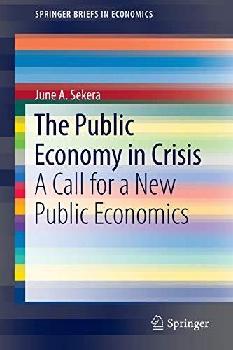
The public economy in crisis : a call for a new public economics
This Brief proposes a new theory of public economics which deemphasizes reliance on the free market and affirms the importance of public goods and services within the context of the democratic process and constitutional governance. Public non-market production makes up from a quarter to more than half of all economic activity in advanced democratic nation-states. Yet by imposing market precepts on the public domain, as mainstream economics, political science, and public administration do, public governing capacity is weakened and the democratic system suffers. Agencies originally created to meet public needs are being warped into entities whose purpose is to generate revenue and, in some cases, deliver private profits at public expense. Drawing on classic public finance literature, this book illustrates the differences between public economy and the market model and why those differences matter. Building on this, the Brief sketches the elements of a new theory of the public non-market and illuminates its connections to the delegation of power and collective provision of resources from the polity. This book will be useful to scholars of public economics, political science, and public administration as well as policy makers and those working in the public sector.
Book
Debtor nation
Before the twentieth century, personal debt resided on the fringes of the American economy, the province of small-time criminals and struggling merchants. By the end of the century, however, the most profitable corporations and banks in the country lent money to millions of American debtors. How did this happen? The first book to follow the history of personal debt in modern America,Debtor Nationtraces the evolution of debt over the course of the twentieth century, following its transformation from fringe to mainstream--thanks to federal policy, financial innovation, and retail competition.
How did banks begin making personal loans to consumers during the Great Depression? Why did the government invent mortgage-backed securities? Why was all consumer credit, not just mortgages, tax deductible until 1986? Who invented the credit card? Examining the intersection of government and business in everyday life, Louis Hyman takes the reader behind the scenes of the institutions that made modern lending possible: the halls of Congress, the boardrooms of multinationals, and the back rooms of loan sharks. America's newfound indebtedness resulted not from a culture in decline, but from changes in the larger structure of American capitalism that were created, in part, by the choices of the powerful--choices that made lending money to facilitate consumption more profitable than lending to invest in expanded production.
From the origins of car financing to the creation of subprime lending,Debtor Nationpresents a nuanced history of consumer credit practices in the United States and shows how little loans became big business.
eBook


Falling behind
With a timely new foreword by Robert Frank, this groundbreaking book explores the very meaning of happiness and prosperity in America today. Although middle-income families don't earn much more than they did several decades ago, they are buying bigger cars, houses, and appliances. To pay for them, they spend more than they earn and carry record levels of debt. Robert Frank explains how increased concentrations of income and wealth at the top of the economic pyramid have set off \"expenditure cascades\" that raise the cost of achieving many basic goals for the middle class. Writing in lively prose for a general audience, Frank employs up-to-date economic data and examples drawn from everyday life to shed light on reigning models of consumer behavior. He also suggests reforms that could mitigate the costs of inequality. Falling Behind compels us to rethink how and why we live our economic lives the way we do.
eBook