
Catalogue Search | MBRL


Are you sure you want to remove the book from the shelf?

{{itemTitle}}
179
result(s) for
"United States Economic policy 2009-"
Sort by:


The Federal Reserve and the financial crisis
In 2012, Ben Bernanke, chairman of the U.S. Federal Reserve, gave a series of lectures about the Federal Reserve and the 2008 financial crisis, as part of a course at George Washington University on the role of the Federal Reserve in the economy. In this unusual event, Bernanke revealed important background and insights into the central bank's crucial actions during the worst financial crisis since the Great Depression. Taken directly from these historic talks,The Federal Reserve and the Financial Crisisoffers insight into the guiding principles behind the Fed's activities and the lessons to be learned from its handling of recent economic challenges.
Bernanke traces the origins of the Federal Reserve, from its inception in 1914 through the Second World War, and he looks at the Fed post-1945, when it began operating independently from other governmental departments such as the Treasury. During this time the Fed grappled with episodes of high inflation, finally tamed by then-chairman Paul Volcker. Bernanke also explores the period under his predecessor, Alan Greenspan, known as the Great Moderation. Bernanke then delves into the Fed's reaction to the recent financial crisis, focusing on the central bank's role as the lender of last resort and discussing efforts that injected liquidity into the banking system. Bernanke points out that monetary policies alone cannot revive the economy, and he describes ongoing structural and regulatory problems that need to be addressed.
Providing first-hand knowledge of how problems in the financial system were handled,The Federal Reserve and the Financial Crisiswill long be studied by those interested in this critical moment in history.
eBook


Great Recession, The
Officially over in 2009, the Great Recession is now generally acknowledged to be the most devastating global economic crisis since the Great Depression. As a result of the crisis, the United States lost more than 7.5 million jobs, and the unemployment rate doubled—peaking at more than 10 percent. The collapse of the housing market and subsequent equity market fluctuations delivered a one-two punch that destroyed trillions of dollars in personal wealth and made many Americans far less financially secure. Still reeling from these early shocks, the U.S. economy will undoubtedly take years to recover. Less clear, however, are the social effects of such economic hardship on a U.S. population accustomed to long periods of prosperity. How are Americans responding to these hard times? The Great Recession is the first authoritative assessment of how the aftershocks of the recession are affecting individuals and families, jobs, earnings and poverty, political and social attitudes, lifestyle and consumption practices, and charitable giving. Focused on individual-level effects rather than institutional causes, The Great Recession turns to leading experts to examine whether the economic aftermath caused by the recession is transforming how Americans live their lives, what they believe in, and the institutions they rely on. Contributors Michael Hout, Asaf Levanon, and Erin Cumberworth show how job loss during the recession—the worst since the 1980s—hit less-educated workers, men, immigrants, and factory and construction workers the hardest. Millions of lost industrial jobs are likely never to be recovered and where new jobs are appearing, they tend to be either high-skill positions or low-wage employment—offering few opportunities for the middle-class. Edward Wolff, Lindsay Owens, and Esra Burak examine the effects of the recession on housing and wealth for the very poor and the very rich. They find that while the richest Americans experienced the greatest absolute wealth loss, their resources enabled them to weather the crisis better than the young families, African Americans, and the middle class, who experienced the most disproportionate loss—including mortgage delinquencies, home foreclosures, and personal bankruptcies. Lane Kenworthy and Lindsay Owens ask whether this recession is producing enduring shifts in public opinion akin to those that followed the Great Depression. Surprisingly, they find no evidence of recession-induced attitude changes toward corporations, the government, perceptions of social justice, or policies aimed at aiding the poor. Similarly, Philip Morgan, Erin Cumberworth, and Christopher Wimer find no major recession effects on marriage, divorce, or cohabitation rates. They do find a decline in fertility rates, as well as increasing numbers of adult children returning home to the family nest—evidence that suggests deep pessimism about recovery. This protracted slump—marked by steep unemployment, profound destruction of wealth, and sluggish consumer activity—will likely continue for years to come, and more pronounced effects may surface down the road. The contributors note that, to date, this crisis has not yet generated broad shifts in lifestyle and attitudes. But by clarifying how the recession’s early impacts have—and have not—influenced our current economic and social landscape, The Great Recession establishes an important benchmark against which to measure future change.
eBook

The servant economy : where America's elite is sending the middle class
\"Renowned economist Jeff Faux explains why neither party's leaders have a plan to remedy America's unemployment, inequality, or long economic slide. America's political and economic elite spent so long making such terrible decisions that they caused the collapse of 2008. So how can they continue down the same road? The simple answer, that no one in charge wants to publicly acknowledge: because things are still pretty great for the people who run America. It was an accident of history, Jeff Faux explains, that after World War II the U.S. could afford a prosperous middle class, a dominant military, and a booming economic elite at the same time. For the past three decades, all three have been competing, with the middle class always losing. Soon the military will decline as well. The most plausible projections Faux explores foresee a future economy nearly devoid of production and exports, with the most profitable industries existing to solely to serve the wealthiest 1%. The author's last book, The Global Class War, sold over 20,000 copies by correctly predicting the permanent decline of our debt-burdened middle class at the hands of our off-shoring executives, out of control financiers, and their friends in Washington Since his last book, Faux is repeatedly asked what either party will do to face these mounting crises. After looking over actual policies, proposed plans, non-partisan reports, and think tank papers, his astonishing conclusion: more of the same\"-- Provided by publisher.
Book
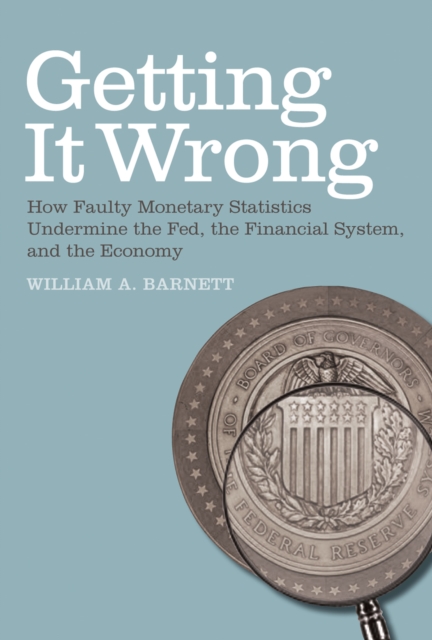
Getting it Wrong
Blame for the recent financial crisis and subsequent recession has commonly been assigned to everyone from Wall Street firms to individual homeowners. It has been widely argued that the crisis and recession were caused by \"greed\" and the failure of mainstream economics. In Getting It Wrong, leading economist William Barnett argues instead that there was too little use of the relevant economics, especially from the literature on economic measurement. Barnett contends that as financial instruments became more complex, the simple-sum monetary aggregation formulas used by central banks, including the U.S. Federal Reserve, became obsolete. Instead, a major increase in public availability of best-practice data was needed. Households, firms, and governments, lacking the requisite information, incorrectly assessed systemic risk and significantly increased their leverage and risk-taking activities. Better financial data, Barnett argues, could have signaled the misperceptions and prevented the erroneous systemic-risk assessments. When extensive, best-practice information is not available from the central bank, increased regulation can constrain the adverse consequences of ill-informed decisions. Instead, there was deregulation. The result, Barnett argues, was a worst-case toxic mix: increasing complexity of financial instruments, inadequate and poor-quality data, and declining regulation. Following his accessible narrative of the deep causes of the crisis and the long history of private and public errors, Barnett provides technical appendixes, containing the mathematical analysis supporting his arguments.
eBook


The US Economy and Neoliberalism
In recent times, policy makers, scientists, academics and commentators have become increasingly nervous about the US economic downturn. Discussions have centred around the range and magnitude of the country's socio-economic problems, its vexing production decline and its unsatisfactory macroeconomic performance, which give rise to the following questions: what are the sources of this recent downfall? And can this situation be reversed by pursuing the same orthodox and neoliberal policies?
This new edited volume, from a top international set of contributors, seeks to answer these questions and to offer alternative, realistic and feasible strategies and policy recommendations towards reversing this situation.
In particular, the volume seeks to challenge US neoliberalism on theoretical and political grounds, and to offer alternative strategies and policies towards addressing the country's recent challenges and multi-dimensional problems. The volume is structured around three main themes:
The return of government: Philosophical issues and ethics
Economic policies for sustainable growth and prosperity
Financial fragility and alternative monetary policy proposals
This unique and highly topical, multidisciplinary volume, will be of great interest to students and researchers in the areas of economics, political economy and contemporary US politics.
eBook


The Vanishing Middle Class
The United States is becoming a nation of rich and poor, with few families in the middle. In this book, MIT economist Peter Temin offers an illuminating way to look at the vanishing middle class. Temin argues that American history and politics, particularly slavery and its aftermath, play an important part in the widening gap between rich and poor. Temin employs a well-known, simple model of a dual economy to examine the dynamics of the rich/poor divide in America, and outlines ways to work toward greater equality so that America will no longer have one economy for the rich and one for the poor.Many poorer Americans live in conditions resembling those of a developing country -- substandard education, dilapidated housing, and few stable employment opportunities. And although almost half of black Americans are poor, most poor people are not black. Conservative white politicians still appeal to the racism of poor white voters to get support for policies that harm low-income people as a whole, casting recipients of social programs as the Other -- black, Latino, not like \"us.\" Politicians also use mass incarceration as a tool to keep black and Latino Americans from participating fully in society. Money goes to a vast entrenched prison system rather than to education. In the dual justice system, the rich pay fines and the poor go to jail.
eBook