
Catalogue Search | MBRL


Are you sure you want to remove the book from the shelf?

{{itemTitle}}
182
result(s) for
"United States Emigration and immigration History 19th century."
Sort by:


Authors of Their Lives
2008 United States Postal System's Rita Lloyd Moroney Award
In the era before airplanes and e-mail, how did immigrants keep in touch with loved ones in their homelands, as well as preserve links with pasts that were rooted in places from which they voluntarily left? Regardless of literacy level, they wrote letters, explains David A. Gerber in this path-breaking study of British immigrants to the U.S. and Canada who wrote and received letters during the nineteenth century.
Scholars have long used immigrant letters as a lens to examine the experiences of immigrant groups and the communities they build in their new homelands. Yet immigrants as individual letter writers have not received significant attention; rather, their letters are often used to add color to narratives informed by other types of sources.
Authors of Their Lives analyzes the cycle of correspondence between immigrants and their homelands, paying particular attention to the role played by letters in reformulating relationships made vulnerable by separation. Letters provided sources of continuity in lives disrupted by movement across vast spaces that disrupted personal identities, which depend on continuity between past and present. Gerber reveals how ordinary artisans, farmers, factory workers, and housewives engaged in correspondence that lasted for years and addressed subjects of the most profound emotional and practical significance.
eBook


Lincoln and the Immigrant
Between 1840 and 1860, as Abraham Lincoln pursued his law career, more than four and a half million citizens of other countries became residents of the United States. The annexation of Texas and the outcome of the Mexican War meant that hundreds of thousands of Mexicans had become Americans, and a huge influx of newcomers arrived from northern and western Europe, while a smaller number came from China. Although some Americans sought to make immigration more difficult and to curtail the rights afforded to immigrants, Lincoln advocated for full protection of the rights of all legal residents. In this succinct study, Jason H. Silverman investigates Lincoln’s evolving personal, professional, and political relationships with the wide variety of immigrant groups he encountered throughout his life, revealing the ways in which Lincoln differed from his contemporaries in his acceptance and interaction with these newcomers.
From an early age, Silverman shows, Lincoln developed an awareness of and a tolerance for different peoples and their cultures. While no doubt a man of his time, Lincoln nevertheless refused to let his environment blind him to the strengths of diversity. His travels at a young age to the port of New Orleans exposed Lincoln to the sights, sounds, and tastes of a world unlike any he had ever seen and established in him a lifelong empathy for the foreign-born. Throughout his legal and political career, he displayed an affinity for immigrants, especially those of German, Irish, Jewish, and Scandinavian descent. Recognizing the need for immigrant labor, Lincoln saw that America could be a land of opportunity for newcomers. Consequently, he opposed the Know Nothing Party and the antiforeign attitudes of those in his own Republican Party. Revealing how immigrants affected Lincoln’s presidential policies, Silverman details the importance of German support to Lincoln’s 1860 presidential victory, his appointment of political generals of varying ethnicities, his reliance on an immigrant for the literal rules of war, and the issues that these and other dealings created for him.
The first book to examine Lincoln and the place of the immigrant in America’s society and economy, Silverman’s pioneering work offers a rare new perspective on the renowned sixteenth president.
eBook

Life in America : comparing immigrant experiences
\"Immigrant groups were not treated equally when they arrived in America... Compare and contrast immigrant experiences and how those experiences changed the United States.
Book

Fleeing the Famine
The Irish Potato Famine caused the migration of more than two million individuals who sought refuge in the United States and Canada. In contrast to previous studies, which have tended to focus on only one destination, this collection allows readers to evaluate the experience of transatlantic Famine refugees in a comparative context. Featuring new and innovative scholarship by both established and emerging scholars of Irish America and Irish Canada, it carefully dissects the connection that arose between Ireland and North America during the famine years (1845-1851). In the more than 150 years since the onset of Ireland's Great Famine, historians have intensely scrutinized the causes, the year-by-year events, and the consequences of his human catastrophe. Who was to blame? Were the hunger and misery inevitable? Did the famine have revolutionary effects on the Irish economy? How did it change the nature of Irish religion? This new study complements the wealth of existing literature on the social, cultural, and political aspects of the Famine and invites the reader to consider the fate of the Irish refugees in their new home lands.
eBook

Expelling the poor : Atlantic Seaboard states and the nineteenth-century origins of American immigration policy
\"Expelling the Poor examines the origins of immigration restriction in the United States, especially deportation policy. Based on an analysis of immigration policies in major American coastal states, including New York, Massachusetts, Pennsylvania, Maryland, Louisiana, and California, it provides the first sustained study of immigration control conducted by states prior to the introduction of federal immigration law in the late nineteenth century. The influx of impoverished Irish immigrants over the first half of the nineteenth century led nativists in New York and Massachusetts to develop policies for prohibiting the landing of destitute foreigners and deporting those already resident in the states to Europe, Canada, or other American states. No other coastal state engaged in immigration regulation with the same level of legislative effort and success as the two states. By locating the roots of American immigration control in cultural prejudice against the Irish and, more essentially, economic concerns about their poverty in nineteenth-century New York and Massachusetts, this book fundamentally revises the history of American immigration policy, which has largely focused on anti-Asian racism on the West Coast. By investigating state officials' practices of illegal removal, such as the overseas deportation of those who held American citizenship, this book reveals how the state-level treatment of destitute immigrants set precedents for the assertion by American officers of unrestricted power against undesirable aliens, which characterized later federal control, and demonstrates how American deportation policy operated as part of a broader legal culture of excluding non-producing members from societies in the north Atlantic world\"-- Provided by publisher.
Book


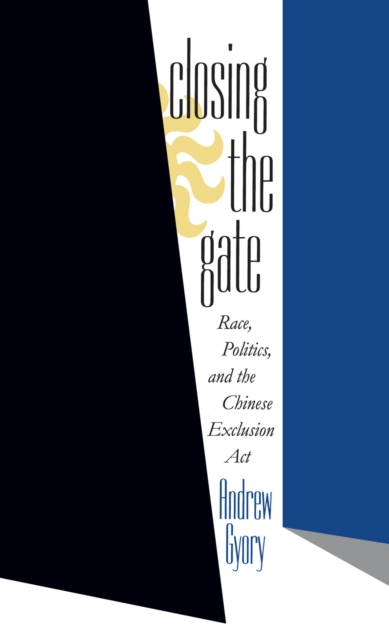
Closing the gate : race, politics, and the Chinese Exclusion Act
The Chinese Exclusion Act of 1882, which barred practically all Chinese from American shores for ten years, was the first federal law that banned a group of immigrants solely on the basis of race or nationality. By changing America's traditional policy of open immigration, this landmark legislation set a precedent for future restrictions against Asian immigrants in the early 1900s and against Europeans in the 1920s. Tracing the origins of the Chinese Exclusion Act, Andrew Gyory presents a bold new interpretation of American politics during Reconstruction and the Gilded Age. Rather than directly confront such divisive problems as class conflict, economic depression, and rising unemployment, he contends, politicians sought a safe, nonideological solution to the nation's industrial crisis--and latched onto Chinese exclusion. Ignoring workers' demands for an end simply to imported contract labor, they claimed instead that working people would be better off if there were no Chinese immigrants. By playing the race card, Gyory argues, national politicians--not California, not organized labor, and not a general racist atmosphere--provided the motive force behind the era's most racist legislation. |Analyzes the Chinese Exclusion Act of 1882 from a national perspective. By playing the race card, national politicians--not California, not organized labor, and not a general racist atmosphere--were responsible for this law.
eBook