
Catalogue Search | MBRL


Are you sure you want to remove the book from the shelf?

{{itemTitle}}
176
result(s) for
"United States Ethnic relations 21st century."
Sort by:

Can \the whole world\ be wrong? : lethal journalism, antisemitism, and global jihad
\"Drawing on the dynamics of apocalyptic movements (outrageous energizing hopes, aggressive denial when disappointed), Landes looks at the turn of the millennium (2000) in terms of a radical mismatch between two millennial styles, an Islamist pre-modern (Caliphators) and a Western post-modern (Woke). Due to a striking cognitive failure, Westerners could neither see nor discuss the foe they faced, and repeatedly, convinced they were bending the arc of history towards justice, took sharp wrong turns. We continue to do so\"-- Provided by publisher.
Book

Latinx : the new force in American politics and culture
\"The Latinx revolution in US culture, society, and politics \"Latinx\" (pronounced \"La-teen-ex\") is the gender-neutral term that covers the largest racial minority in the United States, 17 percent of the country. This is the fastest-growing sector of American society, containing the most immigrants. It is the poorest ethnic group in the country, whose political empowerment is altering the balance of forces in a growing number of states. And yet, Latins barely figure in America's racial conversation--the US census does not even have a category for \"Latino.\" In this groundbreaking discussion, Ed Morales explains how Latin political identities are tied to a long Latin American history of mestizaje, translatable as \"mixedness\" or \"hybridity\", and that this border thinking is both a key to understanding bilingual, bicultural Latin cultures and politics and a challenge to America's infamously black/white racial regime. This searching and long-overdue exploration of a crucial development in American life updates Cornel West's bestselling Race Matters with a Latin inflection\"-- Provided by publisher.
Book
Saying No to Hate
Saying No to Hate grounds readers contextually in the
history of antisemitism in America by emphasizing the legal,
political, educational, communal, and other strategies American
Jews have used through the centuries to address high-profile
threats. Norman H. Finkelstein shows how antisemitism has long
functioned in America in systemic, structural, and interpersonal
ways, from missionaries, the KKK, and American Nazis to employment
discrimination, social media attacks, and QAnon. He explains how
historic antisemitic events such as General Ulysses S. Grant's
General Order No. 11 (1862); the Massena, New York blood libel
(1928); and the mass shooting at the Tree of Life synagogue (2018)
galvanized the Jewish community. Finkelstein shines light on Jews
such as Louis Brandeis and Admiral Hyman Rickover who succeeded
despite discrimination and on individuals and organizations that
have tackled legal and security affairs, from the passage of
Maryland's Jew Bill (1826) to groups helping Jewish institutions
better protect themselves from active shooter threats. Far from a
victim narrative, Saying No to Hate is as much about
Jewish resilience and ingenuity as it is about hatred. Engaging
high school students and adults with personal narratives, it
prepares each of us to recognize, understand, and confront
injustice and hatred today, in the Jewish community and beyond.
eBook


Can ''The Whole World'' Be Wrong?
Landes, a medievalist and historian of apocalyptic movements,
takes us through the first years of the third millennium
(2000-2003), documenting how a radical inability of Westerners to
understand the medieval mentality that drove Global Jihad prompted
a series of disastrous misinterpretations and misguided reactions
that have shaped our so-far unhappy century. These
misinterpretations in 2000, 2001, 2002, and 2005, contributed
fundamentally to the ever-worsening moral and empirical
disorientations of our information elites (journalists, academics,
pundits). So while journalists reported Palestinian war propaganda
as news (lethal journalism), they were also reporting Jihadi war
propaganda as news (own-goal war journalism). These radical
disorientations have created our current dilemma of pervasive
information distrust, deep splits within the voting public in most
democracies, the politicization of science, and the inability of
Western elites to defend their civilization, and instead, to stand
down before an invasion.
eBook

Stranger : the challenge of a Latino immigrant in the Trump era
Jorge Ramos, an Emmy award-winning journalist, Univision's longtime anchorman and widely considered the \"voice of the voiceless\" within the Latino community, was forcefully removed from an Iowa press conference in 2015 by then-candidate Donald Trump after trying to ask about his plans on immigration. In this personal manifesto, Ramos sets out to examine what it means to be a Latino immigrant, or just an immigrant, in present-day America. Using current research and statistics, with a journalist's nose for a story, and interweaving his own personal experience, Ramos shows us the changing face of America while also trying to find an explanation for why he, and millions of others, still feel like strangers in this country.
Book
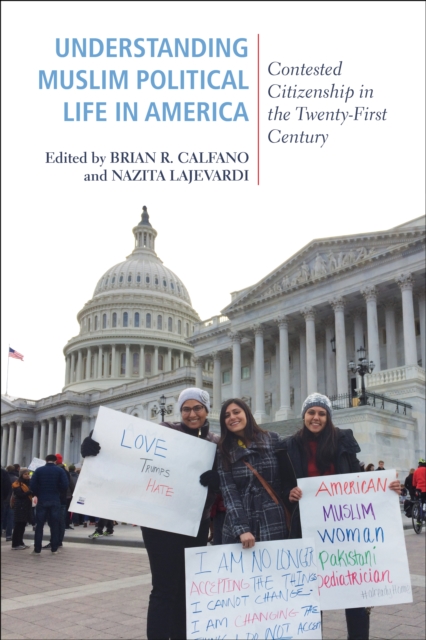
Understanding Muslim Political Life in America
\"Muslim Americans are at a political crossroads,\" write editors Brian Calfano and Nazita Lajevardi. Whereas Muslims are now widely incorporated in American public life, there are increasing social and political pressures that disenfranchise them or prevent them from realizing the American Dream. Understanding Muslim Political Life in America brings clarity to the social, religious, and political dynamics that this diverse religious community faces. In this timely volume, leading scholars cover a variety of topics assessing the Muslim American experience in the post-9/11 and pre-Trump era, including law enforcement; identity labels used in Muslim surveys; the role of gender relations; recognition; and how discrimination, tolerance, and politics impact American Muslims. Understanding Muslim Political Life in America offers an update and reappraisal of what we know about Muslims in American political life. The editors and contributors also consider future directions and important methodological questions for research in Muslim American scholarship. Contributors include Matt A. Barreto, Alejandro Beutel, Tony Carey, Youssef Chouhoud, Karam Dana, Oz Dincer, Rachel Gillum, Kerem Ozan Kalkan, Anwar Manje, Valerie Martinez-Ebers, Dani McLaughlan, Melissa R. Michelson, Yusuf Sarfati, Ahmet Tekelioglu, Marianne Marar Yacobian, and the editors.
eBook

Integration nation : immigrants, refugees, and America at its best
\"Takes readers on a ... cross-country journey, introducing [them] to the people challenging America's xenophobic impulses by welcoming immigrants and collaborating with the foreign-born as they become integral members of their new communities\"-- Provided by publisher.
Book

Bangladeshi Diaspora in the United State after 9/11
After 9/11, Bangladeshi-Americans felt pressured to see their identities in binary Muslim vs. American terms. They refused to accept this identity not only because it does not fit, but also because it curtails their ability to engage society in multiple terms and to exercise their rights as citizens. Bangladeshis' experiences were colored by gender, generation, and social class. While the first-generation Bangladeshis maintain strong connections with Bangladesh and prefer to be identified as Bangladeshi-Americans, the second-generation identifies as \"desi\"-a generic South Asian identity, which helps them reconcile their parents' expectations and the demands of their lives in the United States. Bangladeshi diasporic media are not merely the devices for maintaining connections with their old home, but are an integral part of their lives in the diaspora.
eBook