
Catalogue Search | MBRL


Are you sure you want to remove the book from the shelf?

{{itemTitle}}
68
result(s) for
"United States History Civil War, 1861-1865 Casualties."
Sort by:


Ruin Nation
During the Civil War, cities, houses, forests, and soldiers' bodies were transformed into \"dead heaps of ruins,\" novel sights in the southern landscape. How did this happen, and why? And what did Americans-northern and southern, black and white, male and female-make of this proliferation of ruins? Ruin Nation is the first book to bring together environmental and cultural histories to consider the evocative power of ruination as an imagined state, an act of destruction, and a process of change. Megan Kate Nelson examines the narratives and images that Americans produced as they confronted the war's destructiveness. Architectural ruins-cities and houses-dominated the stories that soldiers and civilians told about the \"savage\" behavior of men and the invasions of domestic privacy. The ruins of living things-trees and bodies-also provoked discussion and debate. People who witnessed forests and men being blown apart were plagued by anxieties about the impact of wartime technologies on nature and on individual identities. The obliteration of cities, houses, trees, and men was a shared experience. Nelson shows that this is one of the ironies of the war's ruination-in a time of the most extreme national divisiveness people found common ground as they considered the war's costs. And yet, very few of these ruins still exist, suggesting that the destructive practices that dominated the experiences of Americans during the Civil War have been erased from our national consciousness.
eBook

Confederate Casualties at Gettysburg
This reference book provides information on 24,000 Confederate soldiers killed, wounded, captured or missing at the Battle of Gettysburg.Casualties are listed by state and unit, in many cases with specifics regarding wounds, circumstances of casualty, military service, genealogy and physical descriptions.
eBook

Marrow of Tragedy
Soldiers lay wounded or sick as both sides struggled to get them fit to return to battle. Winner, George Rosen Prize, American Association for the History of Medicine The Civil War was the greatest health disaster the United States has ever experienced, killing more than a million Americans and leaving many others invalided or grieving. Poorly prepared to care for wounded and sick soldiers as the war began, Union and Confederate governments scrambled to provide doctoring and nursing, supplies, and shelter for those felled by warfare or disease. During the war soldiers suffered from measles, dysentery, and pneumonia and needed both preventive and curative food and medicine. Family members—especially women—and governments mounted organized support efforts, while army doctors learned to standardize medical thought and practice. Resources in the north helped return soldiers to battle, while Confederate soldiers suffered hunger and other privations and healed more slowly, when they healed at all. In telling the stories of soldiers, families, physicians, nurses, and administrators, historian Margaret Humphreys concludes that medical science was not as limited at the beginning of the war as has been portrayed. Medicine and public health clearly advanced during the war—and continued to do so after military hostilities ceased.
eBook

Awaiting the Heavenly Country
\"Americans came to fight the Civil War in the midst of a wider cultural world that sent them messages about death that made it easier to kill and to be killed. They understood that death awaited all who were born and prized the ability to face death with a spirit of calm resignation. They believed that a heavenly eternity of transcendent beauty awaited them beyond the grave. They knew that their heroic achievements would be cherished forever by posterity. They grasped that death itself might be seen as artistically fascinating and even beautiful.\"-from Awaiting the Heavenly Country
How much loss can a nation bear? An America in which 620,000 men die at each other's hands in a war at home is almost inconceivable to us now, yet in 1861 American mothers proudly watched their sons, husbands, and fathers go off to war, knowing they would likely be killed. Today, the death of a soldier in Iraq can become headline news; during the Civil War, sometimes families did not learn of their loved ones' deaths until long after the fact. Did antebellum Americans hold their lives so lightly, or was death so familiar to them that it did not bear avoiding?
In Awaiting the Heavenly Country, Mark S. Schantz argues that American attitudes and ideas about death helped facilitate the war's tremendous carnage. Asserting that nineteenth-century attitudes toward death were firmly in place before the war began rather than arising from a sense of resignation after the losses became apparent, Schantz has written a fascinating and chilling narrative of how a society understood death and reckoned the magnitude of destruction it was willing to tolerate.
Schantz addresses topics such as the pervasiveness of death in the culture of antebellum America; theological discourse and debate on the nature of heaven and the afterlife; the rural cemetery movement and the inheritance of the Greek revival; death as a major topic in American poetry; African American notions of death, slavery, and citizenship; and a treatment of the art of death-including memorial lithographs, postmortem photography and Rembrandt Peale's major exhibition painting The Court of Death. Awaiting the Heavenly Country is essential reading for anyone wanting a deeper understanding of the Civil War and the ways in which antebellum Americans comprehended death and the unimaginable bloodshed on the horizon.
eBook
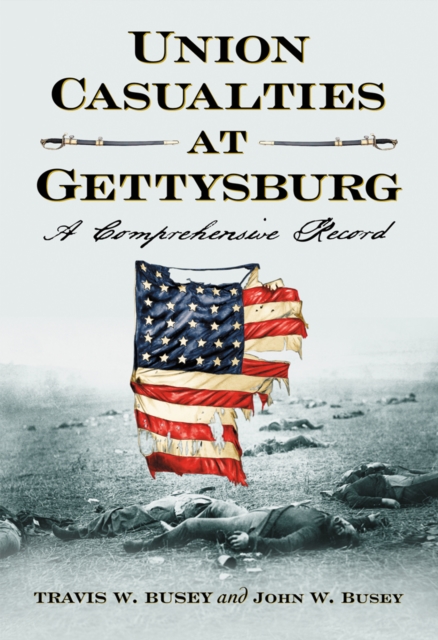
Union Casualties at Gettysburg
This reference work chronicles and categorizes more than 23,000 Union casualties at Gettysburg by generals and staff and by state and unit.Thirteen appendices also cover information by brigade, division and corps; by engagements and skirmishes; by state; by burial at three cemeteries; and by hospitals.
eBook

St. Mary’s Goes to War: The Sisters of the Holy Cross as Civil War Nurses
The second largest group was the Sisters of the Holy Cross (63) of St. Mary's College in Notre Dame, Indiana.1 The other orders that participated in the war included the Sisters of St. Joseph, Sisters of Our Lady of Mount Carmel, Sisters of St. Dominic, Sisters of St. Ursula, Sisters of the Poor of St. Francis, Sisters of Mercy, Sisters of Charity, Daughters of Charity of St. Vincent de Paul, Sisters of Charity of Nazareth (KY) and the Sisters of Our Lady of Mercy.2 In 1861 when the Civil War broke out in Charleston Harbor, the Catholic sisters were almost the only women in America with any nursing experience. A visitor walking through the hospital observed a sister caring for a black patient with a rather repulsive wound and commented: \"Upon my soul, I believe if the devil himself got sick, the charity of these women would induce them to feed and nurse him. [...]they developed a nationwide health care system beginning with the opening of Saint Mary's Hospital in Cairo, Illinois in 1867.60 In May 2000, the Holy Cross Health System consolidated resources with the Sisters of Mercy's Detroit Regional Health System, creating the fourth largest Catholic healthcare system in the United States, Trinity Health.61 In May of 2013, Trinity Health and Catholic Health East consolidated to create one of the nation's largest Catholic health care systems. [...]of that merger they no longer own hospitals but many of the sisters still minister in what originally were hospitals owned by them.
Journal Article

Surviving Wartime Emancipation: African Americans and the Cost of Civil War
Ask any Civil War historian about the cost of the Civil War and they will recite a host of well-known assessments, from military casualties and government expenditures to various measures of direct and indirect costs. But those numbers are not likely to include an appraisal of the humanitarian crisis and suffering caused by the wartime destruction of slavery. Peace-time emancipation in other regions (the northern U.S., for example) and in other societies (like the British West Indies) certainly presented dangers and difficulties for the formerly enslaved, but wartime emancipation chained the new opportunities and possibilities for freedom to war’s violence, civil chaos, destruction and deprivation. The resulting health crisis, including illness, injury, and trauma, had immediate and lasting consequences for black civilians and soldiers. Although historians are more accustomed to thinking of enslaved people as the beneficiaries of this war, rather than its victims, we cannot assess the cost of this war until we answer two important questions: first, what price did enslaved people have to pay because their freedom was achieved through warfare rather than a peacetime process; and secondly, in this war in which so many Americans paid such a high cost, to what extent did racism inflate the cost paid by people of African descent? In answering these questions, we reconsider this specific war, but we must also tie the U.S. Civil War to a larger scholarship on how wars impact civilians, create refugee populations, and accelerate harsh treatment of people regarded as racial, religious, or ethnic outsiders. We are reminded that war is not an equal-opportunity killer.
Journal Article

'This Godforsaken Town:' Death and Disease at Helena, Arkansas, 1862-63
Union officials considered the Army of the Southwest a powerful and dynamic force able to capture and hold Arkansas for the Union cause. However, when supply considerations necessitated the army's occupation of Helena AR in Jul 1862, the army became an ineffective force in fighting not only the Confederates but also the disease-ridden Helena environment. Sickness did not abate over the three and a half years of Federal occupation as Helena became known as one of the most insalubrious locations in the Union. Though it is widely accepted that disease caused more disability and death than wounds during the Civil War, few historians have examined this aspect of military history.
Journal Article