
Catalogue Search | MBRL


Are you sure you want to remove the book from the shelf?

{{itemTitle}}
57
result(s) for
"United States History Civil War, 1861-1865 Diplomatic history."
Sort by:

Power, law and the end of privateering
This text offers an exciting new take on the relationship between law and power. The 1856 Declaration of Paris marks the precise moment when international law became universal, and was an aggressive and successful British move to end privateering forever - then the United States' main weapon in case of war with Britain.
Book

Lord Lyons
The British ambassador in Washington during the US Civil War and ambassador in Paris before and after the Franco-Prussian war, Lord Lyons (1817-1887) was one of the most important diplomats of the Victorian period. Although frequently featured in histories of the United States and Europe in the second half of the nineteenth century, and in discussions and analyses of British foreign policy, he has remained an ill-defined figure. In Lord Lyons: A Diplomat in an Age of Nationalism and War, Brian Jenkins explains the man and examines his career. Based on a staggering study of primary sources, he presents a convincing portrait of a subject who rarely revealed himself personally. Though he avoided publicity, Lyons came to be regarded as his nation's premier diplomat as his career took him to the heart of the great international issues and crises of his generation. As minister to the United States he played a vital role in preserving Anglo-American peace and was a powerful voice opposing Anglo-French intervention in the Civil War. While ambassador to the Ottoman Empire, he helped to prevent French control of the Suez Canal then under construction. In France, he maintained an amiable and constructive relationship with a bitter nation struggling to reorganize itself and its constitution after the Franco-Prussian War. For many historians Lord Lyons has been difficult to ignore but hard to admire. In rescuing him as a truly important historical figure, Jenkins details for the first time the personal and public strategies Lyons employed through decades of exemplary diplomatic service on both sides of the Atlantic.
eBook

Lincoln, Seward, and US Foreign Relations in the Civil War Era
The Civil War marked a significant turning point in American
history-not only for the United States itself but also for its
relations with foreign powers both during and after the conflict.
The friendship and foreign policy partnership between President
Abraham Lincoln and Secretary of State William Henry Seward shaped
those US foreign policies. These unlikely allies, who began as
rivals during the 1860 presidential nomination, helped ensure that
America remained united and prospered in the aftermath of the
nation's consuming war.
In Lincoln, Seward, and US Foreign Relations in the Civil
War Era , Joseph A. Fry examines the foreign policy decisions
that resulted from this partnership and the legacy of those
decisions. Lincoln and Seward, despite differences in upbringing,
personality, and social status, both adamantly believed in the
preservation of the union and the need to stymie slavery. They made
that conviction the cornerstone of their policies abroad, and
through those policies, such as Seward threatening war with any
nation that intervened in the Civil War, they prevented European
intervention that could have led to Northern defeat. The Union
victory allowed America to resume imperial expansion, a dynamic
that Seward sustained beyond Lincoln's death during his tenure as
President Andrew Johnson's Secretary of State.
Fry's analysis of the Civil War from an international
perspective and the legacy of US policy decisions provides a more
complete view of the war and a deeper understanding of this crucial
juncture in American history.
eBook

France and the American Civil War
France's involvement in the American Civil War was critical to its unfolding, but the details of the European power's role remain little understood. Here, Steve Sainlaude offers the first comprehensive history of French diplomatic engagement with the Union and the Confederate States of America during the conflict. Drawing on archival sources that have been neglected by scholars up to this point, Sainlaude overturns many commonly held assumptions about French relations with the Union and the Confederacy. As Sainlaude demonstrates, no major European power had a deeper stake in the outcome of the conflict than France. Reaching beyond the standard narratives of this history, Sainlaude delves deeply into questions of geopolitical strategy and diplomacy during this critical period in world affairs. The resulting study will help shift the way Americans look at the Civil War and extend their understanding of the conflict in global context.
eBook

The Union, the Confederacy, and the Atlantic Rim
From French intervention in Mexico to British interests in the Caribbean, the impact of the Civil War extended far beyond military campaigns in Virginia, diffusing widely into the Atlantic world. Revised to take into account the outpouring of scholarship on Civil War diplomacy that has appeared since the book was first published,The Union, the Confederacy, and the Atlantic Rim features essays by acclaimed historians Howard Jones, R. J. M. Blackett, Thomas Schoonover, and James M. McPherson.
eBook

Blue and Gray Diplomacy
In this examination of Union and Confederate foreign relations
during the Civil War from both European and American perspectives,
Howard Jones demonstrates that the consequences of the conflict
between North and South reached far beyond American soil. Jones
explores a number of themes, including the international economic
and political dimensions of the war, the North's attempts to block
the South from winning foreign recognition as a nation, Napoleon
III's meddling in the war and his attempt to restore French power
in the New World, and the inability of Europeans to understand the
interrelated nature of slavery and union, resulting in their
tendency to interpret the war as a senseless struggle between a
South too large and populous to have its independence denied and a
North too obstinate to give up on the preservation of the Union.
Most of all, Jones explores the horrible nature of a war that
attracted outside involvement as much as it repelled it. Written in
a narrative style that relates the story as its participants saw it
play out around them, Blue and Gray Diplomacy depicts the
complex set of problems faced by policy makers from Richmond and
Washington to London, Paris, and St. Petersburg.
eBook
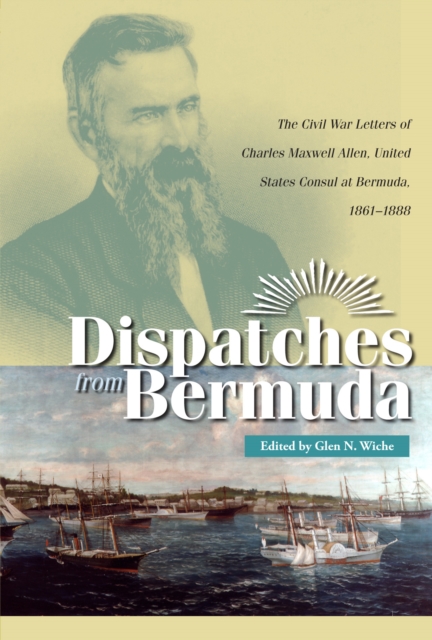
Dispatches from Bermuda: the Civil War letters of Charles Maxwell Allen, United States consul at Bermuda, 1861-1888
This book describes Civil War diplomacy and espionage.In the summer of 1861, President Abraham Lincoln appointed Charles Maxwell Allen U.S. consul to Bermuda. During the Civil War, Allen's post became one of vital importance to the United States as this British colony became a center for Confederate blockade-running activities. As the sole representative of Union interests in pro-Confederate Bermuda, Allen found himself involved in the shadowy world of intelligence gathering as he attempted to thwart these blockade-runners.Allen's dispatches shed new light on two important and often-overlooked aspects of the war: the Union blockade of southern seaports and the effort to bring vital war supplies through the blockade to the Confederate states.Author Glen Wiche has compiled all of Allen's Civil War dispatches to the U.S. State Department and provides well-documented commentary to place Allen's activities in the wider context of the \"\"Atlantic campaign\"\" of the Civil War. \"\"Dispatches from Bermuda\"\" paints a detailed picture of these activities and offers a rare account of this blockade-running traffic from a northern perspective.
eBook

Spain and the American Civil War
In the mid-1800s, Spain experienced economic growth, political stabilization, and military revival, and the country began to sense that it again could be a great global power. In addition to its desire for international glory, Spain also was the only European country that continued to use slaves on plantations in Spanish-controlled Cuba and Puerto Rico. Historically, Spain never had close ties to Washington, D.C., and Spain's hard feelings increased as it lost Latin America to the United States in independence movements. Clearly, Spain shared many of the same feelings as the Confederate States of America during the American Civil War, and it found itself in a unique position to aid the Confederacy since its territories lay so close to the South. Diplomats on both sides, in fact, declared them \"natural allies.\" Yet, paradoxically, a close relationship between Spain and the Confederacy was never forged. In Spain and the American Civil War, Wayne H. Bowen presents the first comprehensive look at relations between Spain and the two antagonists of the American Civil War. Using Spanish, United States and Confederate sources, Bowen provides multiple perspectives of critical events during the Civil War, including Confederate attempts to bring Spain and other European nations, particularly France and Great Britain, into the war; reactions to those attempts; and Spain's revived imperial fortunes in Africa and the Caribbean as it tried to regain its status as a global power. Likewise, he documents Spain's relationship with Great Britain and France; Spanish thoughts of intervention, either with the help of Great Britain and France or alone; and Spanish receptiveness to the Confederate cause, including the support of Prime Minister Leopoldo O'Donnell. Bowen's in-depth study reveals how the situations, personalities, and histories of both Spain and the Confederacy kept both parties from establishing a closer relationship, which might have provided critical international diplomatic support for the Confederate States of America and a means through which Spain could exact revenge on the United States of America.
eBook

The British foreign service and the American Civil War
During the American Civil War, the British legation and consuls experienced strained relations with both the Union and the Confederacy, to varying degrees and with different results.Southern consuls were cut off from the legation in Washington, D.C., and confronted their problems for the most part without direction from superiors.
eBook

The cause of all nations : an international history of the American Civil War
When Abraham Lincoln delivered the Gettysburg Address in 1863, he had broader aims than simply rallying a war-weary nation. Lincoln realized that the Civil War had taken on a wider significancethat all of Europe and Latin America was watching to see whether the United States, a beleaguered model of democracy, would indeed perish from the earth.\" In The Cause of All Nations, distinguished historian Don H. Doyle explains that the Civil War was viewed abroad as part of a much larger struggle for democracy that spanned the Atlantic Ocean, and had begun with the American and French Revolutions. While battles raged at Bull Run, Antietam, and Gettysburg, a parallel contest took place abroad, both in the marbled courts of power and in the public square. Foreign observers held widely divergent views on the warfrom radicals such as Karl Marx and Giuseppe Garibaldi who called on the North to fight for liberty and equality, to aristocratic monarchists, who hoped that the collapse of the Union would strike a death blow against democratic movements on both sides of the Atlantic. Nowhere were these monarchist dreams more ominous than in Mexico, where Napoleon III sought to implement his Grand Design for a Latin Catholic empire that would thwart the spread of Anglo-Saxon democracy and use the Confederacy as a buffer state. Hoping to capitalize on public sympathies abroad, both the Union and the Confederacy sent diplomats and special agents overseas: the South to seek recognition and support, and the North to keep European powers from interfering. Confederate agents appealed to those conservative elements who wanted the South to serve as a bulwark against radical egalitarianism. Lincoln and his Union agents overseas learned to appeal to many foreigners by embracing emancipation and casting the Union as the embattled defender of universal republican ideals, the
last best hope of earth.\" A bold account of the international dimensions of America's defining conflict, The Cause of All Nations frames the Civil War as a pivotal moment in a global struggle that would decide the survival of democracy.
eBook