
Catalogue Search | MBRL


Are you sure you want to remove the book from the shelf?

{{itemTitle}}
10
result(s) for
"United States Militia History 18th century."
Sort by:


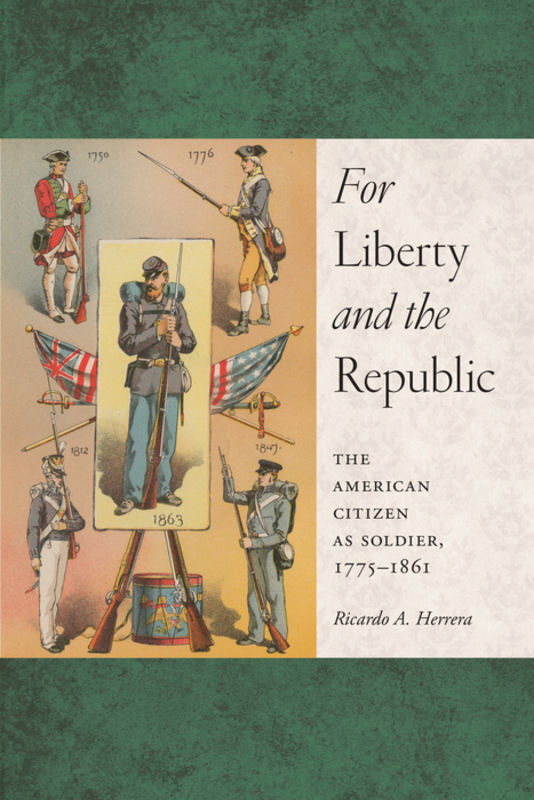
For Liberty and the Republic
In the early decades of the American Republic, American soldiers demonstrated and defined their beliefs about the nature of American republicanism and how they, as citizens and soldiers, were participants in the republican experiment through their service. InFor Liberty and the Republic, Ricardo A. Herrera examines the relationship between soldier and citizen from the War of Independence through the first year of the Civil War.
The work analyzes an idealized republican ideology as a component of soldiering in both peace and war. Herrera argues that American soldiers' belief system-the military ethos of republicanism-drew from the larger body of American political thought. This ethos illustrated and informed soldiers' faith in an inseparable connection between bearing arms on behalf of the republic, and earning and holding citizenship in it. Despite the undeniable existence of customs, organizations, and behaviors that were uniquely military, the officers and enlisted men of the regular army, states' militias, and wartime volunteers were the products of their society, and they imparted what they understood as important elements of American thought into their service.
Drawing from military and personal correspondence, journals, orderly books, militia constitutions, and other documents in over forty archives in twenty-three states, Herrera maps five broad, interrelated, and mutually reinforcing threads of thought constituting soldiers' beliefs: Virtue; Legitimacy; Self-governance; Glory, Honor, and Fame; and the National Mission. Spanning periods of war and peace, these five themes constituted a coherent and long-lived body of ideas that informed American soldiers' sense of identity for generations.
eBook

The Politics of War
War often unites a society behind a common cause, but the notion of
diverse populations all rallying together to fight on the same side
disguises the complex social forces that come into play in the
midst of perceived unity. Michael A. McDonnell uses the Revolution
in Virginia to examine the political and social struggles of a
revolutionary society at war with itself as much as with Great
Britain.
McDonnell documents the numerous contests within Virginia over
mobilizing for war--struggles between ordinary Virginians and
patriot leaders, between the lower and middle classes, and between
blacks and whites. From these conflicts emerged a republican polity
rife with racial and class tensions.
Looking at the Revolution in Virginia from the bottom up, The
Politics of War demonstrates how contests over waging war in
turn shaped society and the emerging new political settlement. With
its insights into the mobilization of popular support, the exposure
of social rifts, and the inversion of power relations, McDonnell's
analysis is relevant to any society at war.
eBook

HISTORICAL TRADITION, THE SECOND AMENDMENT, AND MARRYING GUN RIGHTS AND REGULATION: EXAMINING THE PROPOSALS IN GAVIN NEWSOM'S TWENTY-EIGHTH AMENDMENT AND THEIR PLACE IN SECOND AMENDMENT JURISPRUDENCE
Forty percent of gun-related deaths were murders, while the remaining gun deaths resulted from suicide, accidents, law enforcement, or undetermined circumstances.\"· The rise in both gun deaths among children and teenagers and in mass shootings continues to capture the national conscience, elevating debates on regulatory approaches to gun access, ownership, and use.\" The Twenty-Eighth Amendment was proposed in the midst of conflicting decisions in lower federal courts on issues including the constitutionality of banning assault weapons and adjusting age requirements to purchase firearms.·· The likelihood of ratifying the Twenty-Eighth Amendment is slim, given the hurdles a proposed amendment must leap to be ratified; but as debates over gun regulation intensify, multiple provisions of the Twenty-Eighth Amendment could one day become federal law.\" Gun safety was a significant concern for governments in the colonial era, as colonial and state governments enacted hundreds of laws focused on militia regulation, dangerous weapons, minors accessing firearms, and firearms registration, inspection, and manufacturing.\" C. Keeping Dangerous Weapons Out of the Hands of Minors: a Centuries-Old Concern Age-based gun regulations were commonplace around the adoption of the Second and Fourteenth Amendments, with states preventing the sale and transfer of pistols and other deadly weapons to individuals under the age of twenty-one.®® The age of majority at common law was twenty-one, and regulations prohibiting individuals under age twenty-one from purchasing firearms were robust in the nineteenth century, though no laws said minors
Journal Article

In the wake of the great rebellion
On Monday 19 September 1803, the most significant trial in the history of Ireland took place in Dublin. At the dock stood a twenty-five year old former Trinity College student and doctor’s son. His name was Robert Emmet and he was standing trial for heading a rebellion on 23 July 1803. The iconic power of Robert Emmet in Irish history cannot be overstated. Emmet looms large in narratives of the past, yet the rebellion, which he led, remains to be fully contextualized. Patterson’s book repairs this omission and explains the complex of politicization and revolutionary activity extending into the 1800’s. He details the radicalisation of the grass roots, their para-militarism and engagement in secret societies. Drawing on an intriguing range of sources, Patterson offers a comprehensive insight into a relatively neglected period of history. This work is of particular significance to undergraduate and post-graduate students and lecturers of Irish history.
eBook

A people's army : Massachusetts soldiers and society in the Seven Years' War
A People's Army documents the many distinctions between British regulars and Massachusetts provincial troops during the Seven Years' War.Originally published by UNC Press in 1984, the book was the first investigation of colonial military life to give equal attention to official records and to the diaries and other writings of the common soldier.
eBook

The Continuation of Politics by Other Means: The Original Understanding of War Powers
In recent years, legal commentators have sharply criticized executive initiative in the war-making process. This Article examines the historical and legal background of the war powers in the Anglo-American world of the seventeenth and eighteenth centuries. The author argues that the war powers framework created by the Framers differs sharply from that envisioned by modern scholars. After exploring the Constitutional text, the political and legal context within which the Framers lived, experiences with British political history and state constitutions, and the arguments made during the ratification debates, the author concludes that the Framers created a framework designed to encourage presidential initiative in war. Congress was given a role in war-making decisions not by the Declare War Clause, but by its powers over funding and impeachment. The courts were to have no role at all. Professor Yoo suggests that the Constitution did not inadvertently exclude the judiciary. Instead, the Framers understood the Constitution as giving the two political branches weapons to struggle for influence over the war-making process-rendering judicial supervision unnecessary. The Article concludes that because the Framers failed to specify an exact relationship between the President and Congress in the area of war, precise procedures may evolve over time within the constitutional framework.
Journal Article

An Empirical Test of Federalist and Anti-Federalist Theories of State Contributions, 1775-1783
This article tests Federalist and Anti-Federalist explanations for state contributions to the confederation government using data on troop requisitions from 1775 to 1783. The Federalists claimed that state politicians acted unilaterally and contributed when the Continental army protected their state's interests. The Anti-Federalists claimed that state politicians understood their duty to the Union and contributed to advance its needs. The results suggest that, with one important caveat, states contributed more consistent with the Federalist argument. This helps explain why the Articles of Confederation needed reform.
Journal Article
