
Catalogue Search | MBRL


Are you sure you want to remove the book from the shelf?

{{itemTitle}}
36
result(s) for
"United States Politics and government 1913-1921."
Sort by:


More precious than peace : a new history of America in World War I
Justus D. Doenecke’s monumental study covers diplomatic, military, and ideological aspects of U.S. involvement as a full-scale participant in World War I.
The entry of America into the “war to end all wars” in April 1917 marks one of the major turning points in the nation's history. In the span of just nineteen months, the United States sent nearly two million troops overseas, established a robust propaganda apparatus, and created an unparalleled war machine that played a major role in securing Allied victory in the fall of 1918. At the helm of the nation, Woodrow Wilson and his administration battled against political dissidence, domestic and international controversies, and their own lack of experience leading a massive war effort.
In More Precious than Peace , the long-awaited successor to his critically acclaimed work Nothing Less than War , Justus D. Doenecke examines the entirety of the American experience as a full-scale belligerent in World War I. This book covers American combat on the western front, the conscription controversy, and scandals in military training and production. Doenecke explores the Wilson administration's quest for national unity, the Creel Committee, and patriotic crusades. Weaving together these topics and many others, including the U.S. reaction to the Russian revolutions, Doenecke creates a lively and comprehensive narrative. Based on impressive research, this balanced appraisal challenges historiographical controversies and will be of great use to students, scholars, and any reader interested in the history of World War I.
eBook


Woodrow Wilson
From the Ivy League to the oval office, Woodrow Wilson was the only professional scholar to become a U.S. president. A professor of history and political science, Wilson became the dynamic president of Princeton University in 1902 and was one of its most prolific scholars before entering active politics. Through his labors as student, scholar, and statesman, he left a legacy of elegant writings on everything from educational reform to religion to history and politics.Woodrow Wilson: Essential Writings and Speeches of the Scholar-President collects Wilson's most influential work, from early essays on religion to his famous Fourteen Points speech, which introduced the idea of the League of Nations. Among the last of the presidents to write his own speeches, Wilson left behind works which offer impressive insights into his mind and his age.Deeply religious, Wilson looked to his faith to guide his life and wrote candidly about the connection. A passionate advocate of liberal learning, he broadcast his ideas on educational reform with missionary intensity. In politics he moved from a traditional nineteenth-century conservative view of government to a progressive, international vision which transformed American politics in the new century. His writings allow us to trace the intellectual struggle that took the nation from a position of neutrality in World War I to its role as a central player on the world stage.Penetrating and eloquent, the works gathered here represent the best and the most important of Wilson's writings that retain enduring interest. A rich repository of ideas on the American people and America's purpose in the world, these works reveal the thoughts of one of the most acute analysts and actors in the drama of American politics.
eBook

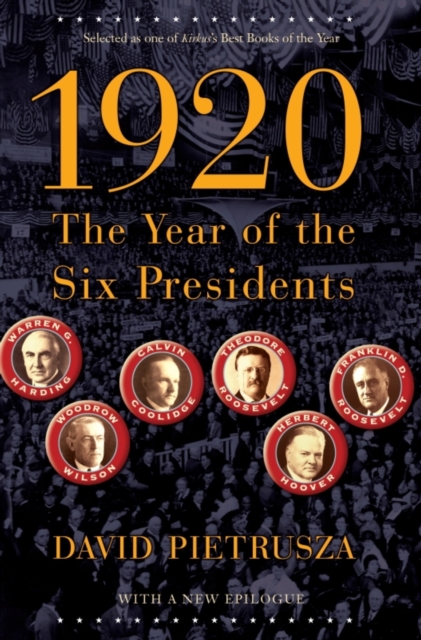
1920
The presidential election of 1920 was among historys most dramatic. Six once-and-future presidents-Wilson, Harding, Coolidge, Hoover, and Teddy and Franklin Roosevelt-jockeyed for the White House. With voters choosing between Wilsons League of Nations and Hardings front-porch isolationism, the 1920 election shaped modern America. Women won the vote. Republicans outspent Democrats by 4 to 1, as voters witnessed the first extensive newsreel coverage, modern campaign advertising, and results broadcast on radio. America had become an urban nation: Automobiles, mass production, chain stores, and easy credit transformed the economy. 1920 paints a vivid portrait of America, beset by the Red Scare, jailed dissidents, Prohibition, smoke-filled rooms, bomb-throwing terrorists, and the Klan, gingerly crossing modernitys threshold.
eBook


America in the Great War : the rise of the war welfare state
Demonstrates how, in order to mobilize the USA for World War I, the US government created a war welfare state in which groups having the largest bargaining power - businessmen, labour and military leaders, social reformers and pro-war lobbies - received the largest rewards for their co-operation.
eBook

Madam President : the secret presidency of Edith Wilson
An up-close look at Edith Wilson, a first lady with unequaled responsibilities during her husband's presidency. After President Woodrow Wilson suffered a paralyzing stroke in the fall of 1919, his wife, First Lady Edith Wilson, began to handle the day-to-day responsibilities of the chief executive. Mrs. Wilson had had little formal education and had only been married to President Wilson for four years, yet in the tenuous peace following the end of World War I, she dedicated herself to managing the office of the president, reading all correspondence intended for her bedridden husband. Though her Oval Office authority was acknowledged in Washington circles at the time--one senator called her \"the presidentress who had fulfilled the dream of suffragettes by changing her title from First Lady to Acting First Man\"--Her legacy as the first woman president is now largely forgotten. William Hazelgrove's Madam President is a vivid, engaging portrait of the woman who became the acting president of the United States in 1919, months before women officially won the right to vote.
Book

The lion's pride : Theodore Roosevelt and his family in peace and war
In The Lion's Pride, Edward J.Renehan, Jr.vividly portrays the grand idealism, heroic bravery, and reckless abandon that Theodore Roosevelt both embodied and bequeathed to his children and the tragic fulfillment of that legacy on the battlefields of World War I.
eBook