
Catalogue Search | MBRL


Are you sure you want to remove the book from the shelf?

{{itemTitle}}
11
result(s) for
"United States Politics and government 1933-1953."
Sort by:


The Red Scare, Politics, and the Federal Communications Commission, 1941-1960
Explores how the politics inherent to the Red Scare profoundly affected FCC decisions and policymaking from 1939-1962. The Red Scare at the FCC started when James Lawrence Fly led the agency in many important decisions that were inspired by the New Deal. These decisions outraged both the broadcasting industry and politically conservative legislators, causing them to accuse the FCC of Communist sympathies. This book analyzes the political transition taken by the FCC that turned it into an agency that fully participated in the Red Scare of the 1950s. This book analyzes many significant FCC cases and policies that have never been considered within the context of New Deal policymaking or its impact. This work is the first to look into the impact of the Red Scare on an executive agency. Its combination of new archival and behind-the- scenes information makes this book a great addition to the growing body of research on media history and regulation.
eBook


Right turn : John T. Flynn and the transformation of American liberalism
John T. Flynn, a prolific writer, columnist for the New Republic , Harper's Magazine , and Collier's Weekly , radio commentator, and political activist, was described by the New York Times in 1964 as “a man of wide-ranging contradictions.” In this new biography of Flynn, John E. Moser fleshes out his many contradictions and profound influence on U.S. history and political discourse.
In the 1930s, Flynn advocated extensive regulation of the economy, the breakup of holding companies, and heavy taxes on the wealthy. A mere fifteen years later he was denouncing the New Deal as “creeping socialism,” calling for an abolition of the income tax, and hailing Senator Joseph McCarthy and his fellow anticommunists as saviors of the American Republic. Yet throughout his career he insisted that he had remained true to the principles of liberalism as he understood them.
It was America's political culture that changed, he argued, and not his values and views. Drawing on Flynn’s life and his prolific writings, Moser illuminates how liberalism in America changed during the mid-twentieth century and considers whether Flynn’s ideological odyssey was the product of opportunism, or the result of a set of deep-seated principles that he championed consistently over the years. In addition, Right Turn examines Flynn’s role in laying the foundations for the “culture war” that would be played out in American society for the rest of the century, helping to define modern American conservatism.
eBook


A divided world
The New Deal introduced sweeping social, political and cultural change across the United States, which Hollywood embraced enthusiastically. Then, when the heady idealism of the 1930s was replaced by the paranoia of the postwar years, Hollywood became an easy target for the anticommunists. A Divided World examines some of the important programs of the New Deal and the subsequent response of the film community - especially in relation to social welfare, women's rights and international affairs. The book also provides an analysis of the major works of three European directors - Billy Wilder, Ernst Lubitsch and Fritz Lang - compared and contrasted with the products of mainstream Hollywood. This is a new interpretation of an influential period in American film history and it is sure to generate further debate and scholarship.
eBook

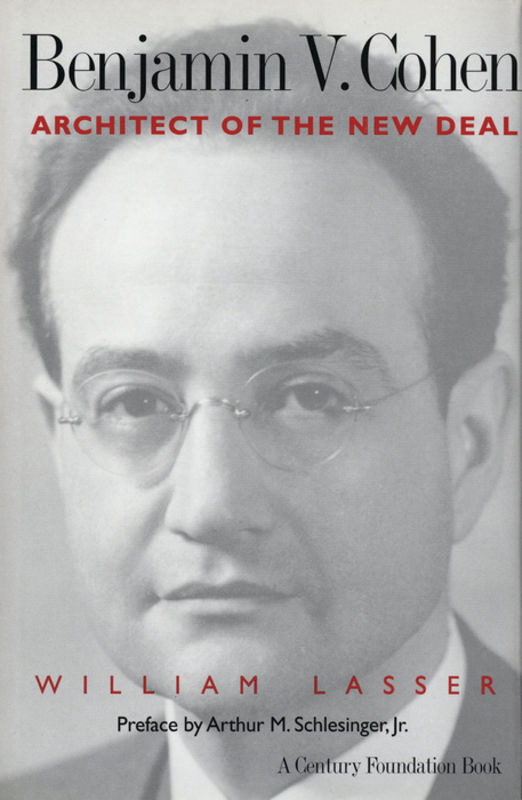
Benjamin V. Cohen
A key figure in the administrations of Franklin D. Roosevelt and Harry S. Truman, Benjamin V. Cohen (1894-1983) was a major architect of public policy from the first days of FDR's presidency through the early days of the Cold War. Although he kept a low public profile, Cohen's influence extended across a wide range of domestic and foreign policy initiatives. In this biography, William Lasser offers the first account of Ben Cohen's life and career, and an assessment of his contribution to the origin and development of modern American liberalism.Cohen's life provides an extraordinary lens through which to view the development of the evolving political philosophy of the Roosevelt and Truman presidencies. A brilliant lawyer noted for his good judgment and experience, Cohen was a leading member of FDR's \"Brain Trust,\" developing ideas, drafting legislation, lobbying within the administration and in Congress, and defending the New Deal in court. The book traces his contributions to domestic financial policy, his activities during the war years in London and Washington, his service as counselor to the State Department and member of the American delegation to the United Nations after the war, and his role in the American Zionist movement. From Cohen's life and work, Lasser draws important insights into the development of the New Deal and the evolution of postwar liberalism.
eBook


Historical dictionary of the 1940s
Offering readers a ready-reference portrait of one of the twentieth century's most tumultuous decades, this is a historical dictionary devoted exclusively to the 1940. In nearly 600 concise entries, the volume defines a historical figure, institution, or event, and then points readers to three sources that treat the subject in depth.
eBook