
Catalogue Search | MBRL


Are you sure you want to remove the book from the shelf?

{{itemTitle}}
124
result(s) for
"United States Politics and government 1963-1969."
Sort by:

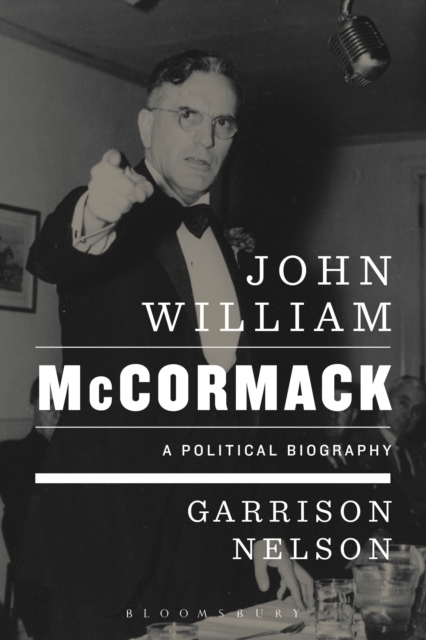
John William McCormack
In the first biography of U.S. House Speaker John W. McCormack, author Garrison Nelson uncovers previously forgotten FBI files, birth and death records, and correspondence long thought lost or buried. For such an influential figure, McCormack tried to dismiss the past, almost erasing his legacy from the public's mind. John William McCormack: A Political Biography sheds light on the behind-the-curtain machinations of American politics and the origins of the modern-day Democratic party, facilitated through McCormack's triumphs. McCormack overcame desperate poverty and family tragedy in the Irish ghetto of South Boston to hold the second-most powerful position in the nation. By reinventing his family history to elude Irish Boston's powerful political gatekeepers, McCormack embarked on a 1928 - 1971 House career and from 1939-71, the longest house leadership career. Working with every president from Coolidge to Nixon, McCormack's social welfare agenda, which included Social Security, Medicare and Medicaid, immigration reform, and civil rights legislation helped commit the nation to the welfare of its most vulnerable citizens. By helping create the Austin-Boston Connection, McCormack reshaped the Democratic Party from a regional southern white Protestant party to one that embraced urban religiously and racially diverse ethnics. A man free of prejudice, John McCormack was the Boston Brahmin's favorite Irishman, the South's favorite northerner, and known in Boston as \"Rabbi John,\" the Jews' favorite Catholic.
eBook


The pro-war movement : domestic support for the Vietnam War and the making of modern American conservatism
In the vast literature on the Vietnam War, much has been written about the antiwar movement and its influence on U.S. policy and politics. In this book, Sandra Scanlon shifts attention to those Americans who supported the war and explores the war's impact on the burgeoning conservative political movement of the 1960s and early 1970s. Believing the Vietnam War to be a just and necessary cause, the pro-war movement pushed for more direct American military intervention in Southeast Asia throughout the Kennedy administration, lobbied for intensified bombing during the Johnson years, and offered coherent, if divided, endorsements of Nixon's policies of phased withdrawal. Although its political wing was dominated by individuals and organizations associated with Barry Goldwater's presidential bids, the movement incorporated a broad range of interests and groups united by a shared antipathy to the New Deal order and liberal Cold War ideology. Appealing to patriotism, conservative leaders initially rallied popular support in favor of total victory and later endorsed Nixon's call for \"peace with honor.\" Yet as the war dragged on with no clear end in sight, internal divisions eroded the confidence of pro-war conservatives in achieving their aims and forced them to reevaluate the political viability of their hardline Cold War rhetoric. Conservatives still managed to make use of grassroots patriotic campaigns to marshal support for the war, particularly among white ethnic workers opposed to the antiwar movement. Yet in so doing, Scanlon concludes, they altered the nature and direction of the conservative agenda in both foreign and domestic policy for years to come.
eBook


American Maelstrom : the 1968 election and the politics of division
American Maelstrom captures the full drama of the 1968 watershed election, taking us to the source of the politics of division.
eBook

Nixonland : the rise of a president and the fracturing of America
An account of the thirty-seventh presidency sets Nixon's administration against a backdrop of the tumultuous civil rights movement while offering insight into how key events in the 1960s set the stage for today's political divides.
BOOK


Liberalism's Last Hurrah
Marked by sharp ideological divisions over civil rights, Vietnam, and federal power, the 1964 presidential campaign between Democrat Lyndon Johnson and Republican Barry Goldwater proved a watershed election in American history. Although Johnson defeated Goldwater in a landslide and liberalism seemed to ride triumphant, the liberal wave crashed almost immediately and conservatives came to dominate a resurgent Republican Party in the late twentieth century. Thoroughly researched and beautifully written, this is the first historical account of this crucial election, and the transition it marked for the nation. Filled with colorful details and fascinating figures - Johnson, Goldwater, Wallace, Rockefeller, Nixon, Reagan, Robert Kennedy, Martin Luther King, Jr., George Bush, and many more - it captures the full excitement, drama, and significance of \"liberalism's last hurrah.\"
eBook