
Catalogue Search | MBRL


Are you sure you want to remove the book from the shelf?

{{itemTitle}}
49
result(s) for
"United States Social life and customs To 1775."
Sort by:


The Politics of Fashion in Eighteenth-Century America
In eighteenth-century America, fashion served as a site of contests over various forms of gendered power. Here, Kate Haulman explores how and why fashion--both as a concept and as the changing style of personal adornment--linked gender relations, social order, commerce, and political authority during a time when traditional hierarchies were in flux.In the see-and-be-seen port cities of Boston, New York, Philadelphia, and Charleston, fashion, a form of power and distinction, was conceptually feminized yet pursued by both men and women across class ranks. Haulman shows that elite men and women in these cities relied on fashion to present their status but also attempted to undercut its ability to do so for others. Disdain for others' fashionability was a means of safeguarding social position in cities where the modes of dress were particularly fluid and a way to maintain gender hierarchy in a world in which women's power as consumers was expanding. Concerns over gendered power expressed through fashion in dress, Haulman reveals, shaped the revolutionary-era struggles of the 1760s and 1770s, influenced national political debates, and helped to secure the exclusions of the new political order.
eBook

Horrible jobs in colonial times
As the 13 colonies grew, they prospered with new industries and tr ade. However, some of these trades, like tanning animal hides, were unpleasant. In fact, from slaves and indentured servants, to mad hatters and risk-taking whalers, jobs in the colonies could be downright horrible!
Book

In the Looking Glass
Focusing on how mirrors were acquired in America and by whom, as well as the profound influence mirrors had, both individually and collectively, on the groups that embraced them, In the Looking Glass is a piece of innovative textual and visual scholarship.
eBook

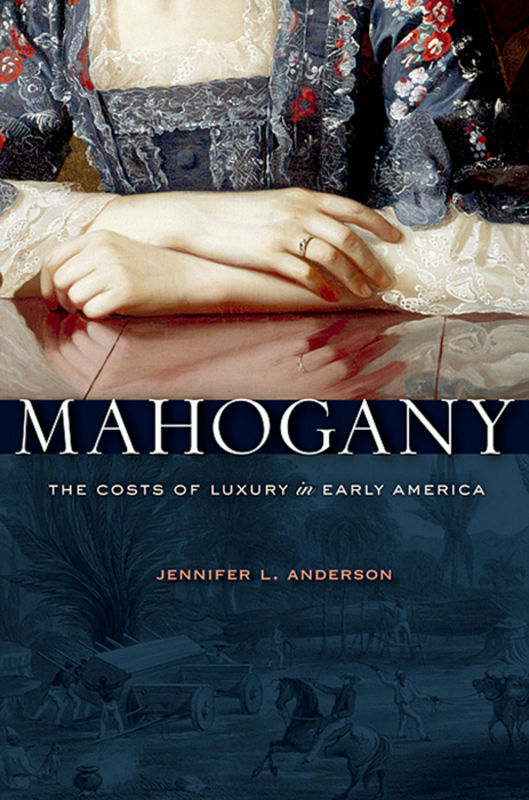
Mahogany : the costs of luxury in early America
In the mid-eighteenth century, colonial Americans became enamored with the rich colors and silky surface of mahogany. This exotic wood, imported from the West Indies and Central America, quickly displaced local furniture woods as the height of fashion. Over the next century, consumer demand for mahogany set in motion elaborate schemes to secure the trees and transform their rough-hewn logs into exquisite objects. But beneath the polished gleam of this furniture lies a darker, hidden story of human and environmental exploitation. Mahogany traces the path of this wood through many hands, from source to sale: from the enslaved African woodcutters, including skilled \"huntsmen\" who located the elusive trees amidst dense rainforest, to the ship captains, merchants, and timber dealers who scrambled after the best logs, to the skilled cabinetmakers who crafted the wood, and with it the tastes and aspirations of their diverse clientele. As the trees became scarce, however, the search for new sources led to expanded slave labor, vicious competition, and intense international conflicts over this diminishing natural resource. When nineteenth-century American furniture makers turned to other materials, surviving mahogany objects were revalued as antiques evocative of the nation's past. Jennifer Anderson offers a dynamic portrait of the many players, locales, and motivations that drove the voracious quest for mahogany to adorn American parlors and dining rooms. This complex story reveals the cultural, economic, and environmental costs of America's growing self-confidence and prosperity, and how desire shaped not just people's lives but the natural world.
eBook


Social Structure of Revolutionary America
No detailed description available for \"Social Structure of Revolutionary America\".
eBook


Citizen Bachelors
In 1755 Benjamin Franklin observed \"a man without a wife is but half a man\" and since then historians have taken Franklin at his word. InCitizen Bachelors, John Gilbert McCurdy demonstrates that Franklin's comment was only one side of a much larger conversation. Early Americans vigorously debated the status of unmarried men and this debate was instrumental in the creation of American citizenship.
In a sweeping examination of the bachelor in early America, McCurdy fleshes out a largely unexamined aspect of the history of gender. Single men were instrumental to the settlement of the United States and for most of the seventeenth century their presence was not particularly problematic. However, as the colonies matured, Americans began to worry about those who stood outside the family. Lawmakers began to limit the freedoms of single men with laws requiring bachelors to pay higher taxes and face harsher penalties for crimes than married men, while moralists began to decry the sexual immorality of unmarried men. But many resisted these new tactics, including single men who reveled in their hedonistic reputations by delighting in sexual horseplay without marital consequences.
At the time of the Revolution, these conflicting views were confronted head-on. As the incipient American state needed men to stand at the forefront of the fight for independence, the bachelor came to be seen as possessing just the sort of political, social, and economic agency associated with citizenship in a democratic society. When the war was won, these men demanded an end to their unequal treatment, sometimes grudgingly, and the citizen bachelor was welcomed into American society.
Drawing on sources as varied as laws, diaries, political manifestos, and newspapers, McCurdy shows that in the course of the seventeenth and eighteenth centuries the bachelor was a simultaneously suspicious and desirable figure: suspicious because he was not tethered to family and household obligations yet desirable because he was free to study, devote himself to political office, and fight and die in battle. He suggests that this dichotomy remains with us to this day and thus it is in early America that we find the origins of the modern-day identity of the bachelor as a symbol of masculine independence. McCurdy also observes that by extending citizenship to bachelors, the founders affirmed their commitment to individual freedom, a commitment that has subsequently come to define the very essence of American citizenship.
eBook