
Catalogue Search | MBRL


Are you sure you want to remove the book from the shelf?

{{itemTitle}}
218
result(s) for
"United States-Foreign relations-Soviet Union"
Sort by:


The Myth of Triumphalism
Did President Reagan's hawkish policies destroy the Soviet Union and enable the United States to win the Cold War?Many Americans believe this to be the case.In this view--known as \"triumphalism\"--Reagan's denunciations of the \"evil empire\" and his military buildup compelled Moscow to admit defeat.
eBook


Nixon’s Back Channel to Moscow
Most Americans consider détente-the reduction of tensions
between the United States and the Soviet Union-to be among the
Nixon administration's most significant foreign policy successes.
The diplomatic back channel that national security advisor Henry
Kissinger established with Soviet ambassador Anatoly Dobrynin
became the most important method of achieving this thaw in the Cold
War. Kissinger praised back channels for preventing leaks,
streamlining communications, and circumventing what he perceived to
be the US State Department's unresponsive and self-interested
bureaucracy. Nixon and Kissinger's methods, however, were widely
criticized by State Department officials left out of the loop and
by an American press and public weary of executive branch
prevarication and secrecy.
Richard A. Moss's penetrating study documents and analyzes
US-Soviet back channels from Nixon's inauguration through what has
widely been heralded as the apex of détente, the May 1972 Moscow
Summit. He traces the evolution of confidential-channel diplomacy
and examines major flashpoints, including the 1970 crisis over
Cienfuegos, Cuba, the Strategic Arms Limitations Talks (SALT), US
dealings with China, deescalating tensions in Berlin, and the
Vietnam War. Moss argues that while the back channels improved
US-Soviet relations in the short term, the Nixon-Kissinger methods
provided a poor foundation for lasting policy.
Employing newly declassified documents, the complete record of
the Kissinger-Dobrynin channel-jointly compiled, translated,
annotated, and published by the US State Department and the Russian
Foreign Ministry-as well as the Nixon tapes, Moss reveals the
behind-the-scenes deliberations of Nixon, his advisers, and their
Soviet counterparts. Although much has been written about détente,
this is the first scholarly study that comprehensively assesses the
central role of confidential diplomacy in shaping America's foreign
policy during this critical era.
eBook


Unraveling the Gray Area Problem
In Unraveling the Gray Area
Problem , Luke Griffith examines the US role
in why the Intermediate-Range Nuclear Forces (INF) Treaty took
almost a decade to negotiate and then failed in just thirty
years. The INF Treaty enhanced Western security by
prohibiting US and Russian ground-based missiles with maximum
ranges of 500 to 5,500 kilometers. Significantly, it eliminated
hundreds of Soviet SS-20 missiles, which could annihilate targets
throughout Eurasia in minutes. Through close scrutiny of US theater
nuclear policy from 1977 to 1987, Griffith describes the Carter
administration's masterminding of the dual-track decision of
December 1979, the North Atlantic Treaty Organization (NATO)
initiative that led to the INF Treaty. The Reagan administration,
in turn, overcame bureaucratic infighting, Soviet intransigence,
and political obstacles at home and abroad to achieve a
satisfactory outcome in the INF negotiations.
Disagreements between the US and Russia undermined the INF
Treaty and led to its dissolution in 2019. Meanwhile, the US is
developing a new generation of ground-based, INF-type missiles that
will have an operational value on the battlefield. Griffith urges
policymakers to consider the utility of INF-type missiles in new
arms control negotiations. Understanding the scope and consistency
of US arms control policy across the Carter and Reagan
administrations offers important lessons for policymakers in the
twenty-first century.
eBook


The Cold War's last battlefield : Reagan, the Soviets, and Central America
Central America was the final place where U.S. and Soviet proxy forces faced off against one another in armed conflict. In The Cold War's Last Battlefield, Edward A. Lynch blends his own first-hand experiences as a member of the Reagan Central America policy team with interviews of policy makers and exhaustive study of primary source materials, including once-secret government documents, in order to recount these largely forgotten events and how they fit within Reagan's broader foreign policy goals. Lynch's compelling narrative reveals a president who was willing to risk both influence and image to aggressively confront Soviet expansion in the region. He also demonstrates how the internal debates between competing sides of the Reagan administration were really an argument about the basic thrust of U.S. foreign policy, and that they anticipated, to a remarkable degree, policy discussions following the September 11, 2001 terror attacks.
eBook

Picturing the cosmos : a visual history of early Soviet space endeavor
Space is the ultimate canvas for the imagination, and in the 1950s and '60s, as part of the space race with the United States, the solar system was the blank page upon which the Soviet Union etched a narrative of exploration and conquest. In Picturing the Cosmos, drawing on a comprehensive corpus of rarely seen photographs and other visual phenomena, Iina Kohonen maps the complex relationship between visual propaganda and censorship during the Cold War. Kohonen ably examines each image, elucidating how visual media helped to anchor otherwise abstract political and intellectual concepts of the future and modernization within the Soviet Union. The USSR mapped and named the cosmos, using new media to stake a claim to this new territory and incorporating it into the daily lives of its citizens. Soviet cosmonauts, meanwhile, were depicted as prototypes of the perfect Communist man, representing modernity, good taste, and the aesthetics of the everyday. Across five heavily illustrated chapters, Picturing the Cosmos navigates and critically examines these utopian narratives, highlighting the rhetorical tension between propaganda, censorship, art, and politics.
Book
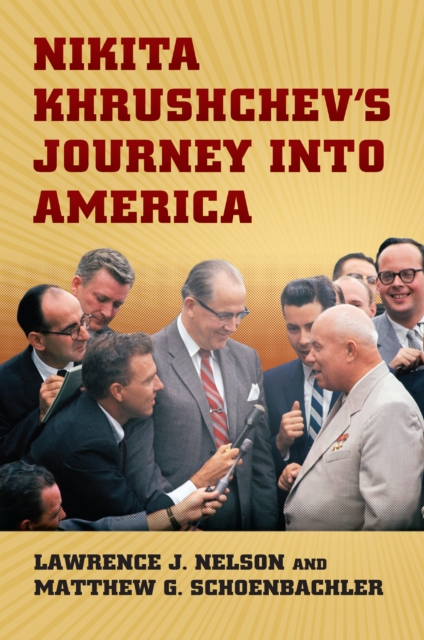
Nikita Khrushchev's Journey into America
When Nikita Khrushchev toured America in 1959-the first Russian
leader ever to set foot in the Western Hemisphere, let alone the
United States-the country was enjoying a period of unprecedented
prosperity, just as the Cold War and the possibility of
thermonuclear annihilation were causing widespread, bone-deep dread
throughout the land. This book for the first time fully explores
Khrushchev's journey as a reflection of a critical moment in US
life. Deeply researched and deftly written, Nikita Khrushchev's
Journey into America captures that moment in all its
complexity and implications, describing not only the Russian
leader's occasionally surreal itinerary (a tantrum at being denied
entry into Disneyland, for instance, or a near-riot upon wandering
into a grocery store in San Francisco) but also the tenor of the
crowds and the country along the way. Following Khrushchev from his
arrival in the nation's capital to the eerily silent greeting of
hundreds of thousands of spectators to his tickling of pigs,
kissing of babies, and glad-handing of union workers and farm
laborers in rural Iowa to his encounter with President Dwight
Eisenhower, Nelson and Schoenbachler's work offers glimpses of the
clash between a true believer in the Soviet system and the icons of
capitalism and visions of prosperity he repeatedly confronted on
his trip. At the same time the book shows us the American people of
the time coming to terms with who they were even as they confronted
the embodiment of everything they believed they weren't: atheistic,
socialist, and ideological. As the narrative unfolds, Khrushchev's
visit can be understood as easily the most democratic event of the
Cold War, one that laid bare the depth of ideological commitments
on both sides of the geopolitical divide as well as the key role of
religion in shaping Americans' reactions to the Soviet leader and
to the Cold War itself.
eBook