
Catalogue Search | MBRL


Are you sure you want to remove the book from the shelf?

{{itemTitle}}
16
result(s) for
"United States-Politics and government-1977-1981"
Sort by:

Right star rising : a new politics, 1974-1980
Tells the history of the Ford-Carter years, discusses the relevance of the period's politics on today's issues, and explains its shaping of the current political environment.
Book

Meltdown Expected
In January 1978, President Jimmy Carter proclaimed that \"There is all across our land a growing sense of peace and a sense of common purpose.\" Yet in the ensuing months, a series of crises disturbed that fragile sense of peace, ultimately setting the stage for Reagan's decisive victory in 1980 and ushering in the final phase of the Cold War..
eBook

Redeemer : the life of Jimmy Carter
Discusses how the progressive principles of a born-again Evangelical Christian peanut farmer, which included racial justice, women's rights, and concern for the plight of the poor, won the presidency in 1976.
Book

The White House Vice Presidency
\"I am nothing, but I may be everything,\" John Adams, the first vice president, wrote of his office. And for most of American history, the \"nothing\" part of Adams's formulation accurately captured the importance of the vice presidency, at least as long as the president had a heartbeat. But a job that once was \"not worth a bucket of warm spit,\" according to John Nance Garner, became, in the hands of the most recent vice presidents, critical to the governing of the country on an ongoing basis. It is this dramatic development of the nation's second office that Joel K. Goldstein traces and explains inThe White House Vice Presidency.The rise of the vice presidency took a sharp upward trajectory with the vice presidency of Walter Mondale. In Goldstein's work we see how Mondale and Jimmy Carter designed and implemented a new model of the office that allowed the vice president to become a close presidential adviser and representative on missions that mattered. Goldstein takes us through the vice presidents from Mondale to Joe Biden, presenting the arrangements each had with his respective president, showing elements of continuity but also variations in the office, and describing the challenges each faced and the work each did. The book also examines the vice-presidential selection process and campaigns since 1976, and shows how those activities affect and/or are affected by the newly developed White House vice presidency.The book presents a comprehensive account of the vice presidency as the office has developed from Mondale to Biden. ButThe White House Vice Presidencyis more than that; it also shows how a constitutional office can evolve through the repetition of accumulated precedents and demonstrates the critical role of political leadership in institutional development. In doing so, the book offers lessons that go far beyond the nation's second office, important as it now has become.
eBook

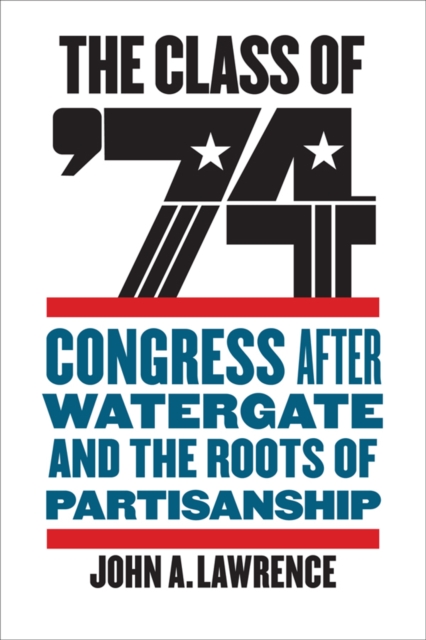
The class of '74 : Congress after Watergate and the roots of partisanship
A thought-provoking look at the game-changing congressional Class of 1974. In November 1974, following the historic Watergate scandal, Americans went to the polls determined to cleanse American politics. Instead of producing the Republican majority foreshadowed by Richard Nixon's 1972 landslide, dozens of GOP legislators were swept out of the House, replaced by 76 reforming Democratic freshmen. In The Class of '74, John A. Lawrence examines how these newly elected representatives bucked the status quo in Washington, helping to effectuate unprecedented reforms. Lawrence's long-standing work in Congress afforded him unique access to former members, staff, House officers, journalists, and others, enabling him to challenge the time-honored reputation of the Class as idealistic, narcissistic, and naïve \"Watergate Babies.\" Their observations help reshape our understanding of the Class and of a changing Congress through frank, humorous, and insightful opinions. These reformers provided the votes to disseminate power, elevate suppressed issues, and expand participation by junior legislators in congressional deliberations. But even as such innovations empowered progressive Democrats, the greater openness they created, combined with changing undercurrents in American politics in the mid-1970s, facilitated increasingly bitter battles between liberals and conservatives. These disputes foreshadowed contemporary legislative gridlock and a divided Congress. Today, many observers point to gerrymandering, special-interest money, and a host of other developments to explain the current dysfunction of American politics. In The Class of '74, Lawrence argues that these explanations fail to recognize deep roots of partisanship. To fully understand the highly polarized political environment that now pervades the House and American politics, we must examine the complex politics, including a more open and contentious House, that emerged in the wake of Watergate.
eBook


Radiation nation : Three Mile Island and the political transformation of the 1970s
On March 28, 1979, the worst nuclear reactor accident in U.S. history occurred at the Three Mile Island power plant. Radiation Nation uses the accident to explore the late 1970s as a turning point, focusing on how women crafted a homegrown ecological politics and a new body-centered nationalism. The first cultural history of the accident, Radiation Nation reveals the surprising ecological dimensions of post-Vietnam conservatism while showing how growing anxieties surrounding bodily illness infused the political realignment of the 1970s in ways that blurred any easy distinction between left and right.
eBook

The 1970s : a new global history from civil rights to economic inequality
This title looks at an iconic decade when the cultural left and economic right came to the fore in American society and the world at large. The author creates a framework for understanding the 1970s and its legacy.
Book

Reagan rising : the decisive years, 1976-1980
\"In 1976, when Ronald Reagan lost his second bid for the GOP presidential nomination (the first was in 1968), most observers believed his political career was over. Yet one year later, at the annual Conservative Political Action Conference, Reagan sounded like a new man. He introduced conservatives to a \"New Republican Party\"--one that looked beyond the traditional country club and corporate boardroom base to embrace \"the man and woman in the factories ... the farmer ... the cop on the beat. Reagan's movement quickly spread ... [and] Reagan also began drawing young people to American conservatism. But it was not only the former governor's political philosophy that was changing. A new man was emerging as well: the angry anticommunist was evolving into a more reflective, thoughtful, hopeful, and more spiritual leader. Championing the individual at home, rejecting containment and detente abroad, and advocating for the defeat of Soviet communism, his appeal crossed party lines\"-- Provided by publisher.
Book