
Catalogue Search | MBRL


Are you sure you want to remove the book from the shelf?

{{itemTitle}}
95
result(s) for
"United States-Race relations-History-19th century"
Sort by:

The Chinese must go : violence, exclusion, and the making of the alien in America
\"In 1882, the United States launched an unprecedented experiment in federal border control--which promptly failed. The Chinese Must Go examines this formative moment when America's lackluster attempt to bar Chinese workers provoked a wave of anti-Chinese violence across the U.S. West. In 1885 and 1886, white vigilantes in over 150 communities used intimidation, harassment, bombs, arson, assault, and murder to drive out their Chinese neighbors. This little-known outbreak of racial violence had profound consequences. Displacing tens of thousands of Chinese immigrants, the expulsions reshaped America's racial geography. In response, the federal government not only overhauled U.S. immigration law, but also transformed its diplomatic relations with China. The Chinese Must Go recasts the history of Chinese exclusion and its importance for modern America.\"--Publisher's description.
Book

The Life of Sherman Coolidge, Arapaho Activist
This is the biography of Sherman Coolidge, Arapaho survivor of the Indian Wars, witness to the maladministration of the reservation system, mediator between Native and white worlds, and ultimate defender of Native rights and heritage.
eBook


The False Cause
The Lost Cause ideology that emerged after the Civil War and flourished in the early twentieth century sought to recast a struggle to perpetuate a slaveholding culture as a heroic defense of the South. As Adam Domby reveals in his new book, this was not only an insidious goal; it was founded on falsehoods. The False Cause focuses on North Carolina to examine the role of lies and exaggeration in the creation of the Lost Cause narrative. In the process the book shows how these lies have long obscured the past and been used to buttress white supremacy in ways that resonate to this day.Domby explores how fabricated narratives about the war's cause, Reconstruction, and slavery-as expounded at monument dedications and political rallies-were crucial to Jim Crow. He questions the persistent myth of the Confederacy as one of history's greatest armies, revealing a convenient disregard of deserters, dissent, and Unionism, and exposes how pension fraud facilitated a myth of unwavering support of the Confederacy among nearly all white Southerners. Domby shows how the dubious concept of \"black Confederates\" was spun from a small number of elderly and indigent African American North Carolinians who got pensions by presenting themselves as \"loyal slaves.\" The book concludes with a penetrating examination of how the Lost Cause narrative and the lies on which it is based continue to haunt the country today and still work to maintain racial inequality.
eBook


Artistic Liberties
A landmark study of the illustrations that originally
accompanied now-classic works of American literary
realism Though today we commonly read major works
of nineteenth-century American literature in unillustrated
paperbacks or anthologies, many of them first appeared as
magazine serials, accompanied by ample illustrations that
sometimes made their way into the serials’ first printings
as books. The graphic artists creating these illustrations often
visually addressed questions that the authors had left for the
reader to interpret, such as the complexions of racially
ambiguous characters in
Uncle Tom’s Cabin . The artists created
illustrations that depicted what outsiders saw in Huck and Jim in
Adventures of Huckleberry Finn , rather than what Huck
and Jim learned to see in one another. These artists even worked
against the texts on occasion—for instance, when the
illustrators reinforced the same racial stereotypes that writers
such as Paul Laurence Dunbar had intended to subvert in their
works. Authors of American realism commonly submitted their
writing to editors who allowed them little control over the
aesthetic appearance of their work. In his groundbreaking
Artistic Liberties , Adam Sonstegard studies the
illustrations from these works in detail and finds that the
editors employed illustrators who were often unfamiliar with the
authors’ intentions and who themselves selected the
literary material they wished to illustrate, thereby taking
artistic liberties through the tableaux they created. Sonstegard
examines the key role that the appointed artists played in
visually shaping narratives—among them Mark Twain’s
Pudd’nhead Wilson , Stephen Crane’s
The Monster , and Edith Wharton’s
The House of Mirth —as audiences tended to accept
their illustrations as guidelines for understanding the texts. In
viewing these works as originally published, received, and
interpreted, Sonstegard offers a deeper knowledge not only of the
works, but also of the realities surrounding publication during
this formative period in American literature.
eBook

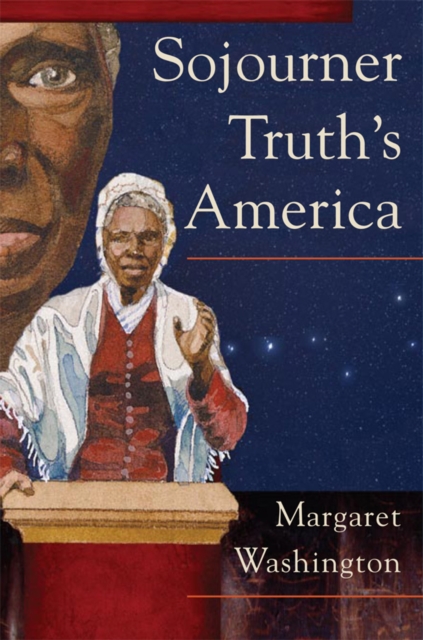
Sojourner Truth's America
This fascinating biography tells the story of nineteenth-century America through the life of one of its most charismatic and influential characters: Sojourner Truth. In an in-depth account of this amazing activist, Margaret Washington unravels Sojourner Truth's world within the broader panorama of African American slavery and the nation's most significant reform era. _x000B__x000B_Born into bondage among the Hudson Valley Dutch in Ulster County, New York, Isabella was sold several times, married, and bore five children before fleeing in 1826 with her infant daughter one year before New York slavery was abolished. In 1829, she moved to New York City, where she worked as a domestic, preached, joined a religious commune, and then in 1843 had an epiphany. Changing her name to Sojourner Truth, she began traveling the country as a champion of the downtrodden and a spokeswoman for equality by promoting Christianity, abolitionism, and women's rights._x000B__x000B_Gifted in verbal eloquence, wit, and biblical knowledge, Sojourner Truth possessed an earthy, imaginative, homespun personality that won her many friends and admirers and made her one of the most popular and quoted reformers of her times. Washington's biography of this remarkable figure considers many facets of Sojourner Truth's life to explain how she became one of the greatest activists in American history, including her African and Dutch religious heritage; her experiences of slavery within contexts of labor, domesticity, and patriarchy; and her profoundly personal sense of justice and intuitive integrity._x000B__x000B_Organized chronologically into three distinct eras of Truth's life, Sojourner Truth's America examines the complex dynamics of her times, beginning with the transnational contours of her spirituality and early life as Isabella and her embroilments in legal controversy. Truth's awakening during nineteenth-century America's progressive surge then propelled her ascendancy as a rousing preacher and political orator despite her inability to read and write. Throughout the book, Washington explores Truth's passionate commitment to family and community, including her vision for a beloved community that extended beyond race, gender, and socioeconomic condition and embraced a common humanity. For Sojourner Truth, the significant model for such communalism was a primitive, prophetic Christianity._x000B__x000B_Illustrated with dozens of images of Truth and her contemporaries, Sojourner Truth's America draws a delicate and compelling balance between Sojourner Truth's personal motivations and the influences of her historical context. Washington provides important insights into the turbulent cultural and political climate of the age while also separating the many myths from the facts concerning this legendary American figure.
eBook


Seeing Red
Against long odds, the Anishinaabeg resisted removal, retaining
thousands of acres of their homeland in what is now Michigan,
Wisconsin, and Minnesota. Their success rested partly on their
roles as sellers of natural resources and buyers of trade goods,
which made them key players in the political economy of plunder
that drove white settlement and U.S. development in the Old
Northwest. But, as Michael Witgen demonstrates, the credit for
Native persistence rested with the Anishinaabeg themselves.
Outnumbering white settlers well into the nineteenth century, they
leveraged their political savvy to advance a dual citizenship that
enabled mixed-race tribal members to lay claim to a place in U.S.
civil society. Telling the stories of mixed-race traders and
missionaries, tribal leaders and territorial governors, Witgen
challenges our assumptions about the inevitability of U.S.
expansion. Deeply researched and passionately written, Seeing
Red will command attention from readers who are invested in
the enduring issues of equality, equity, and national belonging at
its core.
eBook