
Catalogue Search | MBRL


Are you sure you want to remove the book from the shelf?

{{itemTitle}}
3,927
result(s) for
"United States. Congress. House -- Elections"
Sort by:

Choosing the leader : leadership elections in the U.S. House of Representatives
How are congressional party leaders chosen? In the first comprehensive study since Robert Peabody's classic Leadership in Congress, political scientists Matthew Green and Douglas Harris draw on newly collected data about U.S. House members who have sought leadership positions from the 1960s to the present - data including whip tallies, public and private vote commitments, interviews, and media accounts - to provide new insights into how the selection process truly works. Elections for congressional party leaders are conventionally seen as a function of either legislators' ideological preferences or factors too idiosyncratic to permit systematic analysis. Analyzing six decades' worth of information, Green and Harris find evidence for a new comprehensive model of vote choice in House leadership elections that incorporates both legislators' goals and their connections with leadership candidates. This study will stand for years to come as the definitive treatment of a crucial aspects of American politics.
Book

Ambition, competition, and electoral reform
In Ambition, Competition, and Electoral Reform, Jamie L. Carson and Jason M. Roberts present an original study of U.S. congressional elections and electoral institutions for 1872-1944 from a contemporary political science perspective. Using data on late nineteenth and early twentieth century congressional elections, the authors test the applicability in a historical context of modern political science theories, assess the effects of institutional reforms, and identify the factors that shape the competitiveness of elections. They present several key findings: the strategic politicians theory is applicable in an era without candidate-centered campaigns; there was an incumbency advantage prior to the full development of candidate-centered campaigns; institutional reforms have had a significant effect on elections; and the degree of electoral competition frequently correlates with elected officials' responsiveness to citizens.
eBook


Money in the House
Money in the House provides a compelling look at how the drive to raise campaign money has come to dominate congressional party politics. Author Marian Currinder examines the rise of member-to-member and member-to-party giving as part of a broader process that encourages ambitious House members to compete for power by raising money for the party and its candidates. As the margin between parties in the House has narrowed, the political environment has become fiercely competitive. Because electoral success is largely equated with fundraising success, the party that raises the most money is at a distinct advantage. In addition to relying on outside interests and individuals for campaign contributions, the congressional parties increasingly call on their own members to give for the good of the whole. As a result, lawmakers must devote ever-increasing amounts of time to fundraising. The fundraising expectations for members who wish to advance in the chamber are even higher. By requiring their members to raise and redistribute tremendous amounts of money in order to gain power in the chamber, the parties benefit from their members? ambitious pursuits. Currinder argues that the new `rule of money? is fundamentally altering the way House members pursue power and the way congressional parties define and reward loyalty.Contents1. Introduction: Redistributing Campaign Funds and Congressional Party Politics 2. Pursuing Ambition in a Parties Framework 3. The 1970s Reform Era: The Money Chase Begins 4. The 1980s: New Directions in Campaign Funding 5. A Republican Revolution in Politics and Money 6. Redistributing Campaign Money in a New Era
eBook


The Battle for Congress: Consultants, Candidates, and Voters
This volume provides an in-depth examination of six political campaigns waged during competitive 1998 races for the U.S. House of Representatives. The case studies evaluate the professional political consultants who managed each campaign, their interaction with the candidates, and the impact of the campaigns on voters. Relying on unparalleled access to both the consultants involved and the candidates themselves, the contributors explore the electoral setting and context of the congressional districts, the strategy, theme, and message of each campaign, the consultants' decisionmaking, fund-raising, and spending, and any outside forces that entered into the races. The book features new data on tracking, polls, and television advertising budgets.
eBook
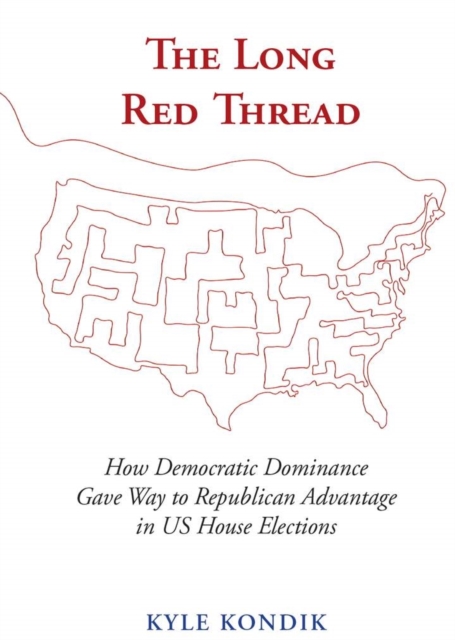
The Long Red Thread
An incisive study that shows how Republicans transformed the US House of Representatives into a consistent GOP stronghold—with or without a majority.
Long-term Democratic dominance in the US House of Representatives gave way to a Republican electoral advantage and frequently held majority following the GOP takeover in 1994. Republicans haven't always held the majority in recent decades, but nationalization, partisan realignment, and the gerrymandering of House seats have contributed to a political climate in which they've had an edge more often than not for nearly thirty years.
The Long Red Thread examines each House election cycle from 1964 to 2020, surveying academic and journalistic literature to identify key trends and takeaways from more than a half-century of US House election results in order to predict what Americans can expect to see in the future.
eBook
The political battle over congressional redistricting
John Engler, former Governor of Michigan, once claimed that redistricting is one of the purest actions a legislative body can take. Academicians and political leaders alike, however, have regularly debated the ideal way by to redistrict national and state legislatures. Rather than being the pure process that Governor Engler envisioned, redistricting has led to repeated court battles waged on such traditional democratic values as one person, one vote, and minority rights. Instead of being an opportunity to help ensure maximum representation for the citizens, the process has become a cat and mouse game in many states with citizen representation seemingly the farthest idea from anyone’s mind. From a purely political perspective, those in power in the state legislature at the time of redistricting largely act like they have unilateral authority to do as they please. In this volume, contributors discuss why such an assumption is concerning in the modern political environment.
eBook

A woman's place is in the House
In this first comprehensive examination of women candidates for the U.S. House of Representatives, Barbara Burrell argues that women are as successful at winning elections as men. Why, then, are there still so few women members of Congress? Compared to other democratically elected national parliaments, the U.S. Congress ranks very low in its proportion of women members. During the past decade, even though more and more women have participated in state and local governments, they have not made the same gains at the national level. A Woman's Place Is in the House examines the experiences of the women who have run for a seat in the U.S. House of Representatives from 1968 through 1992 and compares their presence and performance with that of male candidates. The longitudinal study examines both general and primary elections and refutes many myths associated with women candidates including their ability to raise money and garner support from both interest groups and political parties. According to Burrell, election year 1992 was correctly dubbed the \"Year of the Woman\" in American politics—not so much because women overcame perceived barriers to being elected but because for the first time a significant number of women chose to run in primaries. Burrell's study examines the effects women are having on the congressional agenda and offers insight on how such issues as term limitations and campaign finance reform will impact on the election of women to Congress.
eBook
Reapportionment and redistricting in the West
In Reapportionment and Redistricting in the West, Gary F. Moncrief brings together some of the best-known scholars in American state and electoral politics to explore the unique processes and problems of redistricting in the western United States. These political scientists examine the specific challenges facing western states in ensuring fair and balanced political representation. Western states tend to be geographically large and experiencing rapid population growth and the chapters in this enlightening volume discuss the changing demographics in western states, paying special attention to the rise in the Latino population and the effect this has had on reapportionment and redistricting. They describe the ways in which some of these states achieve redistricting through independent redistricting commissions—a process rarely found in other regions—and they provide policy prescriptions for the future.
eBook