
Catalogue Search | MBRL


Are you sure you want to remove the book from the shelf?

{{itemTitle}}
92
result(s) for
"United States. Continental Army Military life."
Sort by:

Washington at Valley Forge
Washington's army nearly perished during the winter of 1777-78. Camped at Valley Forge, the revolutionaries endured severe hardship. The army's supply system had collapsed and they were without supplies. But when the harsh winter ended, the soldiers had survived, and marched away from Valley Forge more determined than ever.
BOOK

George Washington's enforcers : policing the Continental Army
A well-disciplined army was vital to win American independence, but policing soldiers during the Revolution presented challenges.George Washington's Enforcers: Policing the Continental Army examines how justice was left to the overlapping duties of special army personnel and how an improvised police force imposed rules and regulations.
eBook

Becoming men of some consequence : youth and military service in the Revolutionary War
\"This book examines young Revolutionary War soldiers' and officers' changing motivations and expectations in relation to their enlistments, experiences in the army, choices about quitting long-term military service, and their attempts to rejoin civilian life after the war\"--Provided by publisher.
Book

Almost a miracle : the American victory in the War of Independence
In this gripping chronicle of America's struggle for independence, award-winning historian John Ferling transports readers to the grim realities of that war, capturing an eight-year conflict filled with heroism, suffering, cowardice, betrayal, and fierce dedication. As Ferling demonstrates, it was a war that America came much closer to losing than is now usually remembered. General George Washington put it best when he said that the American victory was \"little short of a standing miracle.\" Almost a Miracle offers an illuminating portrait of America's triumph, offering vivid descriptions of all the major engagements, from the first shots fired on Lexington Green to the surrender of General Cornwallis at Yorktown, revealing how these battles often hinged on intangibles such as leadership under fire, heroism, good fortune, blunders, tenacity, and surprise. The author paints sharp-eyed portraits of the key figures in the war, including General Washington and other American officers and civilian leaders. Some do not always measure up to their iconic reputations, including Washington himself. Others, such as the quirky, acerbic Charles Lee, are seen in a much better light than usual. The book also examines the many faceless men who soldiered, often for years on end, braving untold dangers and enduring abounding miseries. The author explains why they served and sacrificed, and sees them as the forgotten heroes who won American independence. Ferling's narrative is also filled with compassion for the men who comprised the British army and who, like their American counterparts, struggled and died at an astonishing rate in this harsh war. Nor does Ferling ignore the naval war, describing dangerous patrols and grand and dazzling naval actions. Finally, Almost a Miracle takes readers inside the legislative chambers and plush offices of diplomats to reveal countless decisions that altered the course of this war. The story that unfolds is at times a tale of folly, at times one of appalling misinformation and confusion, and now and then one of insightful and dauntless statesmanship.
eBook

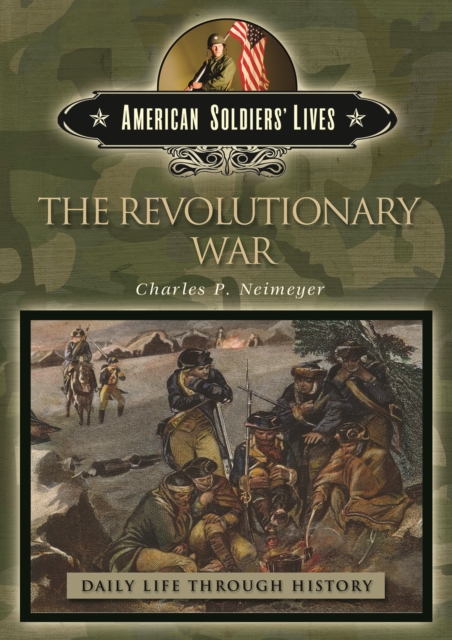
The Revolutionary War
American soldiers eventually make King George say uncle in spite of profound hardships and deprivation. Nearly everyone in the U.S. has studied the Revolutionary War. Too often, however, historians of the Revolution focus on the activity of the army without noticing what was taking place inside the army. Making liberal use of diaries and correspondence by the soldiers and their families, Charles P. Neimeyer tells the stories of the men and women who fought for the young country's independence. Sometimes starting off as rag-tag groups of men shooting off their muskets at geese just for the thrill of the sound, the soldiers became more disciplined and focused. The army recruited a significant number of African American soldiers, who fought side by side with whites. Women also fought and served in the army, either masquerading as male soldiers or providing support for army operations in camp and on the march. Suffering through times of numbing cold and starvation where men boiled their shoes for food, the sheer perseverance of the soldiers in the ranks ultimately won the war for independence. Presenting stories from letters and diaries of the men and women of the time, this volume reveals the stories of fear, exhaustion, hard work, grief, and exhilaration of the people in the camps and on the march. Highlights include: ; Recruitment, which included just about any healthy man willing to serve, including immigrants and enemy POWs ; General Washington's attempts to create a model, respectable army ; Attempts at medical treatment, and the ravages of smallpox, which left men dying at makeshift hospitals ; African American soldiers in the War ; Women's contributions to war efforts, whether in disguise as soldiers, or in filling in for husbands killed in battle ; Daily life in the camp: the monotony, the lack of food and supplies, drinking, sleeping in huts and out in the open, games, letter writing and religious observations ; The failure to fairly pay the soldiers as they mustered out of service The book also includes a timeline that puts dates and events in better perspective; a comprehensive, topically arranged bibliography; and a thorough index.
eBook

Incidence Rates of Tinnitus in Active Duty Military Service Members Between 2001 and 2015
Purpose Due to hazards in the contemporary operating environment, U.S. military service members are at increased risk for tinnitus. Previous research has characterized tinnitus prevalence in military veterans, but no population-based study of tinnitus has been conducted in active duty military service members. This study evaluated the incidence of tinnitus diagnoses in military electronic health records based on International Classification of Diseases, 9th Revision (ICD-9) codes for active duty service members between 2001 and 2015. Method Data on 85,438 active duty military service members who served between 2001 and 2015 were drawn from the Defense Medical Epidemiological Database and stratified by race, age, sex, marital status, service branch, and military pay grade. Results The incidence rate of tinnitus in U.S. military service members (per 1,000) rose consistently from 1.84 in 2001 to 6.33 in 2015. Service members most often diagnosed with tinnitus were White (72%), married (72%), males (88%), in the enlisted pay grade of E-5 to E-9 (55%), in the Army (37%), and were 35 years of age or older (50%). Statistically significant differences (
< .001) were found between observed and expected counts across all 6 demographic variables. Conclusions This is the first study to assess the incidence rates of tinnitus in active duty service members. Although there are many risk factors for auditory damage in the contemporary military operating environment, the extant literature on tinnitus in active duty military service members is limited. Future studies should consider the relationship between tinnitus-related psychological comorbidity and objective health-related quality of life, as it impacts operational readiness in active duty military service members.
Journal Article

Family Characteristics Associated With Child Maltreatment Across the Deployment Cycle of U.S. Army Soldiers
Soldier deployment can create a stressful environment for U.S. Army families with young children. Prior research has identified elevated rates of child maltreatment in the 6 months immediately following a soldier's return home from deployment. In this study, we longitudinally examine how other child- and family-level characteristics influence the relationship of deployment to risk for maltreatment of dependent children of U.S. Army soldiers.
We conducted a person-time analysis of substantiated reports and medical diagnoses of maltreatment among the 73,404 children of 56,087 U.S. Army soldiers with a single deployment between 2001 and 2007. Cox proportional hazard models estimated hazard rates of maltreatment across deployment periods and simultaneously considered main effects for other child- and family-level characteristics across periods.
In adjusted models, maltreatment hazard was highest in the 6 months following deployment (hazard ratio [HR] = 1.63, p < 0.001). Children born prematurely or with early special needs independently had an increased risk for maltreatment across all periods (HR = 2.02, p < 0.001), as well as those children whose soldier-parent had been previously diagnosed with a mental illness (HR = 1.68, p < 0.001). In models testing for effect modification, during the 6 months before deployment, children of female soldiers (HR = 2.22, p = 0.006) as well as children of soldiers with a mental health diagnosis (HR = 2.78, p = 0.001) were more likely to experience maltreatment, exceeding the risk at all other periods.
Infants and children are at increased risk for maltreatment in the 6 months following a parent's deployment, even after accounting for other known family- and child-level risk factors. However, the risk does not appear to be the same for all soldiers and their families in relation to deployment, particularly for female soldiers and those who had previously diagnosed mental health issues, for whom the risk appears most elevated before deployment. Accounting for the unique needs of high-risk families at different stages of a soldier's deployment cycle may allow the U.S. Army to better direct resources that prevent and address child maltreatment.
Journal Article
Factors Associated With Psychiatric Evacuation Among Service Members Deployed to Operation Enduring Freedom and Operation Iraqi Freedom, January 2004 to September 2010
To calculate the annual rate of psychiatric evacuation of U.S. Service members out of Iraq and Afghanistan and identify risk factors for evacuation.
Descriptive and regression analyses were performed using deployment records for Service members evacuated from January 2004 through September 2010 with a psychiatric diagnosis, and a 20% random sample of all other deployers (N = 364,047).
A total of 5,887 deployers psychiatrically evacuated, 3,951 (67%) of which evacuated on first deployment. The rate increased from 72.9 per 100,000 in 2004 to 196.9 per 100,000 in 2010. Evacuees were overrepresented in both combat and supporting duty assignments. In multivariate analysis, Army active duty had the highest odds of evacuation relative to Army National Guard (adjusted odds ratio [AOR] 0.852, 95% confidence interval [CI] 0.790-0.919), Army Reserve (AOR 0.825, 95% CI 0.740-0.919), and all other components. Accessions in 2005 had the highest risk (AOR 1.923, 95% CI 1.621-2.006) relative to pre-2001 accessions.
Risk for psychiatric evacuation is highest among the Army Active Component. A strong link between multiple deployments or combat-related exposure and psychiatric evacuation is not apparent. Increased risk among post-2001 accessions suggests further review of changes in recruitment, training, and deployment policies and practices.
Journal Article

Psychiatry and Race during World War II
Although the American literature on “war neuroses” expanded during World War II, psychiatrists remained more interested in dramatic instances of “combat fatigue” than in the problems of soldiers who broke down far from the field of battle. This bias in the medical literature shaped both diagnosis and treatment. It had an especially powerful effect on African American soldiers who, in the “Jim Crow” army of World War II, were assigned in disproportionate numbers to service units. When military neuropsychiatrists did write about troubled young African Americans, many revealed a racial conservatism that was surprising given the liberal environmentalist paradigm of the day. (Here, a particularly useful source is the two-volume history of Neuropsychiatry in World War II, produced by the Medical Department of the U.S. Army.) The major challenge to such views came from the National Medical Association (NMA). Despite its many criticisms of military medicine, the NMA argued that African American soldiers and veterans needed more, not fewer, psychiatric services. NMA members also joined their white counterparts in the campaign to diminish the stigma of mental illness, especially among the families of soldiers returning home. We need more investigation of the subsequent history of race and psychiatry, especially within the Veterans Administration.
Journal Article