
Catalogue Search | MBRL


Are you sure you want to remove the book from the shelf?

{{itemTitle}}
427
result(s) for
"United States. President (1861-1865 : Lincoln)."
Sort by:

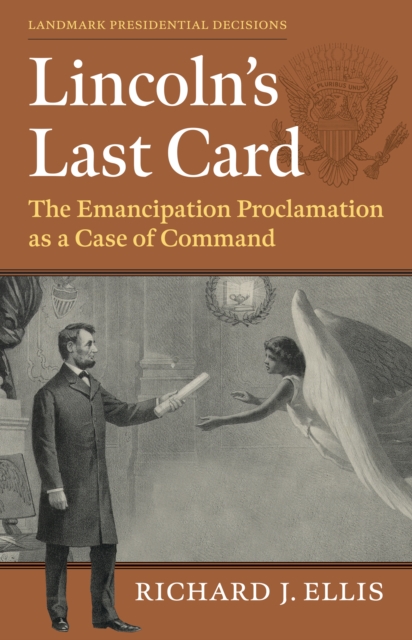
Lincoln's Last Card
A fresh reassessment of the Emancipation Proclamation that
looks beyond the Lincoln mythos and sees the decision as
Lincoln’s last resort after his failure to persuade a
divided country.
There is a certain comfort in being able to see
Lincoln—or any president—simply as either a hero or
a villain. The truth, however, is more complicated.
Lincoln’s Last Card helps us look beyond the
myths to see Lincoln as the flawed and consequential leader
that he was.
Few presidential edicts are more famous or misunderstood
than the Emancipation Proclamation. The traditional myth about
the proclamation is that President Lincoln freed the slaves
with a bold stroke of his pen. This popular understanding
deifies Lincoln as the sagacious Great Emancipator and
constructs a narrative of American history centered around the
heroic deeds of our “great” presidents. A more
cynical view, bolstered by recent historical examinations of
Lincoln’s own racial biases, says the proclamation was
much ado about nothing; a largely hollow gesture that freed no
slaves at all and lacked even a moral indictment of slavery.
Both views, however, see presidential power as largely
unrestricted and unilateral, so that Lincoln’s decisions
occur in a virtual vacuum—a timeless display of his moral
virtue, or lack thereof.
Richard Ellis, a veteran scholar of the American presidency,
suggests that we look at Lincoln’s proclamation through
the lens of presidential weakness rather than greatness. To do
so, Ellis draws on the work of renowned political scientist
Richard Neustadt, who explored “three cases of
command” from the twentieth century in his 1960 work,
Presidential Power . Where the public saw presidential
success, Neustadt saw presidents engaged in “a painful
last resort,” suggesting not political mastery but rather
the failure to achieve goals through other means. Ellis applies
this same perspective to the Emancipation Proclamation, showing
how Lincoln’s great success was, in fact, his last card.
Lincoln’s original hope was to persuade the border states
to endorse his plan for gradual, compensated abolition,
preferably coupled with some level of voluntary colonization.
Contrary to conventional wisdom and in contrast to
Lincoln’s reputation as the greatest presidential orator,
Ellis shows how the Emancipation Proclamation was a sign of
Lincoln’s failure to persuade.
eBook

Emancipating Lincoln : the proclamation in text, context, and memory
Emancipating Lincoln seeks a new approach to the Emancipation Proclamation, a foundational text of American liberty that in recent years has been subject to woeful misinterpretation. These seventeen hundred words are Lincoln's most important piece of writing, responsible both for his being hailed as the Great Emancipator and for his being pilloried by those who consider his once-radical effort at emancipation insufficient and half-hearted. Harold Holzer, an award-winning Lincoln scholar, invites us to examine the impact of Lincoln's momentous announcement at the moment of its creation, and then as its meaning has changed over time. Using neglected original sources, Holzer uncovers Lincoln's very modern manipulation of the media-from his promulgation of disinformation to the ways he variously withheld, leaked, and promoted the Proclamation- in order to make his society-altering announcement palatable to America. Examining his agonizing revisions, we learn why a peerless prose writer executed what he regarded as his 'greatest act' in leaden language. Turning from word to image, we see the complex responses in American sculpture, painting, and illustration across the past century and a half, as artists sought to criticize, lionize, and profit from Lincoln's endeavor. Holzer shows the faults in applying our own standards to Lincoln's efforts, but also demonstrates how Lincoln's obfuscations made it nearly impossible to discern his true motives. As we approach the 150th anniversary of the Proclamation, this concise volume is a vivid depiction of the painfully slow march of all Americans-white and black, leaders and constituents-toward freedom. -- Publisher description
Book

Act of Justice
In his first inaugural address, Abraham Lincoln declared that as president he would \"have no lawful right\" to interfere with the institution of slavery. Yet less than two years later, he issued a proclamation intended to free all slaves throughout the Confederate states. When critics challenged the constitutional soundness of the act, Lincoln pointed to the international laws and usages of war as the legal basis for his Proclamation, asserting that the Constitution invested the president \"with the law of war in time of war.\" As the Civil War intensified, the Lincoln administration slowly and reluctantly accorded full belligerent rights to the Confederacy under the law of war. This included designating a prisoner of war status for captives, honoring flags of truce, and negotiating formal agreements for the exchange of prisoners -- practices that laid the intellectual foundations for emancipation. Once the United States allowed Confederates all the privileges of belligerents under international law, it followed that they should also suffer the disadvantages, including trial by military courts, seizure of property, and eventually the emancipation of slaves. Even after the Lincoln administration decided to apply the law of war, it was unclear whether state and federal courts would agree. After careful analysis, author Burrus M. Carnahan concludes that if the courts had decided that the proclamation was not justified, the result would have been the personal legal liability of thousands of Union officers to aggrieved slave owners. This argument offers further support to the notion that Lincoln's delay in issuing the Emancipation Proclamation was an exercise of political prudence, not a personal reluctance to free the slaves. In Act of Justice, Carnahan contends that Lincoln was no reluctant emancipator; he wrote a truly radical document that treated Confederate slaves as an oppressed people rather than merely as enemy property. In this respect, Lincoln's proclamation anticipated the psychological warfare tactics of the twentieth and twenty-first centuries. Carnahan's exploration of the president's war powers illuminates the origins of early debates about war powers and the Constitution and their link to international law.
eBook

The long road to Antietam : how the Civil War became a revolution
In the summer of 1862, after a year of protracted fighting, Abraham Lincoln decided on a radical change of strategy, one that abandoned hope for a compromise peace and committed the nation to all-out war. The centerpiece of that new strategy was the Emancipation Proclamation: an unprecedented use of federal power that would revolutionize Southern society.
BOOK
Final Freedom
This book examines emancipation after the Emancipation Proclamation of 1863. Focusing on the making and meaning of the Thirteenth Amendment, Final Freedom looks at the struggle among legal thinkers, politicians, and ordinary Americans in the North and the border states to find a way to abolish slavery that would overcome the inadequacies of the Emancipation Proclamation. The book tells the dramatic story of the creation of a constitutional amendment and reveals an unprecedented transformation in American race relations, politics, and constitutional thought. Using a wide array of archival and published sources, Professor Vorenberg argues that the crucial consideration of emancipation occurred after, not before, the Emancipation Proclamation; that the debate over final freedom was shaped by a level of volatility in party politics underestimated by prior historians; and that the abolition of slavery by constitutional amendment represented a novel method of reform that transformed attitudes toward the Constitution.
eBook


Emancipating Lincoln : the Proclamation in text, context, and memory
The Emancipation Proclamation is responsible both for Lincoln's being hailed as the Great Emancipator and for his being pilloried by those who consider his once-radical effort at emancipation insufficient. Holzer examines the impact of Lincoln's announcement at the moment of its creation, and then as its meaning has changed over time.
eBook


Lincoln and freedom : slavery, emancipation, and the Thirteenth Amendment
Lincoln’s reelection in 1864 was a pivotal moment in the history of the United States. The Emancipation Proclamation had officially gone into effect on January 1, 1863, and the proposed Thirteenth Amendment had become a campaign issue. Lincoln and Freedom: Slavery, Emancipation, and the Thirteenth Amendment captures these historic times, profiling the individuals, events, and enactments that led to slavery’s abolition. Fifteen leading Lincoln scholars contribute to this collection, covering slavery from its roots in 1619 Jamestown, through the adoption of the Constitution, to Abraham Lincoln’s presidency.              This comprehensive volume, edited by Harold Holzer and Sara Vaughn Gabbard, presents Abraham Lincoln’s response to the issue of slavery as politician, president, writer, orator, and commander-in-chief. Topics include the history of slavery in North America, the Supreme Court’s Dred Scott decision, the evolution of Lincoln’s view of presidential powers, the influence of religion on Lincoln, and the effects of the Emancipation Proclamation.              This collection effectively explores slavery as a Constitutional issue, both from the viewpoint of the original intent of the nation’s founders as they failed to deal with slavery, and as a study of the Constitutional authority of the commander-in-chief as Lincoln interpreted it. Addressed are the timing of Lincoln’s decision for emancipation and its effect on the public, the military, and the slaves themselves.              Other topics covered include the role of the U.S. Colored Troops, the election campaign of 1864, and the legislative debate over the Thirteenth Amendment. The volume concludes with a heavily illustrated essay on the role that iconography played in forming and informing public opinion about emancipation and the amendments that officially granted freedom and civil rights to African Americans.              Lincoln and Freedom provides a comprehensive political history of slavery in America and offers a rare look at how Lincoln’s views, statements, and actions played a vital role in the story of emancipation.  
eBook