
Catalogue Search | MBRL


Are you sure you want to remove the book from the shelf?

{{itemTitle}}
72
result(s) for
"United Stetes"
Sort by:

Roosevelt's Lost Alliances
In the spring of 1945, as the Allied victory in Europe was approaching, the shape of the postwar world hinged on the personal politics and flawed personalities of Roosevelt, Churchill, and Stalin. Roosevelt's Lost Alliances captures this moment and shows how FDR crafted a winning coalition by overcoming the different habits, upbringings, sympathies, and past experiences of the three leaders. In particular, Roosevelt trained his famous charm on Stalin, lavishing respect on him, salving his insecurities, and rendering him more amenable to compromise on some matters.
eBook

Ideology in America
Public opinion in the United States contains a paradox. The American public is symbolically conservative: it cherishes the symbols of conservatism and is more likely to identify as conservative than as liberal. Yet at the same time, it is operationally liberal, wanting government to do and spend more to solve a variety of social problems. This book focuses on understanding this contradiction. It argues that both facets of public opinion are real and lasting, not artifacts of the survey context or isolated to particular points in time. By exploring the ideological attitudes of the American public as a whole, and the seemingly conflicted choices of individual citizens, it explains the foundations of this paradox. The keys to understanding this large-scale contradiction, and to thinking about its consequences, are found in Americans' attitudes with respect to religion and culture and in the frames in which elite actors describe policy issues.
eBook

Contemporary financial intermediation
In Contemporary Financial Intermediation, Third Edition, Greenbaum, Thakor and Boot offer a distinctive approach to financial markets and institutions, presenting an integrated portrait that puts information at the core. Instead of simply naming and describing markets, regulations, and institutions as competing books do, the authors explore the endless subtlety and plasticity of financial institutions and credit markets. This edition has six new chapters and increased, enhanced pedagogical supplements. The book is ideal for anyone working in the financial sector, presenting professionals with a comprehensive understanding of the reasons why markets, institutions, and regulators act as they do. Readers will find an unmatched, thorough discussion of the world's financial markets and how they function.--
eBook

Journey Through America
Amerikafahrtby Wolfgang Koeppen is a masterpiece of observation, analysis, and writing, based on his 1958 trip to the United States. A major twentieth-century German writer, Koeppen presents a vivid and fascinating portrait of the US in the late 1950s: its major cities, its literary culture, its troubled race relations, its multi-culturalism and its vast loneliness, a motif drawn, in part, from Kafka'sAmerika. A modernist travelogue, the text employs symbol, myth, and image, as if Koeppen sought to answer de Tocqueville's questions in the manner of Joyce and Kafka.Journey through Americais also a meditation on America, intended for a German audience and mindful of the destiny of postwar Europe under many Americanizing influences.
eBook

Warring Friends
Allied nations often stop each other from going to war. Some
countries even form alliances with the specific intent of
restraining another power and thereby preventing war. Furthermore,
restraint often becomes an issue in existing alliances as one ally
wants to start a war, launch a military intervention, or pursue
some other risky military policy while the other ally balks. In
Warring Friends, Jeremy Pressman draws on and critiques realist,
normative, and institutionalist understandings of how alliance
decisions are made.
Alliance restraint often has a role to play both in the genesis
of alliances and in their continuation. As this book demonstrates,
an external power can apply the brakes to an incipient conflict,
and even unheeded advice can aid in clarifying national goals. The
power differentials between allies in these partnerships are
influenced by leadership unity, deception, policy substitutes, and
national security priorities.
Recent controversy over the complicated relationship between the
U.S. and Israeli governments-especially in regard to military and
security concerns-is a reminder that the alliance has never been
easy or straightforward. Pressman highlights multiple episodes
during which the United States attempted to restrain Israel's
military policies: Israeli nuclear proliferation during the Kennedy
Administration; the 1967 Arab-Israeli War; preventing an Israeli
preemptive attack in 1973; a small Israeli operation in Lebanon in
1977; the Israeli invasion of Lebanon in 1982; and Israeli action
during the Gulf War of 1991. As Pressman shows, U.S. initiatives
were successful only in 1973, 1977, and 1991, and tensions have
flared up again recently as a result of Israeli arms sales to
China.
Pressman also illuminates aspects of the Anglo-American special
relationship as revealed in several cases: British nonintervention
in Iran in 1951; U.S. nonintervention in Indochina in 1954; U.S.
commitments to Taiwan that Britain opposed, 1954-1955; and British
intervention and then withdrawal during the Suez War of 1956. These
historical examples go far to explain the context within which the
Blair administration failed to prevent the U.S. government from
pursuing war in Iraq at a time of unprecedented American power.
Allied nations often stop each other from going to war. Some
countries even form alliances with the specific intent of
restraining another power and thereby preventing war. Furthermore,
restraint often becomes an issue in existing alliances as one ally
wants to start a war, launch a military intervention, or pursue
some other risky military policy while the other ally balks. In
Warring Friends , Jeremy Pressman draws on and critiques
realist, normative, and institutionalist understandings of how
alliance decisions are made.
Alliance restraint often has a role to play both in the genesis
of alliances and in their continuation. As this book demonstrates,
an external power can apply the brakes to an incipient conflict,
and even unheeded advice can aid in clarifying national goals. The
power differentials between allies in these partnerships are
influenced by leadership unity, deception, policy substitutes, and
national security priorities. Recent controversy over the
complicated relationship between the U.S. and Israeli
governments-especially in regard to military and security
concerns-is a reminder that the alliance has never been easy or
straightforward.
Pressman highlights multiple episodes during which the United
States attempted to restrain Israel's military policies: Israeli
nuclear proliferation during the Kennedy Administration; the 1967
Arab-Israeli War; preventing an Israeli preemptive attack in 1973;
a small Israeli operation in Lebanon in 1977; the Israeli invasion
of Lebanon in 1982; and Israeli action during the Gulf War of 1991.
As Pressman shows, U.S. initiatives were successful only in 1973,
1977, and 1991, and tensions have flared up again recently as a
result of Israeli arms sales to China.
Pressman also illuminates aspects of the Anglo-American special
relationship as revealed in several cases: British nonintervention
in Iran in 1951; U.S. nonintervention in Indochina in 1954; U.S.
commitments to Taiwan that Britain opposed, 1954-1955; and British
intervention and then withdrawal during the Suez War of 1956. These
historical examples go far to explain the context within which the
Blair administration failed to prevent the U.S. government from
pursuing war in Iraq at a time of unprecedented American power.
eBook

Fugitive Texts
Antebellum slave narratives have taken pride of place in the
American literary canon. Once ignored, disparaged, or simply
forgotten, the autobiographical narratives of Frederick Douglass,
Harriet Jacobs, and other formerly enslaved men and women are now
widely read and studied. One key aspect of the genre, however, has
been left unexamined: its materiality. What did original editions
of slave narratives look like? How were these books circulated? Who
read them? In Fugitive Texts , Michaël Roy offers the first
book-length study of the slave narrative as a material artifact.
Drawing on a wide range of sources, he reconstructs the publication
histories of a number of famous and lesser-known narratives,
placing them against the changing backdrop of antebellum print
culture. Slave narratives, he shows, were produced through a
variety of print networks. Remarkably few were published under the
full control of white-led antislavery societies; most were
self-published and distributed by the authors, while some were
issued by commercial publishers who hoped to capitalize on the
success of Harriet Beecher Stowe's Uncle Tom's Cabin . The
material lives of these texts, Roy argues, did not end within the
pages. Antebellum slave narratives were \"fugitive texts\" apt to be
embodied in various written, oral, and visual forms. Published to
rave reviews in French, Fugitive Texts illuminates the
heterogeneous nature of a genre often described in monolithic terms
and ultimately paves the way for a redefinition of the literary
form we have come to recognize as \"the slave narrative.\"
eBook
US Environmental History
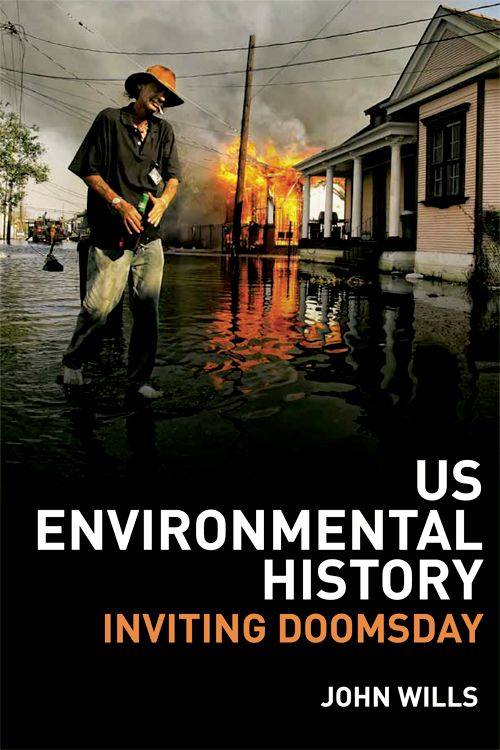
Environmental issues in the USA are more important now than ever before. The devastation inflicted by Hurricane Katrina, growing evidence of global warming, and a struggling national energy supply highlight the unfolding crisis. Environmental fears translate into US automobile giants plying consumers with 'fuel efficient' cars in the 'MPG Lounge' of sales. Politicians talk of energy independence and getting tough on polluters. Fears gravitate around a fast-approaching doomsday scenario, an environmental endgame, of wholesale collapse, unless something is done.Yet fears of doomsday are nothing
eBook

Anglicizing America
The thirteen mainland colonies of early America were arguably never more British than on the eve of their War of Independence from Britain. Though home to settlers of diverse national and cultural backgrounds, colonial America gradually became more like Britain in its political and judicial systems, material culture, economies, religious systems, and engagements with the empire. At the same time and by the same process, these politically distinct and geographically distant colonies forged a shared cultural identityone that would bind them together as a nation during the Revolution.
Anglicizing Americarevisits the theory of Anglicization, considering its application to the history of the Atlantic world, from Britain to the Caribbean to the western wildernesses, at key moments before, during, and after the American Revolution. Ten essays by senior historians trace the complex processes by which global forces, local economies, and individual motives interacted to reinforce a more centralized and unified social movement. They examine the ways English ideas about labor influenced plantation slavery, how Great Britain's imperial aspirations shaped American militarization, the influence of religious tolerance on political unity, and how Americans' relationship to Great Britain after the war impacted the early republic's naval and taxation policies. As a whole,Anglicizing Americaoffers a compelling framework for explaining the complex processes at work in the western hemisphere during the age of revolutions.
Contributors: Denver Brunsman, William Howard Carter, Ignacio Gallup-Diaz, Anthony M. Joseph, Simon P. Newman, Geoffrey Plank, Nancy L. Rhoden, Andrew Shankman, David J. Silverman, Jeremy A. Stern.
eBook

Studying diversity in teacher education
Studying Diversity in Teacher Education is a collaborative effort by experts seeking to elucidate one of the most important issues facing education today. First, the volume examines historically persistent, yet unresolved issues in teacher education and presents research that is currently being done to address these issues. Second, it centers on research on diverse populations, bringing together both research on diversity and research on diversity in teacher education. The contributors present frameworks, perspectives and paradigms that have implications for reframing research on complex issues that are often ignored or treated too simplistically in teacher education literature. Concluding the volume with an agenda for future research and a guide for preparing teachers for diversity education in a global context, the contributors provide a solid foundation for all educators. Studying Diversity in Teacher Education is a vital resource for all those interested in diversity and education research.
eBook
American autobiography
This introduction to the major forms of autobiographical writing in America and important current developments in autobiography studies discusses both 'canonised' texts and those from contemporary writers. Taking a broadly chronological approach, the history of American autobiography is explored including the social and cultural factors that might account for the importance of autobiography in American culture. Then post-1970 autobiographies are examined, taking into account the development in poststructuralism from this time that affected notions of the subject who could write, and conceptions of truth, identity and reference. Key Features * Engages in discussions about the 'Americanness' of autobiography, especially in relation to important contemporary issues such as multiculturalism and transnationalism* Acknowledges the problematic nature of the 'canon' of American autobiography* Explores the most exciting recent developments in relation to the self, writing, and autobiography (e.g. poststructuralist thought, the postmodern, the post-colonial, life-writing and genre)* Considers autobiographies from Benjamin Franklin, Frederick Douglass, Harriet Jacobs, Walt Whitman and Gertrude Stein to Maxine Hong Kingston, Lance Armstrong, Lucy Grealy and Barack Obama* Includes study of the Puritan autobiography, the slave narrative, political texts, photography in autobiography, and illness/ disability memoirs
eBook