
Catalogue Search | MBRL


Are you sure you want to remove the book from the shelf?

{{itemTitle}}
4,591
result(s) for
"University of Michigan"
Sort by:


A telescope on society : survey research and social science at the University of Michigan and beyond
A Telescope on Society seeks to convey the development of social science in the twentieth century through its interaction with a major new instrument for gathering data about society-survey research. The story of survey research and social science is largely told by social scientists affiliated with the Survey Research Center (SRC) and Institute for Social Research (IRS) at the University of Michigan about work done there. But the book also places this story in the broader context of survey-based social science in the United States and the world, to which many individuals and institutions beyond SRC, ISR, and Michigan have also contributed. The chapters of this volume illustrate the impact that developments in survey research have had and continue to have on a broad range of social science disciplines and interdisciplinary areas ranging from political behavior and electoral systems to macroeconomics and individual income dynamics, mental and physical health, human development and aging, and racial/ethnic diversity and relationships. The volume will speak to a wide audience of social science and survey research professionals and students interested in learning more about the broad history of survey-based social science and its contributions to understanding ourselves as social beings. It also seeks to convey how crucial institutional and public support are to the development of social science and survey research, as they have been to development in the natural, biomedical, and life sciences. The five editors of this book are longtime research professors and colleagues in the Survey Research Center of the Institute for Social Research at the University of Michigan. James S. House is also Professor in the Department of Sociology; F. Thomas Juster is Professor Emeritus in the Department of Economics; Robert L. Kahn is Professor Emeritus in the Department of Psychology and Department of Health Management and Policy; and Howard Schuman is Professor Emeritus in the Department of Sociology; Eleanor Singer is Research Professor in the Survey Research Center, all at the University of Michigan. Professors House (1991-2001), Kahn (1970-76), and Schuman (1982-90) have each served as Director of the Survey Research Center; Professor Juster served (1976-86) as Director of the Institute for Social Research; and Professor Singer served (1999-2002) as Associate Director of the Survey Research Center.
eBook

A setting for excellence : the story of the planning and development of the Ann Arbor campus of the University of Michigan
\"While there are times when the mix of old and new buildings and the chaotic activities of thousands of students can give a haphazard appearance to the university, campus planning has in fact become a highly refined form of architecture. This is demonstrated in a convincing fashion by this immensely informative and entertaining history of the evolution of the campuses of the University of Michigan by Fred Mayer, who served for more than three decades as the campus planner for the university during an important period of its growth during the late twentieth century. By tracing the development of the Michigan campus from its early days to the present, within the context of the evolution of higher education in America, Mayer provides a strong argument for the importance of rigorous and enlightened campus planning as a critical element of the learning environment of the university. His comprehensive history of campus planning, illustrated with photos, maps, and diagrams from Michigan's history, is an outstanding contribution to the university's history as it approaches its bicentennial in 2017. Perhaps more important, Mayer's book provides a valuable treatise on the evolution of campus planning as an architectural discipline\"-- Provided by publisher.
Book
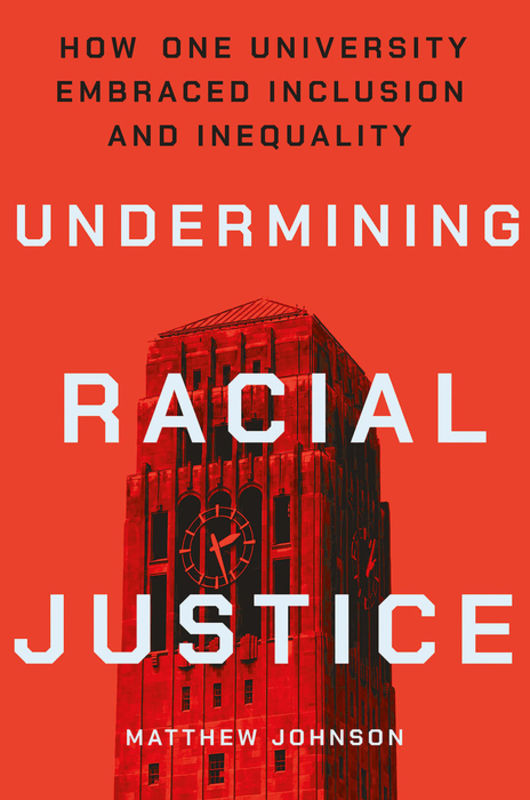


Undermining racial justice
\"In this book, Matthew Johnson focuses on the University of Michigan-an institution at the epicenter of the struggle over what racial justice should look like in practice in American higher education. In 1963, Michigan became one of the first post-secondary institutions in the United States to create an affirmative action admissions program. Since then, Michigan administrators have been on the frontlines of implementing and defending race-conscious solutions to inequality. Johnson analyzes the five-decade fight, from the early 1960s to the turn of the twenty-first century, over what racial justice should look like at the University of Michigan. He finds that, over time, the early linkage between racial equality and social and economic justice became attenuated. The rise of the language of diversity as the goal of Michigan's admissions program signaled the decline of social and economic justice as a stated or even implicit goal of admissions policy.\" -- Contents: Introduction : Preserving Inequality -- Bones and Sinews -- The Origins of Affirmative Action -- Rise of the Black Action Movement -- Controlling Inclusion -- Affirmative Action for Whom? -- Sustaining Racial Retrenchment -- The Michigan Mandate -- Gratz v. Bollinger -- Epilogue : The University as Victim.
eBook

Under The Law: Boys, men, and Title IX
Title IX, the federal law that protects against sex discrimination in schools, is frequently considered a law to protect women from bias, harassment, and assault. However, in recent years, it has also been used to protect the rights of LGBTQ+ students and of men. Robert Kim describes how male victims of harassment have been able to seek justice under Title IX. At the same time, men accused of harassment have turned to the law when they believe that anti-male bias drove the decisions to punish them.
Journal Article

A Conflict of Principles
\"No state . . . shall deny to any person within its jurisdiction the equal protection of the laws.\" So says the Equal Protection Clause of the U.S. Constitution, a document held dear by Carl Cohen, a professor of philosophy and longtime champion of civil liberties who has devoted most of his adult life to the University of Michigan. So when Cohen discovered, after encountering some resistance, how his school, in its admirable wish to increase minority enrollment, was actually practicing a form of racial discrimination-calling it \"affirmative action\"-he found himself at odds with his longtime allies and colleagues in an effort to defend the equal treatment of the races at his university. InA Conflict of PrinciplesCohen tells the story of what happened at Michigan, how racial preferences were devised and implemented there, and what was at stake in the heated and divisive controversy that ensued. He gives voice to the judicious and seldom heard liberal argument against affirmative action in college admission policies.In the early 1970s, as a member of the Board of Directors of the American Civil Liberties Union, Cohen vigorously supported programs devised to encourage the recruitment of minorities in colleges, and in private employment. But some of these efforts gave deliberate preference to blacks and Hispanics seeking university admission, and this Cohen recognized as a form of racism, however well-meaning. In his book he recounts the fortunes of contested affirmative action programs as they made their way through the legal system to the Supreme Court, beginning withDeFunis v. Odegaard(1974) at the University of Washington Law School, thenBakke v. Regents of the University of California(1978) at the Medical School on the UC Davis campus, and culminating at the University of Michigan in the landmark cases ofGrutter v. BollingerandGratz v. Bollinger(2003). He recounts his role in the initiation of the Michigan cases, explaining the many arguments against racial preferences in college admissions. He presents a principled case for the resultant amendment to the Michigan constitution, of which he was a prominent advocate, which prohibited preference by race in public employment and public contracting, as well as in public education.An eminently readable personal, consistently fair-minded account of the principles and politics that come into play in the struggles over affirmative action,A Conflict of Principlesis a deeply thoughtful and thought-provoking contribution to our national conversation about race.
eBook

Defending diversity
Even as lawsuits challenging its admissions policies made their way through the courts, the University of Michigan carried the torch for affirmative action in higher education.
In June 2003, the Supreme Court vindicated UM's position on affirmative action when it ruled that race may be used as a factor for universities in their admissions programs, thus confirming what the UM had argued all along: diversity in the classroom translates to a beneficial and wide-ranging social value. With the green light given to the law school's admissions policies, Defending Diversity validates the positive benefits gained by students in a diverse educational setting.
Written by prominent University of Michigan faculty, Defending Diversity is a timely response to the court's ruling. Providing factual background, historical setting, and the psychosocial implications of affirmative action, the book illuminates the many benefits of a diverse higher educational setting -- including preparing students to be full participants in a pluralistic democracy -- and demonstrates why affirmative action is necessary to achieve that diversity.
Defending Diversity is a significant contribution to the ongoing discussion on affirmative action in higher education. Perhaps more important, it is a valuable record of the history, events, arguments, and issues surrounding the original lawsuits and the Supreme Court's subsequent ruling, and helps reclaim the debate from those forces opposed to affirmative action.
Patricia Gurin is Professor Emerita, Department of Psychology, University of Michigan. Jeffrey S. Lehman, former Dean of the University of Michigan Law School, is President of Cornell University. Earl Lewis is Dean of Rackham Graduate School, University of Michigan.
eBook

The life and work of Francis Willey Kelsey
President of the Archaeological Institute of America, professor at the University of Michigan from 1889 to 1927, and president of the American Philological Association, Francis Kelsey was crucially involved in the founding or growth of major educational institutions. He came to maturity in a period of great technological change in communications, transportation, and manufacturing. Kelsey took full advantage of such innovations in his ceaseless drive to promote education for all, to further the expansion of knowledge, and to champion the benefits of the study of antiquity.
A vigorous traveler around the United States, Europe, and the Mediterranean, Kelsey strongly believed in the value of personally viewing sites ancient and modern and collecting artifacts that could be used by the new museums and universities that were springing up in the United States. This collecting habit put him in touch with major financiers of the day, including Charles Freer, Andrew Carnegie, and J. P. Morgan, as he sought their help for important projects.
Drawing heavily on Kelsey's daily diaries now held at the University of Michigan's Bentley Historical Library, John Griffiths Pedley gives us a biography that records the wide-ranging activities of a gifted and energetic scholar whose achievements mirrored the creative and contributive innovations of his contemporary Americans.
eBook