
Catalogue Search | MBRL


Are you sure you want to remove the book from the shelf?

{{itemTitle}}
485
result(s) for
"Unmarried persons"
Sort by:
The limits of marriage
This book documents and explains the remarkable decline in the American marriage rate that began about 1970. This decline has occurred in spite of the fact that married people are better off than unmarried people in many ways. Many other attempts to explain the \"retreat from marriage\" blame it on culture change involving a devaluation of marriage, and/or on ignorance of the benefits of marriage among the unmarried population. In turn, because unmarried adults and single-parent families are poorer than others, poverty and its associated problems are attributed to the failure to marry.
The argument presented here is that the declining marriage rate is due to the deteriorating position of workers, particularly men, in the American economy. Not only have jobs disappeared and wages decreased, especially for the less-educated, but existing jobs have become more precarious. Less-educated workers can't count on having jobs in the future, and can't count on earning enough to support families if they have jobs because their wages have stagnated. In this economic environment, the flexibility to change partners becomes a survival strategy for the economically marginalized population, which has been increasing in size for the past four decades. Arrangements such as cohabitation allow for this flexibility; marriage does not.
This argument implies that marriage is not a realistic choice for many Americans. In fact, it is a choice that many people don't actually have. Marriages between economically marginal men and women would not eventuate in the benefits that middle-class people experience when they marry, and would eliminate an option they may need to survive in the face of unrelenting poverty. We won't convince these people that marriage would improve their lives, because in most cases it wouldn't be true. To return the marriage rate to its pre-1970 level, we need to address the economic factors that have caused the decline.
eBook

Season of birth and later outcomes
Season of birth is associated with later outcomes; what drives this association remains unclear. We consider a new explanation: variation in maternal characteristics. We document large changes in maternal characteristics for births throughout the year; winter births are disproportionally realized by teenagers and the unmarried. Family background controls explain nearly half of season-of-birth's relation to adult outcomes. Seasonality in maternal characteristics is driven by women trying to conceive; we find no seasonality among unwanted births. Prior seasonalityin-fertility research focuses on conditions at conception; here, expected conditions at birth drive variation in maternal characteristics, while conditions at conception are unimportant.
Journal Article

The rise of living alone and loneliness in history
This article connects two current debates: the rise of single-person households or of 'solitaries', and the so-called 'loneliness epidemic'. It raises questions about how these are associated, via social-science literature on loneliness as a social, contextual and subjective experience, and findings in that literature about the relevance of lone-person households. The article is concerned to explore the history of living alone as a form of family structure, via analysis of European, North American and Japanese pre-industrial and industrial listings of inhabitants, and the post-1851 British censuses to 2011. It also does this cartographically via British mapping of lone-person households in 1851, 1881, 1911 and 2011. It documents dramatic rise across many countries in single-person households during the twentieth century, notably since the 1960s. Many pre-industrial settlements had no single-person households, and the average was around 5 percent of households. The current western proportions of such households (e.g. 31 percent in the UK) are wholly unprecedented historically, even reaching to 60 percent or more of households in some modern European and North American cities. The discussion examines this trend - which has very wide ramifications - and raises issues about its relevance for modern problems of loneliness as a social and welfare concern.
Journal Article


The Long-Term Effects of Building Strong Families: A Program for Unmarried Parents
The authors present findings from a large-scale, random-assignment evaluation of Building Strong Families (BSF), a program offering group sessions on relationship skills education to low-income, unmarried parents who were expecting or had recently had a baby. Findings based on a 3-year follow-up survey of over 4,000 couples indicate that BSF did not succeed in its central objectives of improving the couple relationship, increasing the quality of coparenting, or enhancing father involvement. In fact, the program had modest negative effects on some of these outcomes. BSF also had little impact on child well-being, with no effect on children's family stability or economic well-being and only a modest positive effect on children's socioemotional development. Impacts varied across the 8 study sites. Although attendance at group sessions was relatively low, there is little evidence of program effects even among couples who attended sessions regularly.
Journal Article
Dating Relationships in Older Adulthood: A National Portrait
Dating in later life is likely common, especially as the proportion of older adults who are single continues to rise. Yet there are no recent national estimates of either the prevalence or factors associated with dating during older adulthood. Using data from the 2005–2006 National Social Life, Health, and Aging Project, a nationally representative sample of 3,005 individuals ages 57–85, the authors constructed a national portrait of older adult daters. Roughly 14% of singles were in a dating relationship. Dating was more common among men than women and declined with age. Compared to non-daters, daters were more socially advantaged. Daters were more likely to be college educated and had more assets, were in better health, and reported more social connectedness. This study underscores the importance of new research on partnering in later life, particularly with the aging of the U.S. population and the swelling ranks of older singles.
Journal Article
Transitions Into and Out of Cohabitation in Later Life
Cohabitation among adults over age 50 is rising rapidly, more than doubling from 1.2 million in 2000 to 2.75 million in 2010. A small literature provides a descriptive portrait of older cohabitors, but no study has investigated transitions into and out of cohabitation during later life. Drawing on demographic and life course perspectives, the authors developed a framework for conceptualizing later life union behaviors. Using data from the 1998–2006 Health and Retirement Study, they estimated discrete-time event-history models predicting union formation (i.e., cohabitation or marriage) among older unmarried individuals (N = 3,736) as well as transitions to either marriage or separation among older cohabitors (N = 377). Those who formed a union were as likely to be in a cohabiting relationship as a marriage. Older adult cohabiting unions were quite stable and unlikely to culminate in either marriage or separation. During later life, cohabitation appears to operate as a long-term alternative to marriage.
Journal Article
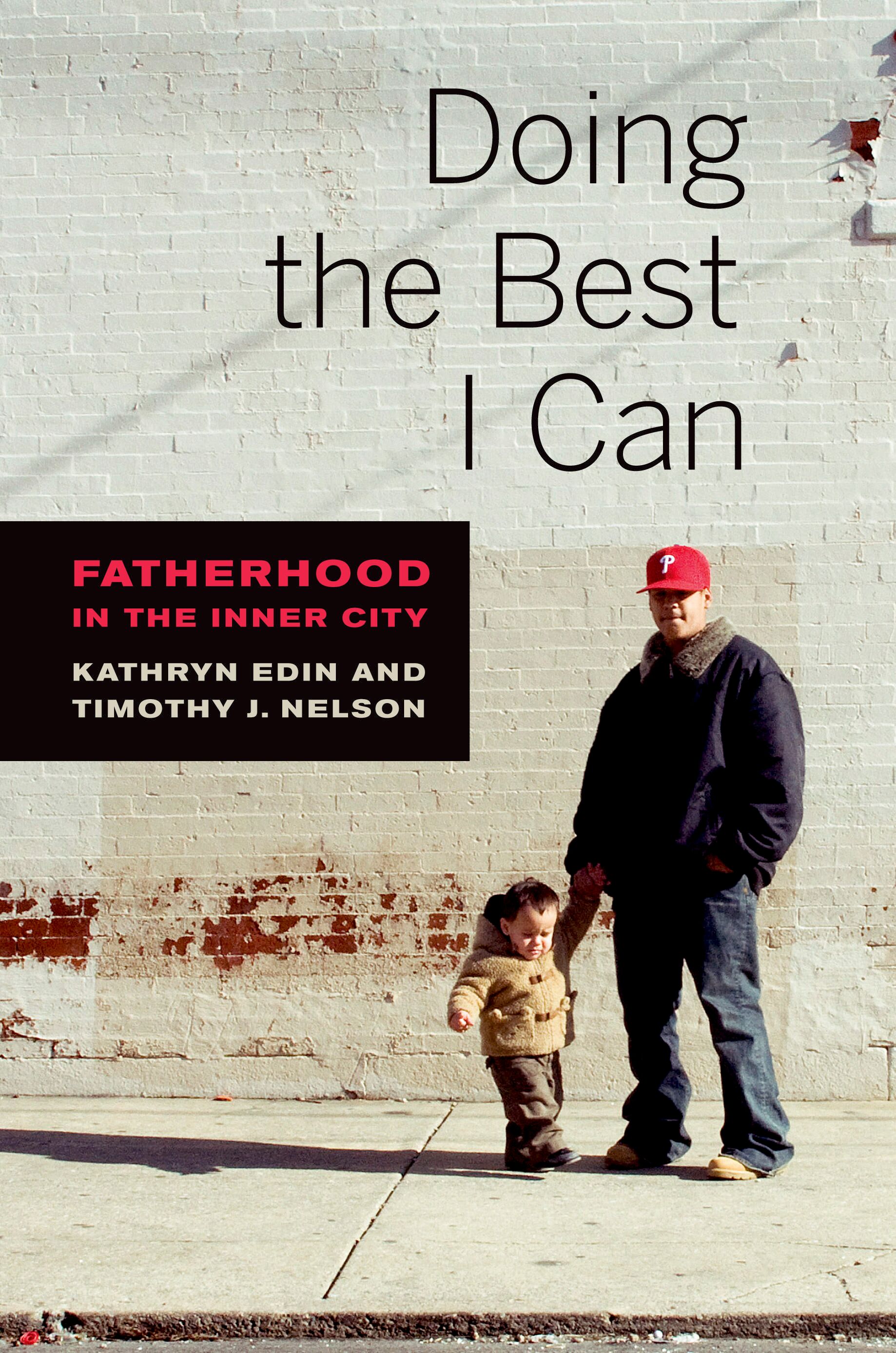
Doing the best I can
Across the political spectrum, unwed fatherhood is denounced as one of the leading social problems of today. Doing the Best I Can is a strikingly rich, paradigm-shifting look at fatherhood among inner-city men often dismissed as \"deadbeat dads.\" Kathryn Edin and Timothy J. Nelson examine how couples in challenging straits come together and get pregnant so quickly—without planning. The authors chronicle the high hopes for forging lasting family bonds that pregnancy inspires, and pinpoint the fatal flaws that often lead to the relationship’s demise. They offer keen insight into a radical redefinition of family life where the father-child bond is central and parental ties are peripheral. Drawing on years of fieldwork, Doing the Best I Can shows how mammoth economic and cultural changes have transformed the meaning of fatherhood among the urban poor. Intimate interviews with more than 100 fathers make real the significant obstacles faced by low-income men at every step in the familial process: from the difficulties of romantic relationships, to decision-making dilemmas at conception, to the often celebratory moment of birth, and finally to the hardships that accompany the early years of the child's life, and beyond.
eBook

The Latin American Cohabitation Boom, 1970-2007
The article describes the rise of unmarried cohabitation in Latin American countries during the last 30 years of the twentieth century, both at the national and regional levels. It documents that this major increase occurred in regions with and without traditional forms of cohabitation alike. In addition, the striking degree of catching up of cohabitation among the better-educated population segments is illustrated. The connections between these trends and economic (periods of high inflation) and cultural (reduction of stigmas in ethical domains) factors are discussed. The conclusion is that the periods of inflation and hyperinflation may have been general catalysts, but no clear indications of correlation were found between such economic factors and the rise in cohabitation. The shift toward more tolerance for hitherto stigmatized forms of conduct (e.g., homosexuality, euthanasia, abortion, single-parent household) is in line with the rise of cohabitation in regions of Argentina, Chile, and Brazil where cohabitation used to be uncommon. Further rises in cohabitation during the first decade of the twenty-first century are expected in a number of countries (e.g., Mexico) despite conditions of much lower inflation.
Journal Article

Marital and Sexual Lifestyles in the United States
This helpful book is designed to provide a broad view of the diversity of contemporary U. S. attitudes, behaviors, and relationships. It also covers basic sociological concepts and research methods. Marital and Sexual Lifestyles in the United States: Attitudes, Behaviors, and Relationships in Social Context integrates the sociological approach with a focus on individual choices and behaviors. Covering dating, sex, marriage, divorce, homosexuality, and other sexual issues, this helpful book is plentifully illustrated with tables, charts, and figures that show where we are going as well as where we have been.
eBook