
Catalogue Search | MBRL


Are you sure you want to remove the book from the shelf?

{{itemTitle}}
7,399
result(s) for
"Updike, John."
Sort by:


Melodramatic Political Discourse in John Updike's Terrorist
This article explores John Updike's Terrorist (2006) through the lens of the rhetoric of victimhood and the dynamics of melodramatic political discourse. Melodramatic political discourse frames politics within a moral economy that portrays the nation-state as the innocent victim of malevolent acts. This framework equates national suffering with virtue, attributes evil to adversaries, and casts acts of war and global dominance as demonstrations of heroism and moral righteousness. The analysis is conducted through a close textual examination, organised into two key constructs: \"Victims,\" which examines the portrayal of American characters as potential victims and the implications of their victimisation, and \"Aggressors,\" which investigates the representation of terrorists and their oppositional stance toward Americans. The study argues that the novel employs a melodramatic political discourse, emphasising the vulnerability of Americans and the malignancy of violence inflicted upon them. This narrative not only validates but also promotes a retaliatory response, including military action, as a means of safeguarding American lives.
Journal Article

John Updike's Pennsylvania Interviews
Updike remains both a critical and popular success; however, because Updike asked that his personal letters not be published the only way that Updike scholars and fans can read more of the author's candid and insightful remarks is to revisit some of the many interviews he granted--most of which are difficult to locate or obtain.
eBook

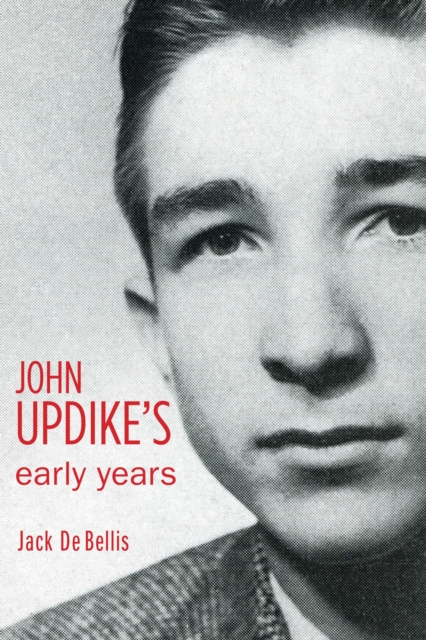
John Updike's early years
John Updike’s Early Years first examines his family, then places him in the context of the Depression and World War II. Relying upon interviews with former classmates, the next chapters examine Updike’s early life and leisure activities, his athletic ability, social leadership, intellectual prowess, comical pranks, and his experience with girls. Two chapters explore Updike’s cartooning and drawing, and the last chapter explains how he modeled his characters on his schoolmates. Lists of Updike’s works treating Pennsylvania, and a compilation of contributions to his school paper are included, along with profiles of all students, faculty and administrators during his years at Shillington High School.
eBook

Higher gossip : essays and criticism
A collection of the eloquent, insightful, and beautifully written prose works that Updike was compiling when he died in January 2009, this book opens with a self-portrait of the writer in winter--a Prospero who, though he fears his most dazzling performances are behind him, reveals himself in every sentence to be in deep conversation with the sources of his magic.
Book

A Theology of Sense
Scott Dill's A Theology of Sense: John Updike, Embodiment, and
Late Twentieth-Century American Literature brings together
theology, aesthetics, and the body, arguing that Updike, a central
figure in post-1945 American literature, deeply embeds in his work
questions of the body and the senses with questions of theology.
Dill offers new understandings not only of the work of Updike-which
is importantly being revisited since the author's death in 2009-but
also new understandings of the relationship between aesthetics,
religion, and physical experience. Dill explores Updike's unique
literary legacy in order to argue for a genuinely postsecular
theory of aesthetic experience. Each chapter takes up one of the
five senses and its relation to broader theoretical concerns:
affect, subjectivity, ontology, ethics, and theology. While placing
Updike's work in relation to other late twentieth-century American
writers, Dill explains their notions of embodiment and uses them to
render a new account of postsecular aesthetics. No other novelist
has portrayed mere sense experience as carefully, as extensively,
or as theologically-repeatedly turning to the doctrine of creation
as his stylistic justification. Across this examination of his many
stories, novels, poems, and essays, Dill proves that Updike forces
us to reconsider the power of literature to revitalize sense
experience as a theological question.
eBook


A Study of Consumption Alienation in Updike’s Works
Updike’s works reflect the characteristics of contemporary American society. There are many descriptions of consumerism in his works. The purpose of this paper is to present the consumption alienation in Updike’s works, to explore the survival predicament of people under the consumption alienation, and to point out its damage to the ecological environment.
Journal Article