
Catalogue Search | MBRL


Are you sure you want to remove the book from the shelf?

{{itemTitle}}
4
result(s) for
"Uppfinningar historia."
Sort by:

The invention of improvement : information and material progress in seventeenth-century England
Improvement was a new concept in seventeenth-century England; only then did it become usual for people to think that the most effective way to change things for the better was not a revolution or a return to the past, but the persistent application of human ingenuity to the challenge of increasing the country's wealth and general wellbeing. Improvements in agriculture and industry, commerce and social welfare, would bring infinite prosperity and happiness. The word improvement was itself a recent coinage. It was useful as a slogan summarising all these goals, and since it had no equivalent in other languages, it gave the English a distinctive culture of improvement that they took with them to Ireland and Scotland, and to their possessions overseas. It made them different from everyone else. The Invention of Improvement explains how this culture of improvement came about. Paul Slack explores the political and economic circumstances which allowed notions of improvement to take root, and the changes in habits of mind which improvement accelerated. It encouraged innovation, industriousness, and the acquisition of consumer goods which delivered comfort and pleasure. There was a new appreciation of material progress as a process that could be measured, and its impact was publicised by the circulation of information about it. It had made the country richer and many of its citizens more prosperous, if not always happier. Drawing on a rich variety of contemporary literature, The Invention of Improvement situates improvement at the centre of momentous changes in how people thought and behaved, how they conceived of their environment and their collective prospects, and how they cooperated in order to change them. --Provided by publisher.
Book

Tesla
Nikola Tesla was a major contributor to the electrical revolution that transformed daily life at the turn of the twentieth century. His inventions, patents, and theoretical work formed the basis of modern AC electricity, and contributed to the development of radio and television. Like his competitor Thomas Edison, Tesla was one of America's first celebrity scientists, enjoying the company of New York high society and dazzling the likes of Mark Twain with his electrical demonstrations. An astute self-promoter and gifted showman, he cultivated a public image of the eccentric genius. Even at the end of his life when he was living in poverty, Tesla still attracted reporters to his annual birthday interview, regaling them with claims that he had invented a particle-beam weapon capable of bringing down enemy aircraft.
Plenty of biographies glamorize Tesla and his eccentricities, but until now none has carefully examined what, how, and why he invented. In this groundbreaking book, W. Bernard Carlson demystifies the legendary inventor, placing him within the cultural and technological context of his time, and focusing on his inventions themselves as well as the creation and maintenance of his celebrity. Drawing on original documents from Tesla's private and public life, Carlson shows how he was an \"idealist\" inventor who sought the perfect experimental realization of a great idea or principle, and who skillfully sold his inventions to the public through mythmaking and illusion.
This major biography sheds new light on Tesla's visionary approach to invention and the business strategies behind his most important technological breakthroughs.
eBook
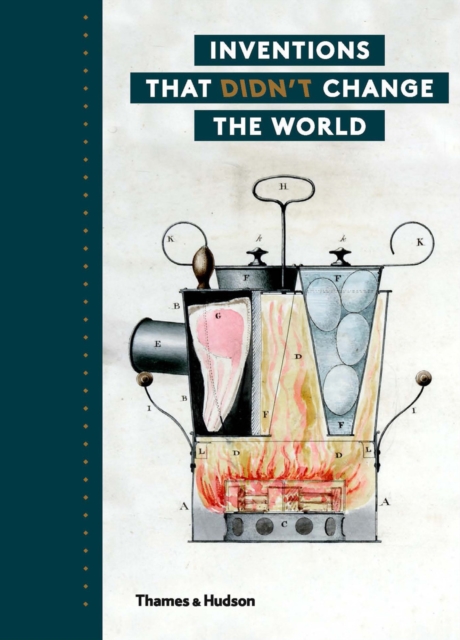
Inventions That Didn't Change the World
Inventions that Didn't Change the World is a fascinating visual tour through some of the most bizarre inventions registered with the British authorities in the nineteenth century. In an era when Britain was the workshop of the world, registration of designs was quicker and cheaper than the convoluted patenting process, and all manner of bizarre curiosities were painstakingly recorded in beautiful color illustrations and well-penned explanatory text, alongside the genuinely great inventions of the period. Irreverent commentary contextualizes each submission as well as taking a humorous view on how each has stood the test of time. This book introduces such gems as a ventilating top hat; an artificial leech; a design for an aerial machine adapted for the arctic regions; an anti-explosive alarm whistle; a tennis racket with ball-picker; and a currant-cleaning machine. Here is everything the end user could possibly require for a problem he never knew he had. Organized by area of application industry, clothing, transportation, medical, health and safety, the home, and leisure Inventions that Didn t Change the World reveals the concerns of a bygone era giddy with the possibilities of a newly industrialized world.
eBook
