
Catalogue Search | MBRL


Are you sure you want to remove the book from the shelf?

{{itemTitle}}
4,203
result(s) for
"Urbanization Economic aspects."
Sort by:


Eco2 cities : ecological cities as economic cities
This book provides an overview of the World Bank's Eco2 cities: ecological cities as economic cities initiative. The objective of the Eco2 cities initiative is to help cities in developing countries achieve a greater degree of ecological and economic sustainability. The book is divided into three parts. Part one describes the Eco2 cities initiative framework. It describes the approach, beginning with the background and rationale. Key challenges are described, and lessons are drawn from cities that have managed to turn these challenges into opportunities. A set of four key principles is introduced. These principles are the foundation upon which the initiative is built. They are: (1) a city-based approach enabling local governments to lead a development process that takes into account their specific circumstances, including their local ecology; (2) an expanded platform for collaborative design and decision making that accomplishes sustained synergy by coordinating and aligning the actions of key stakeholders; (3) a one-system approach that enables cities to realize the benefits of integration by planning, designing, and managing the whole urban system; and (4) an investment framework that values sustainability and resiliency by incorporating and accounting for life-cycle analysis, the value of all capital assets, and a broader scope for risk assessment in decision making. Part two presents a city-based decision support system that introduces core methods and tools to help cities as they work toward applying some of the core elements and stepping stones. Part two looks into methods for collaborative design and decision making and methods to create an effective long-term framework able to help align policies and the actions of stakeholders. Part three consists of the Field Reference Guide. The guide contains background literature designed to support cities in developing more in-depth insight and fluency with the issues at two levels. It provides a city-by-city and sector-by-sector lens on urban infrastructure. The next section comprises a series of sector notes, each of which explores sector-specific issues in urban development.
eBook

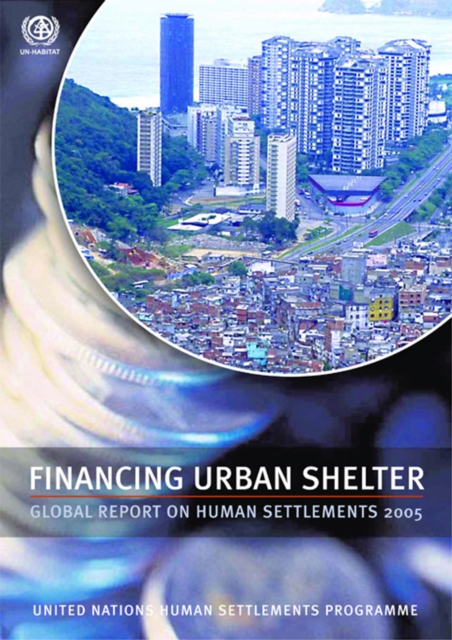
Financing Urban Shelter
'Achieving the goals set by world leaders in the United Nations Millennium Declaration will be difficult without a significant improvement in the lives of slum dwellers, and the lives of slum dwellers cannot be improved without the sound and sustainable economic development that is conducive to the establishment of a strong shelter sector. As Financing Urban Shelter: Global Report on Human Settlements 2005 emphasizes, one of the key challenges in meeting the Millennium Declaration Goal on slums is mobilization of the financial resources necessary for both slum upgrading and slum prevention by supplying new housing affordable to lower income groups on a large scale.
... It is my hope that, by highlighting the impacts of current shelter financing systems on low-income households and by identifying the types of financing mechanisms that appear to have worked for them, this report will contribute to the efforts of the wide range of actors involved in improving the lives of slum dwellers, including governments at the central and local levels, as well as non-governmental and international organizations.'
From the Foreword by KOFI ANNAN, Secretary-General, United Nations
Financing Urban Shelter presents the first global assessment of housing finance systems, placing shelter and urban development challenges within the overall context of macroeconomic policies. The report describes and analyses housing finance conditions and trends in all regions of the world, including formal housing finance mechanisms, microfinance and community funding, highlighting their relevance to the upgrading of slums. Recent shelter finance policy development is discussed at the international and national levels, and the directions that could be taken to strengthen shelter finance systems are examined.
The Global Report on Human Settlements is the most authoritative and up-to-date assessment of conditions and trends in the world's cities. It is an essential tool and reference for researc
eBook


Urban Transformations, Land-Use, and Environmental Change
This book provides interesting insights for the identification of socioeconomic, demographic and territorial factors that affect structural disparities in local economies.
eBook

The future of the Middle East
\"The Future of the Middle East first focuses on the way in which land use is considered a critical issue in physical urban development. Population growth and the need to develop urban areas has given rise to concerns regarding the management of natural disasters in urban communities. The authors investigate Iran's agricultural sector, particularly its current condition and trends, in an effort to assess the welfare of the community as well as the environmental quality. Additionally, this compilation aims to determine the main causes of economic development in Yazd City, reviewing the role of merchants in the historical context. The evolution of U.S. policy in Afghanistan is evaluated from the war's initiation in 2001 up to the present. Despite overtures to achieve a cease fire and on again off again talks with the Taliban, President Trump has conceded that the U.S. will remain in Afghanistan until we have either a deal or total victory, neither of which looks realistic at this time. The authors attempt to link the increase in youth population in Afghanistan to rising terrorism, addressing implications on security and policy. Following this, the US-led reconstruction efforts that followed the 2001 invasion of Afghanistan and the 2003 invasion of Iraq are described. In the penultimate chapter, the structure of law enforcement agencies in Afghanistan and their contribution to the promotion of state authority, security perception and legitimacy is evaluated. In closing, the reconstruction of the magnificent ruins of Palmyra, a World Heritage monument, is assessed\"-- Provided by publisher.
Book
Mondialisation et Dynamiques de la Production Urbaine
Au cours des vingt dernières années, les processus d'urbanisation ont subi de profondes transformations sous l'influence croissante d'acteurs privés, tout particulièrement financiers, exposant le cadre physique des villes aux flux de capitaux mondiaux. Cela a généré une hausse généralisée des valeurs immobilières à l'échelle planétaire, le plus souvent déconnectée des capacités financières des acteurs locaux - en premier lieu les ménages - qui creuse les inégalités et accroît la vulnérabilité des sociétés aux risques financiers et environnementaux.Mondialisation et dynamiques de la production urbaine offre des clés de lecture pour appréhender ces dynamiques d'accumulation du capital dans le cadre bâti des villes, en rendant compte de la diversité de leurs configurations, de leur intensité et de leurs effets urbains selon les contextes nationaux. Au-delà du cas des grands pays occidentaux, foyers initiaux de l'industrie financière et des théorisations sur l'urbain, cet ouvrage aborde les contextes particuliers de la production immobilière dans quatre grandes régions : Asie du Nord-Est, Asie du Sud-Est, Moyen-Orient et Afrique de l'Ouest.
eBook