
Catalogue Search | MBRL


Are you sure you want to remove the book from the shelf?

{{itemTitle}}
4,516
result(s) for
"Urbanization History."
Sort by:

Suburbs : a very short introduction
\"This book explores two centuries of suburban growth as integral to global urbanism. It argues that the future of an urbanizing world will be a suburban world and presents suburbs as places that are interesting and viable on their own terms rather than simply poor cousins of big cities. Examples come from every peopled continent, offering glimpses of suburbs from London to Lima, Sao Paolo to Singapore, Cairo to Chicago, and Dublin to Delhi. The approach is both historical and thematic. The book first traces the history of suburban development in England and North America to 1940 and then examines three different trajectories of suburbanization in more recent decades. The United States and other nations drawing on British planning traditions have built low density suburbia characterized by owner-occupied housing, dependence on automobiles, planned new towns, and a legacy of racial residential segregations. High-rise housing built by national governments dominated suburban rings in Eastern Europe and parts of Western Europe and East Asia. Where neither government nor private market has been able to meet demand, residents have acted themselves to create informal communities with self-built housing on cheap peripheral land, sometimes misleadingly called shantytowns. After this world tour, a chapter explores suburban rings as places of work, from early dispersed manufacturing and industrial suburbs to research and development suburbs in developed economies about the world. Another thematic chapter examines the negative and even dystopian reputation of suburbs and sprawl in literature, popular media, and science fiction\"-- Provided by publisher.
BOOK

Kuwait transformed : a history of oil and urban life
As the first Gulf city to experience oil urbanization, Kuwait City's transformation in the mid-twentieth century inaugurated a now-familiar regional narrative: a small traditional town of mudbrick courtyard houses and plentiful foot traffic transformed into a modern city with marble-fronted buildings, vast suburbs, and wide highways. In Kuwait Transformed, Farah Al-Nakib connects the city's past and present, from its settlement in 1716 to the twenty-first century, through the bridge of oil discovery. She traces the relationships between the urban landscape, patterns and practices of everyday life, and social behaviors and relations in Kuwait. The history that emerges reveals how decades of urban planning, suburbanization, and privatization have eroded an open, tolerant society and given rise to the insularity, xenophobia, and divisiveness that characterize Kuwaiti social relations today. The book makes a call for a restoration of the city that modern planning eliminated. But this is not simply a case of nostalgia for a lost landscape, lifestyle, or community. It is a claim for a \"right to the city\"—the right of all inhabitants to shape and use the spaces of their city to meet their own needs and desires.
eBook

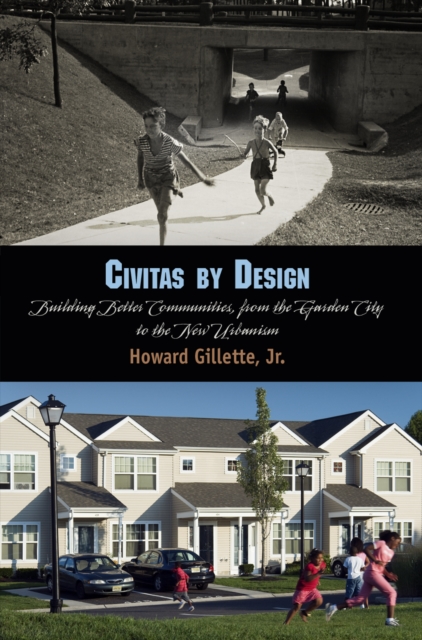
Civitas by Design
Since the end of the nineteenth century, city planners have aspired not only to improve the physical living conditions of urban residents but also to strengthen civic ties through better design of built environments. From Ebenezer Howard and his vision for garden cities to today's New Urbanists, these visionaries have sought to deepen civitas, or the shared community of citizens.
InCivitas by Design, historian Howard Gillette, Jr., takes a critical look at this planning tradition, examining a wide range of environmental interventions and their consequences over the course of the twentieth century. As American reform efforts moved from progressive idealism through the era of government urban renewal programs to the rise of faith in markets, planners attempted to cultivate community in places such as Forest Hills Gardens in Queens, New York; Celebration, Florida; and the post-Katrina Gulf Coast. Key figures-including critics Lewis Mumford and Oscar Newman, entrepreneur James Rouse, and housing reformer Catherine Bauer-introduced concepts such as neighborhood units, pedestrian shopping malls, and planned communities that were implemented on a national scale. Many of the buildings, landscapes, and infrastructures that planners envisioned still remain, but frequently these physical designs have proven insufficient to sustain the ideals they represented. Will contemporary urbanists' efforts to join social justice with environmentalism generate better results? Gillette places the work of reformers and designers in the context of their times, providing a careful analysis of the major ideas and trends in urban planning for current and future policy makers.
eBook

A world in emergence : cities and regions in the 21st century
Beginning with the recent history of capitalism and urbanization and moving into a thorough and complex discussion of the modern city, this book outlines the dynamics of what the author calls the third wave of urbanization, characterized by global capitalism's increasing turn to forms of production revolving around technology-intensive artifacts, financial services, and creative commodities such as film, music, and fashion. The author explores how this shift toward a cognitive and cultural economy has caused dramatic changes in the modern economic landscape in general and in the form and function of world cities in particular. Armed with cutting-edge research and decades of expertise, Allen J. Scott breaks new ground in identifying and explaining how the cities of the past are being reshaped into a complex system of global economic spaces marked by intense relationships of competition and cooperation.
Book

Urbanization in Viking Age and Medieval Denmark
This study traces the history of urbanization in Denmark from c. 500-1350 and explores how interconnected political, religious, economic factors were instrumental in bringing about the growth of towns. Prior to urban development, certain specialized sites such as elite residences and coastal landing places performed many of the functions that would later be taken over by medieval towns. Fundamental changes in political power, the coming of Christianity, and economic development over the course of the Viking and Middle Ages led to the abandonment of these sites in favour of new urban settlements that would come to form the political, religious, and economic centres of the medieval kingdom. Bringing together both archaeological and historical sources, this study illustrates not only how certain cultural and economic shifts were crucial to the development of towns, but also the important role urbanization had in the transition from Viking to medieval Denmark.
eBook

Imperial Urbanism in the Borderlands : Kyiv, 1800-1905
\"In the nineteenth and early twentieth century Kyiv was an important city in the European part of the Russian empire, rivaling Warsaw in economic and strategic significance. It also held the unrivaled spiritual and ideological position as Russia's own Jerusalem. In Imperial Urbanism in the Borderlands, Serhiy Bilenky examines issues of space, urban planning, socio-spatial form, and the perceptions of change in imperial Kyiv. Combining cultural and social history with that of urban studies, Bilenky unearths a wide range of unpublished archival materials and argues that the changes experienced by the city prior to the revolution of 1917 were no less dramatic and traumatic than those of the Communist and post-Communist era. In fact, much of Kyiv's contemporary urban form, architecture, and natural setting were shaped by imperial modernizers during the long nineteenth century. The author also explores a general culture of imperial urbanism in Eastern Europe. Imperial Urbanism in the Borderlands is the first work to approach the history of Kyiv from an interdisciplinary perspective and showcases Kyiv's rightful place as a city worthy of attention from historians, urbanists, and literary scholars.\"-- Provided by publisher.
Book

Urban Space in the Middle Ages and the Early Modern Age
Die neue englischsprachige Reihe zur Medivistik strebt eine methodisch reflektierte, anspruchsvolle Verbindung von Text- und Kulturwissenschaft an. Sie widmet sich den kulturellen Grundthemen der mittelalterlichen Welt aus der Perspektive der Literatur- und Geschichtswissenschaft. Grundthemen' sind die kulturprgenden Denkbilder, Weltanschauungen, Sozialstrukturen und Alltagsbedingungen des mittelalterlichen Lebens, also z. B. Kindheit und Alter, Sexualitt, Religion, Medizin, Rituale, Arbeit, Armut und Reichtum, Aberglauben, Erde und Kosmos, Stadt und Land, Krieg, Emotionen, Kommunikation, Reisen usw. Die Reihe greift wichtige aktuelle Fachdiskussionen auf und stellt ein Forum der interdisziplinren Mittelalter-Forschung dar. Fundamentals of Medieval and Early Modern Culture steht Sammelbnden ebenso offen wie Monographien. Intention ist immer, kompendienhafte Werke zu zentralen Fragen der mittelalterlichen Kulturgeschichte vorzulegen, die einen soliden berblick ber einen geschlossenen Themenkreis aus der Perspektive verschiedener Fachdisziplinen vermitteln. Im Ganzen bietet die Reihe so eine Enzyklopdie der mittelalterlichen Literatur- und Kulturgeschichte und ihrer Hauptthemen. Es werden ca. zwei Bnde pro Jahr erscheinen.
eBook

The city and the process of transition from early modern times to the present
In 2017, during a conference held at the Historical Institute of the University of Wroclaw, Poland, an international group of early career researchers and PhD students had the opportunity to discuss the process of transition in cities from early modern times to the present day. This book, arising from the discussions of that meeting, focuses on the social, economic, political and structural transformations of some cities in Europe, the Near East and Asia from the seventeenth century up to the contemporary era.
Book
Urban China
Over the past three decades, China's urbanization has supported high growth and rapid transformation of the economy. Today, more than half of the world's population lives in cities, and by 2030 that will rise to an estimated 60 percent. The report takes as its point of departure the conviction that China's urbanization can become more efficient, inclusive, and sustainable. However, it stresses that achieving this vision will require strong support from both government and the markets for policy reforms in a number of areas. The report proposes six main areas for reform: first, amending land management institutions to foster more efficient land use, denser cities, modernized agriculture, and more equitable wealth distribution; second, adjusting the hukou system to increase labor mobility and provide urban migrant workers with equal access to a common standard of public services; third, placing urban finances on a more sustainable footing, while fostering financial discipline among local governments; fourth, improving urban planning to enhance connectivity and encourage scale and agglomeration economies; fifth, reducing environmental pressures through more efficient resource management; and sixth, improving governance at the local level. The report also provides recommendations on the timing and sequencing of reforms. It stresses the need to first implement reforms related to land, fiscal, and public service systems. Doing so will facilitate China's transition to higher-quality economic growth. In the first section of this report, chapters one through four analyze China's achievements in urbanization and the challenges it faces in achieving efficient, inclusive, and sustainable urbanization. In the second section, a comprehensive reform agenda is proposed. Chapter five lays out the vision for urban China in 2030 and the reform package that will be needed to achieve it. It also describes the urban landscape in 2030 under the reform scenario. Chapters six through ten provide a detailed set of recommendations in the key areas of reform. Finally, chapter eleven proposes the sequencing and timing of reforms. This report is complemented by seven supporting reports, urbanization and economic growth, spatial design and urban planning, inclusive urbanization, land, food security, green urbanization, and financing urbanization that further deepen the analysis and expand on the policy recommendations.
eBook