
Catalogue Search | MBRL


Are you sure you want to remove the book from the shelf?

{{itemTitle}}
7,461
result(s) for
"Uruguay"
Sort by:

How party activism survives : Uruguay's Frente Amplio
\"Political parties with activists are in decline due to various external shocks. The emergence of new technologies of communication diminished the role of activists and their numbers. Party elites increasingly can make do without grassroots activists, however, recent scholarship concerning different democracies has highlighted the fact that activism still matters for representation. This book contributes to that literature by analyzing a unique case: the Uruguayan Frente Amplio, (FA) the only mass-organic institutionalized leftist party in Latin America. This case study highlights the value of an organization-centered approach for understanding party role in democracy in the twenty-first century. Within the FA, organizational rules grant activists a significant voice, which imbues activists' participation with a strong sense of efficacy. This explains activists' willingness to invest time and effort in the party. The book offers a case study based on mixed methods, including thick description, a systematic process tracing, and a survey research\"-- Provided by publisher.
Book

Edge of empire
In the first decades of the 1800s, after almost three centuries of Iberian rule, former Spanish territories fragmented into more than a dozen new polities.Edge of Empireanalyzes the emergence of Montevideo as a hot spot of Atlantic trade and regional center of power, often opposing Buenos Aires. By focusing on commercial and social networks in the Rio de la Plata region, the book examines how Montevideo merchant elites used transimperial connections to expand their influence and how their trade offered crucial support to Montevideo's autonomist projects.These transimperial networks offered different political, social, and economic options to local societies and shaped the politics that emerged in the region, including the formation of Uruguay. Connecting South America to the broader Atlantic World, this book provides an excellent case study for examining the significance of cross-border interactions in shaping independence processes and political identities.
eBook

Cantoras
\"From the highly acclaimed, award-winning author of The Gods of Tango, a revolutionary new novel about five wildly different women who, in the midst of the Uruguayan dictatorship, find each other as lovers, friends, and ultimately, family. In 1977 Uruguay, a military government has crushed political dissent with ruthless force. In an environment where citizens are kidnapped, raped, and tortured, homosexuality is a dangerous transgression. And yet, despite such societal realities, Romina, Flaca, Anita \"La Venus,\" Paz, and Malena--five cantoras, women who \"sing\"--somehow, miraculously, find each other and discover an isolated cape, Cabo Polonio, inhabited by just a lonely lighthouse keeper and a few rugged seal hunters. They claim this place as their secret sanctuary. Over the next 35 years, their lives move back and forth between Cabo Polonio and Montevideo, the city they call home, as they return, sometimes together, sometimes in pairs, with lovers in tow, or alone. Throughout it all, the women will be tested repeatedly--by their families, lovers, society, and each other--as they fight to live authentic lives. A genre-defining novel and De Robertis's masterpiece, Cantoras is a breathtaking portrait of queer love, community, forgotten history, and the strength of the human spirit. De Robertis has written a novel that is at once timeless and groundbreaking--a tale about the fire in all our souls and those who make it burn\"-- Provided by publisher.
Book
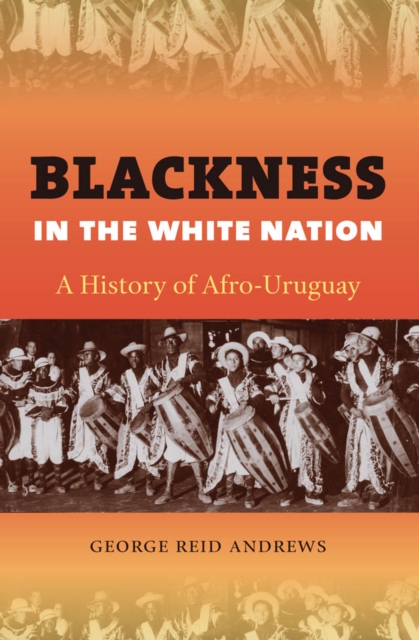
Blackness in the White Nation
Uruguay is not conventionally thought of as part of the African diaspora, yet during the period of Spanish colonial rule, thousands of enslaved Africans arrived in the country. Afro-Uruguayans played important roles in Uruguay's national life, creating the second-largest black press in Latin America, a racially defined political party, and numerous social and civic organizations.Afro-Uruguayans were also central participants in the creation of Uruguayan popular culture and the country's principal musical forms, tango andcandombe.Candombe, a style of African-inflected music, is one of the defining features of the nation's culture, embraced equally by white and black citizens.InBlackness in the White Nation, George Reid Andrews offers a comprehensive history of Afro-Uruguayans from the colonial period to the present. Showing how social and political mobilization is intertwined withcandombe, he traces the development of Afro-Uruguayan racial discourse and argues thatcandombe's evolution as a central part of the nation's culture has not fundamentally helped the cause of racial equality. Incorporating lively descriptions of his own experiences as a member of acandombedrumming and performance group, Andrews consistently connects the struggles of Afro-Uruguayans to the broader issues of race, culture, gender, and politics throughout Latin America and the African diaspora generally.
eBook

The Politics of Social Policy Change in Chile and Uruguay
This work explains the causes of social policy reform in Chile and Uruguay in the areas of health care, pensions and education. Until the 1970s, Chile and Uruguay shared striking similarities.
eBook

Springtime in a broken mirror
\"Santiago, a political prisoner in Uruguay, was jailed after a brutal military coup that saw many of his comrades flee elsewhere. Santiago, feeling trapped, can do nothing but write letters to his family, and try to stay sane. Far away, his nine-year-old daughter Beatrice wonders at the marvels of 1970s Buenos Aires, but her grandpa and mother--Santiago's beautiful, careworn wife, Graciela--struggle to adjust to a life in exile\"-- Provided by publisher.
Book

From Shipmates to Soldiers
Although it never had a plantation-based economy, the Río de la Plata region, comprising present-day Argentina, Uruguay, and Paraguay, has a long but neglected history of slave trading and slavery. This book analyzes the lives of Africans and their descendants in Montevideo and Buenos Aires from the late colonial era to the first decades of independence. The author shows how the enslaved Africans created social identities based on their common experiences, ranging from surviving together the Atlantic and coastal forced passages on slave vessels to serving as soldiers in the independence-era black battalions. In addition to the slave trade and the military, their participation in black lay brotherhoods, African “nations,” and the lettered culture shaped their social identities. Linking specific regions of Africa to the Río de la Plata region, the author also explores the ties of the free black and enslaved populations to the larger society in which they found themselves.
eBook


Deepening Local Democracy in Latin America
The resurgence of the Left in Latin America over the past decade has been so notable that it has been called “the Pink Tide.” In recent years, regimes with leftist leaders have risen to power in Argentina, Bolivia, Brazil, Chile, Ecuador, El Salvador, Nicaragua, Uruguay, and Venezuela. What does this trend portend for the deepening of democracy in the region? Benjamin Goldfrank has been studying the development of participatory democracy in Latin America for many years, and this book represents the culmination of his empirical investigations in Brazil, Uruguay, and Venezuela. In order to understand why participatory democracy has succeeded better in some countries than in others, he examines the efforts in urban areas that have been undertaken in the cities of Porto Alegre, Montevideo, and Caracas. His findings suggest that success is related, most crucially, to how nationally centralized political authority is and how strongly institutionalized the opposition parties are in the local arenas.
eBook