
Catalogue Search | MBRL


Are you sure you want to remove the book from the shelf?

{{itemTitle}}
196
result(s) for
"User interfaces (Computer systems) Psychological aspects."
Sort by:


Human-AI Teaming
Although artificial intelligence (AI) has many potential benefits, it has also been shown to suffer from a number of challenges for successful performance in complex real-world environments such as military operations, including brittleness, perceptual limitations, hidden biases, and lack of a model of causation important for understanding and predicting future events. These limitations mean that AI will remain inadequate for operating on its own in many complex and novel situations for the foreseeable future, and that AI will need to be carefully managed by humans to achieve their desired utility.
Human-AI Teaming: State-of-the-Art and Research Needs examines the factors that are relevant to the design and implementation of AI systems with respect to human operations. This report provides an overview of the state of research on human-AI teaming to determine gaps and future research priorities and explores critical human-systems integration issues for achieving optimal performance.
eBook


Interacting with Presence
The experience of using and interacting with the newest Virtual Reality and computing technologies is profoundly affected by the extent to which we feel ourselves to be really ‘present’ in computer-generated and -mediated augmented worlds. This feeling of 'Presence’, of “being inside the mediated world”, is key to understanding developments in applications such as interactive entertainment, gaming, psychotherapy, education, scientific visualisation, sports training and rehabilitation, and many more. This edited volume, featuring contributions from internationally renowned scholars, provides a comprehensive introduction to and overview of the topic of mediated presence - or ‘tele-presence’ - and of the emerging field of presence research. It is intended for researchers and graduate students in human-computer interaction, cognitive science, psychology, cyberpsychology and computer science, as well as for experienced professionals from the ICT industry. The editors are all well-known professional researchers in the field: Professor Giuseppe Riva from the Catholic University of Milan, Italy; Professor John Waterworth from Umeå University, Sweden; Dianne Murray, an HCI Consultant and editor of the journal “Interacting with Computers”.
eBook

Animation, embodiment, and digital media : human experience of technological liveliness
\"Grounded in ideas of embodiment - that our minds are largely shaped by our perceptual and bodily experiences - Animation, Embodiment and Digital Media discusses the latest interactive animated phenomena enabled by computing and related technologies. Analysed in terms of sensory perception, bodily action and cognitive processes, Kenny Chow formulates a new theoretical framework, exploring a corpus of digital designs including graphical user interfaces of the Macintosh OS X and iOS systems, interactive installations like Text Rain, and video games like the arcade classic Pong and more recently Angry Birds, the animated remake of the canonical Chinese painting Along the River During the Qingming Festival exhibited at the Shanghai Expo in 2010. These analyses simultaneously demonstrate how the proposed perspectives and principles inform possibilities for creating more immersive, affective, and evocative forms of digital designs\"-- Provided by publisher.
Book


The interface envelope : gaming and the logics of affective design
\"In The Interface Envelope, James Ash develops a series of concepts to understand how digital interfaces work to shape the spatial and temporal perception of players. Drawing upon examples from videogame design and work from post-phenomenology, speculative realism, new materialism and media theory, Ash argues that interfaces create envelopes, or localised foldings of space time, around which bodily and perceptual capacities are organised for the explicit production of economic profit. Modifying and developing Bernard Stiegler's account of psychopower and Warren Neidich's account of neuropower, Ash argues the aim of interface designers and publishers is the production of envelope power. Envelope power refers to the ways that interfaces in games are designed to increase users perceptual and habitual capacities to sense difference. Examining a range of examples from specific videogames, Ash identities a series of logics that are key to producing envelope power and shows how these logics have intensified over the last thirty years. In turn, Ash suggests that the logics of interface envelopes in videogames are spreading to other types of interface. In doing so life becomes enveloped as the environments people inhabit becoming increasingly loaded with digital interfaces. Rather than simply negative, Ash develops a series of responses to the potential problematics of interface envelopes and envelope power and emphasizes their pharmacological nature\"-- Provided by publisher.
Book
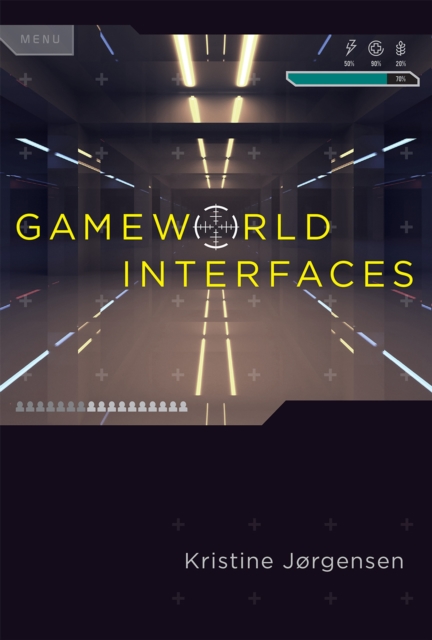
Gameworld Interfaces
Computer games usually take one of two approaches to presenting game information to players. A game might offer information naturalistically, as part of the game's imaginary universe; or it might augment the world of the game with overlays, symbols, and menus. In this book, Kristine Jørgensen investigates both kinds of gameworld interfaces. She shows that although the naturalistic approach may appear more integral to the imaginary world of the game, both the invisible and visible interfaces effectively present information that players need in order to interact with the game and its rules. The symbolic, less naturalistic approach would seem to conflict with the idea of a coherent, autonomous fictional universe; but, Jørgensen argues, gameworlds are not governed by the pursuit of fictional coherence but by the logics of game mechanics. This is characteristic of gameworlds and distinguishes them from other traditional fictional worlds. Jørgensen investigates gameworld interfaces from the perspectives of both game designers and players. She draws on interviews with the design teams of Harmonix Music (producer ofRock Bandand other music games) and Turbine Inc. (producer of such massively multiplayer online games asLord of the Rings Online), many hours of gameplay, and extensive interviews and observations of players. The player studies focus on four games representing different genres:Crysis,Command & Conquer 3: Tiberian Wars,The Sims 2, andDiablo 2. Finally, she presents a theory of game user interfaces and considers the implications of this theory for game design.
eBook

Eye tracking in user experience design
Eye Tracking for User Experience Design explores the many applications of eye tracking to better understand how users view and interact with technology.Ten leading experts in eye tracking discuss how they have taken advantage of this new technology to understand, design, and evaluate user experience.
eBook

Forward first: Joystick interactions of toddlers during digital play
Developmentally appropriate access to technology can support toddlers in learning and play. While touch screens are a popular interaction modality for children under the age of three, they may not be appropriate for all children or all tasks. We know comparatively little about how toddlers interact with joystick-based technology, and more fundamental research is required to understand joystick interactions at different ages and developmental stages. We quantified how 36 nondisabled toddlers used a joystick to play a cause-and-effect game on a computer. Children demonstrated a strong preference for moving the joystick forward first, regardless of the target direction. On average, the oldest children navigated the joystick to the target 5 seconds faster than the youngest children, and were nearly twice as efficient in their joystick path. These findings inform the design of assistive algorithms for joystick-enabled computer play and developmentally appropriate technologies for toddlers.
Journal Article