
Catalogue Search | MBRL


Are you sure you want to remove the book from the shelf?

{{itemTitle}}
6,395
result(s) for
"Utilitarianism"
Sort by:


Utilitarianism : a very short introduction
In this Very Short Introduction Peter Singer and Katarzyna de Lazari-Radek provide an authoritative account of the nature of utilitarianism, from its nineteenth-century origins, to its justification and its varieties. Considering how utilitarians can respond to objections that are often regarded as devastating, they explore the utilitarian answer to the question of whether torture can ever be justified. They also discuss what it is that utilitarians should seek to maximize, paying special attention to the classical utilitarian view that only pleasure or happiness is of intrinsic value. Singer and de Lazari-Radek conclude by analysing the continuing importance of utilitarianism in the world, indicating how it is a force for new thinking on contemporary moral challenges like global poverty, the treatment of animals, climate change, reducing the risk of human extinction, end-of-life decisions for terminally-ill patients, and the shift towards assessing the success of government policies in terms of their impact on happiness.
Book


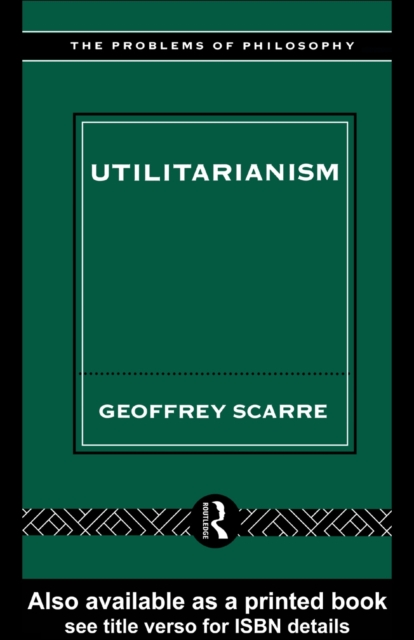
Utilitarianism: A Contemporary Statement
Surveying the historical development and the present condition of utilitarian ethics, Geoffrey Scarre examines the major philosophers from Lao Tzu in the fifth century BC to Richard Hare in the twentieth.Utilitarianism traces the 'doctrine of utility' from the moralists of the ancient world, through the Enlightenment and Victorian utilitarianism up to the lively debate of the present day.Utilitarianism today faces challenges on several fronts: it cannot warrant the drawing of adequate protective boundaries around the essential interests of individuals, and it does not allow them the space to pursue the personal concerns which give meaning to their lives. Geoffrey Scarre considers these and other charges, and concludes that whilst utilitarianism may not be a faultless moral doctrine, its positions are relevant, and significant today.Written with undergraduates in mind, this is an ideal course book for those studying and those teaching moral philosophy.
eBook
