
Catalogue Search | MBRL


Are you sure you want to remove the book from the shelf?

{{itemTitle}}
828
result(s) for
"Utilitarianism History."
Sort by:


Utilitarianism and empire
The classical utilitarian legacy of Jeremy Bentham, J. S. Mill, James Mill, and Henry Sidgwick has often been charged with both theoretical and practical complicity in the growth of British imperialism and the emerging racialist discourse of the nineteenth century. But there has been little scholarly work devoted to bringing together the conflicting interpretive perspectives on this legacy and its complex evolution with respect to orientalism and imperialism. This volume, with contributions by leading scholars in the field, represents the first attempt to survey the full range of current scholarly controversy on how the classical utilitarians conceived of 'race' and the part it played in their ethical and political programs, particularly with respect to such issues as slavery and the governance of India. The book both advances our understanding of the history of utilitarianism and imperialism and promotes the scholarly debate, clarifying the major points at issue between those sympathetic to the utilitarian legacy and those critical of it.
eBook

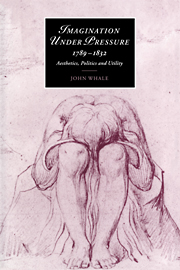
Imagination under Pressure, 1789–1832
This ambitious study, first published in 2000, offers a radical reassessment of one of the most important concepts of the Romantic period - the imagination. In contrast to traditional accounts, John Whale locates the Romantic imagination within the period's lively and often antagonistic polemics on aesthetics and politics. In particular he focuses on the different versions of imagination produced within British writing in response to the cultural crises of the French Revolution and the ideology of utilitarianism. Through detailed analysis of key texts by Burke, Paine, Wollstonecraft, Bentham, Hazlitt, Cobbett and Coleridge, Imagination under Pressure seeks to restore the role of imagination as a more positive force within cultural critique. The book concludes with a chapter on the afterlife of the Coleridgean imagination in the work of John Stuart Mill and I. A. Richards. As a whole it represents a timely and inventive contribution to the ongoing redefinition of Romantic literary and political culture.
eBook

Epistemic problems in Hayek’s defence of free markets
Friedrich von Hayek’s classical liberalism argued that free markets allow individuals the greatest opportunity to achieve their ends. This paper develops an internal critique of this claim. It argues that once externalities are introduced, the forms of economic knowledge Hayek thought to undermine government action and orthodox utilitarianism also rule out relative welfarist assessments of more or less regulated markets. Given the pervasiveness of externalities in modern economies, Hayek will frequently be unable to make comparative welfarist claims, or he must relax his epistemic assumptions and allow for greater government action than his classical liberalism would wish to accept.
Journal Article

Refined utilitarianism in practice: reinterpreting the ethical foundations of the NHS
The COVID-19 pandemic exposed acute tensions in the United Kingdom’s National Health Service (NHS) between its egalitarian self-image and the utilisation of overtly utilitarian tools such as QALY-based cost-effectiveness and prognosis-driven triage. This paper offers a systematic philosophical diagnosis of those tensions through the lens of
refined utilitarianism
, a consequentialist theory that grounds moral rules in their long-run welfare effects while requiring genuine social approbation and cultural fit. After reconstructing the classical act-/rule-utilitarian debate and engaging canonical critics (Rawls, Scanlon, Dworkin and Williams), the paper distinguishes refined utilitarianism from both rule utilitarianism and prioritarianism, then tests the theory against UK healthcare practice pre- and post-pandemic. Using documentary analysis of NICE technology appraisals, BMA emergency guidance, and statutory equality duties, it is shown that the NHS operates a two-tier code: egalitarian, need-based rules in conditions of routine capacity, and outcome-maximising rules, tempered by fairness safeguards, during acute scarcity. This structure closely matches refined utilitarian predictions: apparently non-utilitarian norms (equal access, prohibition of direct age discrimination, ‘rule of rescue’) are retained because they enhance trust, compliance and therefore aggregate welfare, while harsher maximisation moves (frailty scoring, ICU reallocation, staff testing priority) are publicly justified and time-limited to preserve legitimacy. The analysis answers familiar objections, impracticality of hedonic calculus, neglect of minorities, integrity threats, by showing how socially embedded rules mitigate each problem without surrendering the aim of greatest overall benefit. The paper concludes that UK healthcare is best interpreted as
utilitarian in a refined sense,
and that refined utilitarianism provides a practicable, normatively attractive template for future resource-allocation frameworks in public health emergencies and beyond.
Clinical trial number
Not applicable.
Journal Article

Rule Utilitarianism and Rational Acceptance
This article presents a rule-utilitarian theory which lies much closer to the social contract tradition than most other forms of consequentialism do: calculated-rates rule preference utilitarianism. Being preference-utilitarian allows the theory to be grounded in instrumental rationality and the equality of agents, as opposed to teleological assumptions about impartial goodness. The calculated-rates approach, judging rules’ consequences by what would happen if they were accepted by whatever number of people is realistic rather than by what would happen if they were accepted universally or by exactly 90% of the population, allows it to select rules based not just on their ability to give good advice to their followers but also on their ability to attract followers in the first place. The result is a theory that, although fully utilitarian and not at all pluralistic or intuitionist, nevertheless offers a principled justification for giving some weight to seemingly non-utilitarian considerations: Lockean natural rights, Kantian respect for autonomy, and Scanlonian distributive justice.
Journal Article

Integral Europe
Over the past 15 years, the project of advanced European integration has followed a complex secular and cosmopolitan agenda. As that agenda has evolved, however, so have various hard-line populist movements with goals diametrically opposed to the ideals of a harmonious European Union. Spearheaded by figures such as Jean-Marie Le Pen, the controversial leader of France's National Front party, these radical movements have become increasingly influential and, because of their philosophical affinities with fascism and national socialism--politically worrisome.
InIntegral Europe,anthropologist Douglas Holmes posits that such movements are philosophically rooted in integralism, a sensibility that, in its most benign form, enables people to maintain their ethnic identity and solidarity within the context of an increasingly pluralistic society. Taken to irrational extremes by people like Le Pen, integralism is being used to inflame people's feelings of alienation and powerlessness, the by-products of impersonal, transnational \"fast-capitalism.\" The consequences are an invidious politics of exclusion that spawns cultural nationalism, racism, and social disorder.
The analysis moves from northern Italy to Strasbourg and Brussels, the two venues of the European Parliament, and finally to the East End of London. This multi-sited ethnography provides critical perspective on integralism as a form of intimate cultural practice and a violent idiom of estrangement. It combines a wide-ranging review of modern and historical scholarship with two years of field research that included personal interviews with right-wing activists, among them Le Pen and neo-Nazis in inner London. Fascinating, provocative, and sobering,Integral Europeoffers a rare inside look at one of modern Europe's most unsettling political trends.
eBook

Thomas Holcroft’s Revolutionary Drama
A key figure in British literary circles following the French Revolution, novelist and playwright Thomas Holcroft promoted ideas of reform and equality informed by the philosophy of his close friend William Godwin. Arrested for treason in 1794 and released without trial, Holcroft was notorious in his own time, but today appears mainly as a supporting character in studies of 1790s literary activism. Thomas Holcroft’s Revolutionary Drama authoritatively reintroduces and reestablishes this central figure of the revolutionary decade by examining his life, plays, memoirs, and personal correspondence. In engaging with theatrical censorship, apostacy, and the response of audiences and critics to radical drama, this thoughtful study also demonstrates how theater functions in times of political repression. Despite his struggles, Holcroft also had major successes: this book examines his surprisingly robust afterlife, as his plays, especially The Road to Ruin , were repeatedly revived worldwide in the nineteenth century.
eBook

The moral obligation to be vaccinated: utilitarianism, contractualism, and collective easy rescue
We argue that individuals who have access to vaccines and for whom vaccination is not medically contraindicated have a moral obligation to contribute to the realisation of herd immunity by being vaccinated. Contrary to what some have claimed, we argue that this individual moral obligation exists in spite of the fact that each individual vaccination does not significantly affect vaccination coverage rates and therefore does not significantly contribute to herd immunity. Establishing the existence of a moral obligation to be vaccinated (both for adults and for children) despite the negligible contribution each vaccination can make to the realisation of herd immunity is important because such moral obligation would strengthen the justification for coercive vaccination policies. We show that two types of arguments—namely a utilitarian argument based on Parfit’s Principle of Group Beneficence and a contractualist argument—can ground an individual moral obligation to be vaccinated, in spite of the imperceptible contribution that any single vaccination makes to vaccine coverage rates. We add a further argument for a moral obligation to be vaccinated that does not require embracing problematic comprehensive moral theories such as utilitarianism or contractualism. The argument is based on a “duty of easy rescue” applied to collectives, which grounds a collective moral obligation to realise herd immunity, and on a principle of fairness in the distribution of the burdens that must be borne to realise herd immunity.
Journal Article