
Catalogue Search | MBRL


Are you sure you want to remove the book from the shelf?

{{itemTitle}}
2,438
result(s) for
"Utopias History."
Sort by:

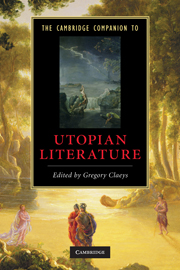
The Cambridge Companion to Utopian Literature
Since the publication of Thomas More's genre-defining work Utopia in 1516, the field of utopian literature has evolved into an ever-expanding domain. This Companion presents an extensive historical survey of the development of utopianism, from the publication of Utopia to today's dark and despairing tendency towards dystopian pessimism, epitomised by works such as George Orwell's Nineteen Eighty-Four and Margaret Atwood's The Handmaid's Tale. Chapters address the difficult definition of the concept of utopia, and consider its relation to science fiction and other literary genres. The volume takes an innovative approach to the major themes predominating within the utopian and dystopian literary tradition, including feminism, romance and ecology, and explores in detail the vexed question of the purportedly 'western' nature of the concept of utopia. The reader is provided with a balanced overview of the evolution and current state of a long-standing, rich tradition of historical, political and literary scholarship.
eBook
Wind and whirlwind : utopian and dystopian themes in literature and philosophy
\"In Wind and Whirlwind the great philosopher Ágnes Heller and social scientist Riccardo Mazzeo explain the pros and cons of utopias and dystopias as they are described in literary works and their relevance to understand the world we live in and the hidden consequences of apparently appealing life trajectories\"-- Provided by publisher.
Book

Dreams of Peace and Freedom
In the wake of the monstrous projects of Hitler, Stalin, Mao, and others in the twentieth century, the idea of utopia has been discredited. Yet, historian Jay Winter suggests, alongside the \"major utopians\" who murdered millions in their attempts to transform the world were disparate groups of people trying in their own separate ways to imagine a radically better world. This original book focuses on some of the twentieth-century's \"minor utopias\" whose stories, overshadowed by the horrors of the Holocaust and the Gulag, suggest that the future need not be as catastrophic as the past.The book is organized around six key moments when utopian ideas and projects flourished in Europe: 1900 (the Paris World's Fair), 1919 (the Paris Peace Conference), 1937 (the Paris exhibition celebrating science and light), 1948 (the Universal Declaration of Human Rights), 1968 (moral indictments and student revolt), and 1992 (the emergence of visions of global citizenship). Winter considers the dreamers and the nature of their dreams as well as their connections to one another and to the history of utopian thought. By restoring minor utopias to their rightful place in the recent past, Winter fills an important gap in the history of social thought and action in the twentieth century.
eBook


Nowhere in the Middle Ages
Literary and cultural historians typically cite Thomas More's 1516 Utopia as the source of both a genre and a concept. Karma Lochrie rejects this origin myth of utopianism along with the assumption that people in the Middle Ages were incapable of such thinking. In Nowhere in the Middle Ages, Lochrie reframes the terms of the discussion by revealing how utopian thought was, in fact, \"somewhere\" in the Middle Ages. In the process, she transforms conventional readings of More's Utopia and challenges the very practice of literary history today.Drawing on a range of contemporary scholarship on utopianism and a broad premodern archive, Lochrie charts variant utopian strains in medieval literature and philosophy that diverge from More's work and at the same time plot uncanny connections with it. Examining works such as Macrobius's fifth-century Commentary on the Dream of Scipio, Mandeville's Travels, and William Langland's Piers Plowman, she finds evidence of a number of utopian drives, including the rejection of European centrality, a desire for more egalitarian politics, and a rethinking of the division between animals and humans. Nowhere in the Middle Ages insists on the relevance and transformative potential of medieval utopias for More's work and positions the sixteenth-century text as one alternative in a broader historical phenomenon of utopian thinking. Tracing medieval utopianisms forward in literary history to reveal their influences on early modern and modern literature and philosophy, Lochrie demonstrates that looking backward, we might extend future horizons of utopian thinking.
eBook

Memories of utopia : the revision of histories and landscapes in Late Antiquity
\"These essays examine how various communities remembered and commemorated their shared past through the lens of utopia and its corollary, dystopia, providing a framework for the reinterpretation of rapidly changing religious, cultural and political realities of the turbulent period from 300 to 750 CE. The common theme of the chapters is the utopian ideals of religious groups, whether these are inscribed on the body, on the landscape, in texts or other cultural objects. The volume is the first to apply this conceptual framework to Late Antiquity, when historically significant conflicts arose between the adherents of four major religious identities: Greco-Roman \"pagans\", newly dominant Christians, diaspora Jews who were more or less persecuted, depending on the current regime, and the emerging religion and power of Islam. Late Antiquity was thus a period when dystopian realities competed with memories of a mythical Golden Age, variously conceived according to the religious identity of the group. The contributors come from a range of disciplines, including cultural studies, religious studies, ancient history and art history, and employ both theoretical and empirical approaches. This volume is unique in the range of evidence it draws upon, both visual and textual, to support the basic argument, that utopia in Late Antiquity, whether conceived spiritually, artistically or politically, was a place of the past but also of the future, even of the Afterlife. Memories of Utopia will be of interest to historians, archaeologists, and art historians of the later Roman empire, and those working on religion in Late Antiquity and Byzantium\"-- Provided by publisher.
Book

Other Englands : utopia, capital, and empire in an age of transition
Other Englands examines the rise of the early English utopia in the context of emergent capitalism. Above all, it asserts that this literary genre was always already an expression of social crisis and economic transition, a context refracted in the origin stories and imagined geographies common to its early modern form. Beginning with the paradigmatic popular utopias of Thomas More and Francis Bacon but attentive to non-canonical examples from the margins of the tradition, the study charts a shifting and, by the time of the English Revolution, self-critical effort to think communities in dynamic socio-spatial forms. Arguing that early utopias have been widely misunderstood and maligned as static, finished polities, Sarah Hogan makes the case that utopian literature offered readers and writers a transformational and transitional social imaginary. She shows how a genre associated with imagining systemic alternatives both contested and contributed to the ideological construction of capitalist imperialism. In the early English utopia, she finds both a precursor to the Enlightenment discourse of political economy and another historical perspective on the beginnings and enduring conflicts of global capital.
eBook


Europe's utopias of peace : 1815, 1919, 1951
Europe's Utopias of Peace explores attempts to create a lasting European peace in the aftermath of the Napoleonic wars and the two world wars.The book charts the 250 year cycle of violent European conflicts followed by new utopian formulations for peace.
eBook