
Catalogue Search | MBRL


Are you sure you want to remove the book from the shelf?

{{itemTitle}}
2,961
result(s) for
"Uzbekistan."
Sort by:

Bukharan Jews and the Dynamics of Global Judaism
Part ethnography, part history, and part memoir, this volume chronicles the complex past and dynamic present of an ancient Mizrahi community. While intimately tied to the Central Asian landscape, the Jews of Bukhara have also maintained deep connections to the wider Jewish world. As the community began to disperse after the fall of the Soviet Union, Alanna E. Cooper traveled to Uzbekistan to document Jewish life before it disappeared. Drawing on ethnographic research there as well as among immigrants to the US and Israel, Cooper tells an intimate and personal story about what it means to be Bukharan Jewish. Together with her historical research about a series of dramatic encounters between Bukharan Jews and Jews in other parts of the world, this lively narrative illuminates the tensions inherent in maintaining Judaism as a single global religion over the course of its long and varied diaspora history.
eBook

Tashkent
Paul Stronski tells the fascinating story of Tashkent, an ethnically diverse, primarily Muslim city that became the prototype for the Soviet-era reimagining of urban centers in Central Asia. Based on extensive research in Russian and Uzbek archives, Stronski shows us how Soviet officials, planners, and architects strived to integrate local ethnic traditions and socialist ideology into a newly constructed urban space and propaganda showcase.
The Soviets planned to transform Tashkent from a \"feudal city\" of the tsarist era into a \"flourishing garden,\" replete with fountains, a lakeside resort, modern roadways, schools, hospitals, apartment buildings, and of course, factories. The city was intended to be a shining example to the world of the successful assimilation of a distinctly non-Russian city and its citizens through the catalyst of socialism. As Stronski reveals, the physical building of this Soviet city was not an end in itself, but rather a means to change the people and their society.
Stronski analyzes how the local population of Tashkent reacted to, resisted, and eventually acquiesced to the city's socialist transformation. He records their experiences of the Great Terror, World War II, Stalin's death, and the developments of the Krushchev and Brezhnev eras up until the earthquake of 1966, which leveled large parts of the city. Stronski finds that the Soviets established a legitimacy that transformed Tashkent and its people into one of the more stalwart supporters of the regime through years of political and cultural changes and finally during the upheavals of glasnost.
eBook


Russian colonial society in Tashkent, 1865-1923
This intensively researched urban study dissects Russian Imperial and
early Soviet rule in Islamic Central Asia from the diverse viewpoints of tsarist
functionaries, Soviet bureaucrats, Russian workers, and lower-class women as well as
Muslim notables and Central Asian traders. Jeff Sahadeo's stimulating analysis
reveals how political, social, cultural, and demographic shifts altered the nature
of this colonial community from the tsarist conquest of 1865 to 1923, when Bolshevik
authorities subjected the region to strict Soviet rule. In addition to placing the
building of empire in Tashkent within a broader European context, Sahadeo's account
makes an important contribution to understanding the cultural impact of empire on
Russia's periphery.
eBook

Constructing the Uzbek state
Over the past three decades, Uzbekistan has attracted the attention of the academic and policy communities because of its geostrategic importance, its critical role in shaping or unshaping Central Asia as a region, its economic and trade potential, and its demographic weight: every other Central Asian being Uzbek, Uzbekistan’s political, social, and cultural evolutions largely exemplify the transformations of the region as a whole. And yet, more than 25 years after the collapse of the Soviet Union, evaluating Uzbekistan’s post-Soviet transformation remains complicated. Practitioners and scholars have seen access to sources, data, and fieldwork progressively restricted since the early 2000s.The death of President Islam Karimov, in power for a quarter of century, in late 2016, reopened the future of the country, offering it more room for evolution. To better grasp the challenges facing post-Karimov Uzbekistan, this volume reviews nearly three decades of independence. In the first part, it discusses the political construct of Uzbekistan under Karimov, based on the delineation between the state, the elite, and the people, and the tight links between politics and economy. The second section of the volume delves into the social and cultural changes related to labor migration and one specific trigger – the difficulties to reform agriculture. The third part explores the place of religion in Uzbekistan, both at the state level and in society, while the last part looks at the renegotiation of collective identities.
eBook

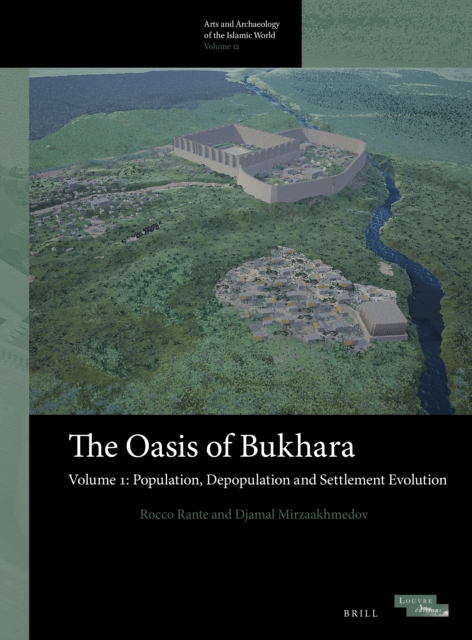
The Oasis of Bukhara
In The Oasis of Bukhara: Population, Depopulation and Settlement Evolution, co-published by Brill and the Louvre Museum, Rocco Rante, archaeologist at the Louvre Museum, presents the results of a regional archaeological investigation of the oasis of Bukhara, from the end of the 1st millennium BCE to the Timurid period.
eBook