
Catalogue Search | MBRL


Are you sure you want to remove the book from the shelf?

{{itemTitle}}
45
result(s) for
"VIVES, JUAN LUIS (1492-1540)"
Sort by:
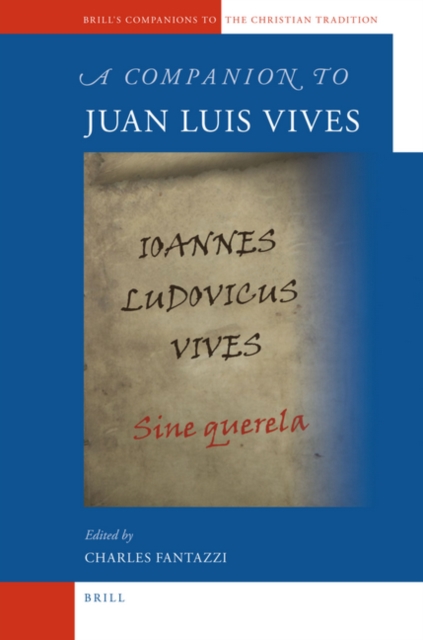
A Companion to Juan Luis Vives
The Companion contains chapters on Vives's life and writings, including his works on the education of women, relief of the poor, political treatises, works on rhetoric and dialectic, defense of the Christian religion, and later influence.
eBook

Una posible influencia de Dionisio de Halicarnaso en el pensamiento historiográfico de Luis Vives
Este artículo explora una posible influencia de Dionisio de Halicarnaso en la concepción historiográfica del humanista valenciano Luis Vives. El autor español se sumó al ambiente de renovación de las artes liberales de su tiempo, siempre con un enfoque ciceroniano que daba primacía a las tres primeras artes del discurso, y a la combinación sintética entre filosofía y retórica. Se trata de un modelo pedagógico procedente de Isócrates. En tanto Dionisio de Halicarnaso tuvo una gran influencia de estas ideas, desarrollando sus posibilidades en el plano historiográfico, se habría convertido en un perfecto modelo para Luis Vives.
Journal Article

Order and Resistance in the Polemical and Catechetical Literature of Early Modern Spain (1515–1599): Christians, Muslims, and Moriscos
This article addresses four works written for the instruction of Muslims and Moriscos in early modern Spain within the framework of negotiation of power and identities. Through Juan Andres's Confusión (1515), Juan Luis Vives's \"Contra sectam Mahometi\" (1543), Pedro Guerra de Lorca's Catéchèses mystagogicae (1586), and Juan de Ribera's Catechismo (1599), it asks how these texts attempt to impose order in an Iberia characterized by heterogeneity. It also asks how the tension between the goals of the corpus and its cultural context surfaces within their pages. The article argues that these texts are not simply an elitist literature reflecting a desire opposed to reality (i.e., religious and cultural homogeneity), but a reflection of their religious and cultural circumstances.
Journal Article

'Quid sit anima': Juan Luis Vives on the soul and its relation to the body
On account of his insights into human nature and conduct, the Renaissance humanist Juan Luis Vives (1493–1540) has occasionally been called 'the father of modern psychology'. Even if the praise regarding his originality is not completely undeserved, it is something of an exaggeration to consider him the initiator of modern psychology without further qualifications. The aim of the present article is to analyse Vives's discussion of the general notion of the soul in his treatise De anima et vita (1538), and to show how deeply rooted it is in the tradition of philosophical psychology that goes back to Plato and Aristotle. Special attention is also paid to the influence of traditional medical theories, such as Galen's conception of the bodily instruments of the soul. Moreover, following the Neoplatonic tradition, Vives uses the analogy of light to explain how an immaterial soul can be united with, but not affected by, a physical body. It is argued that this approach is based on Nemesius of Emesa's treatise De natura hominis, a source that has not been duly appreciated in previous studies.
Journal Article

El lenguaje y la formación cívica según Juan Luis Vives (1492/3-1540)/Language and Civic Education in Juan Luis Vives (1492/3-1540)
This work clarifies the contribution of language disciplines -grammar, dialectics and rhetoric- to the civic education on Juan Luis Vives' work. Such elucidation contributes to justify that the Humanism proposed by Juan Luis Vives is a civic humanism. In the basis of a contextual and intertextual analysis of the political work and the philosophical-educational work of the humanist Vives, the civic orientation is deduced from language disciplines. Reflections derive from such analysis of the relevance of the language in civic education that can be a reference point to review current approaches in the educational field.
Journal Article

PRECEDENTES DE DERECHOS SOCIALES EN ESPAÑA EN EL SIGLO XVI
En este artículo se analizan las tesis doctrinales sobre atención a los pobres de tres españoles del siglo XVI, Juan Luis Vives, Domingo de Soto y Juan de Robles. Aunque con ellos no aparecieron los derechos sociales tal como se entienden en la actualidad, puede decirse que diseñaron los principios básicos que los sustentan: libertad individual, igualdad, respeto a la dignidad humana del pobre e intervención de los poderes públicos. Se examina también el contexto ideológico en el que nacen sus distintas posturas.
Journal Article

Juan Luis Vives, lengua y lenguaje en el humanismo renacentista/Juan Luis Vives, the Language and its Use in the Renaissance Humanism
The aim of this article is to analyze the use of the language carried out by Juan Luis Vives. Due to the wide range of topics Vives dealt with, he has had a strong influence on different specialities like the philology. For Vives, the philological approach and the teaching of languages don't only have to take into account the language from a theoretical point of view, but also from a socio-cultural perspective. His great interest in languages moved him to pay attention on trying to find the real meaning of the original works in Latin and also in Greek. It also moved him to write introductory essays to them. By writing introductions and doing his interpretations, he communicated his own opinion about how to translate them. [PUBLICATION ABSTRACT]
Journal Article

Vives's De ratione dicendi : Structure, Innovations, Problems
Abstract This paper presents a critical assessment of Vives's major rhetorical treatise, De ratione dicendi (1533). In terms of structure it shows that the first book is concerned with the linguistic basis of style, that the second deals with the qualities of style, the four aims of rhetoric, decorum and disposition and that the third presents guidance on composing ten genres of writing practised by humanists. The paper describes Vives's original contributions to the analysis of the linguistic basis of style, the qualities of style, emotional manipulation, decorum, and the composition of history and commentary. In assessing Vives's work it makes comparisons with rhetoric texts by Agricola, Erasmus, Melanchthon, and Ramus. It finds that Vives's reform of rhetoric is based in his encyclopaedic grasp of human learning but that this very encyclopaedism can cause weaknesses in his discussions of particular topics. De ratione dicendi tells us a great deal about Vives's perceptiveness and breadth of reading but, with only three sixteenth century editions, it was not a successful textbook.
Journal Article

Thomas More and the Louvain humanists
Louvain in the title refers to the place where More's Utopia was first printed, and where several friends of his studied or taught, including Erasmus and Vives, and the Dutch patrician at the heart of this article : Cranevelt, a humanist like More in many ways : translator of Greek texts into Latin, married with children, a lawyer promoted from municipal service at Bruges to national service at Mechelen; lovers of peace the two men kept corresponding when their countries were at war, and remained staunch members of the Catholic Church. The author draws mainly on More's thirteen letters (1520-1528), reproduced in facsimile, with translations into English and French, in Moreana 117/3-84, and fleshes them out with other documents. [PUBLICATION ABSTRACT]
Journal Article
Vives’s De ratione dicendi: Structure, Innovations, Problems
This paper presents a critical assessment of Vives's major rhetorical treatise, De ratione dicendi (1533). In terms of structure it shows that the first book is concerned with the linguistic basis of style, that the second deals with the qualities of style, the four aims of rhetoric, decorum and disposition and that the third presents guidance on composing ten genres of writing practised by humanists. The paper describes Vives's original contributions to the analysis of the linguistic basis of style, the qualities of style, emotional manipulation, decorum, and the composition of history and commentary. In assessing Vives's work it makes comparisons with rhetoric texts by Agricola, Erasmus, Melanchthon, and Ramus. It finds that Vives's reform of rhetoric is based in his encyclopaedic grasp of human learning but that this very encyclopaedism can cause weaknesses in his discussions of particular topics. De ratione dicendi tells us a great deal about Vives's perceptiveness and breadth of reading but, with only three sixteenth century editions, it was not a successful textbook. [PUBLICATION ABSTRACT]
Journal Article