
Catalogue Search | MBRL


Are you sure you want to remove the book from the shelf?

{{itemTitle}}
29
result(s) for
"Valentinian I"
Sort by:

Philological and Historical Commentary on Ammianus Marcellinus XXVII
Continuing the series of philological and historical commentaries on Ammianus' Res Gestae this volume deals with Book 27, in which the author deals with military operations and internal affairs. In the central part of the book the emperor Valentinian is portrayed.
eBook

Baptism in Irenaeus of Lyons: Testimony to and Participation with the Triune God
Irenaeus of Lyons wrote
(
) to encourage his readers of the solidity of their faith, especially as this faith was connected to baptism under the threefold seal: Father, Son, and Holy Spirit. The threefold nature of the baptismal formula drives Irenaeus’ discussion in
. 3-7 and is the point with which he concludes the work, saying, ‘error, concerning the three heads of our seal, has caused much straying from the truth’ (
100). Irenaeus structures the intervening chapters to show how Christian baptism is both a testimony to and participation with the Triune God referenced in the baptismal formula. The lack of explicit structural markers within the body of the text has resulted in a neglect of the trinitarian character of its structure. This article explores the manner in which Irenaeus of Lyons’
provides insight into his understanding of the nature and activity of the Triune God based on his conviction that Christian baptism is both a testimony to and a participation with that Triune God.
Journal Article
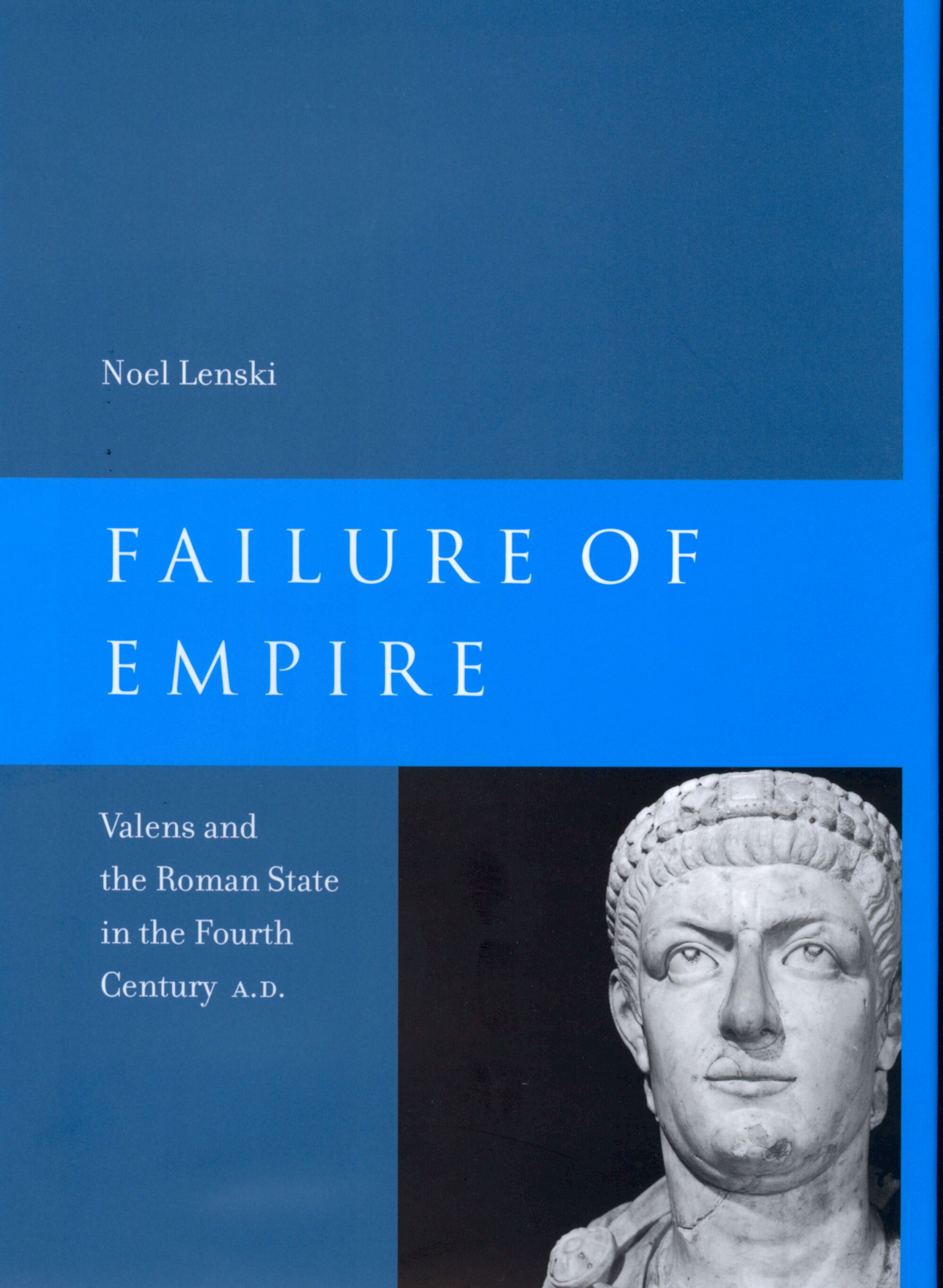
Failure of Empire
Failure of Empireis the first comprehensive biography of the Roman emperor Valens and his troubled reign (a.d. 364-78). Valens will always be remembered for his spectacular defeat and death at the hands of the Goths in the Battle of Adrianople. This singular misfortune won him a front-row seat among history's great losers. By the time he was killed, his empire had been coming unglued for several years: the Goths had overrun the Balkans; Persians, Isaurians, and Saracens were threatening the east; the economy was in disarray; and pagans and Christians alike had been exiled, tortured, and executed in his religious persecutions. Valens had not, however, entirely failed in his job as emperor. He was an admirable administrator, a committed defender of the frontiers, and a ruler who showed remarkable sympathy for the needs of his subjects. In lively style and rich detail, Lenski incorporates a broad range of new material, from archaeology to Gothic and Armenian sources, in a study that illuminates the social, cultural, religious, economic, administrative, and military complexities of Valens's realm.Failure of Empireoffers a nuanced reconsideration of Valens the man and shows both how he applied his strengths to meet the expectations of his world and how he ultimately failed in his efforts to match limited capacities to limitless demands.
eBook

Understanding Ammianus Marcellinus, Book by Book
Abstract
This article examines the now complete Philological and Historical Commentary on Ammianus Marcellinus, begun in the 1930s by Pieter de Jonge and completed in 2018 by J. den Boeft, J.W. Drijvers, D. den Hengst and H.C. Teitler. It starts with a detailed consideration of the final volume, the commentary on Book 31, and addresses aspects of it that reflect both the strengths and the weaknesses of the whole commentary series. From there, it concludes by surveying the most significant historical insights and the most essential historiographical discussions in the volumes produced by the final team of four editors, the so-called quadriga Batavorum.
Journal Article

La carriera militare di Teodosio il Vecchio
Dealing with the career of Theodosius the Elder, we are bound to solve three other issues, namely: 1) the date of the military campaign whence the triumphal surname Francicus maximus came to Valentinian I; 2) the identification of the Franks won in that time; 3) the historiographical perspective and the narrative reasons that impelled Ammianus Marcellinus to drop completely the war with the Franks from the Res Gestae. Here we will review the four issues step by step. Firstly we will reconstruct the career of the Hispanic general, then we will identify the Franks. Finally, we will find the date and the place of Valentinian’s bellum Francicum. At the same time we will throw new light on the chronology of the barbarica conspiratio as well as on the Ammianean methods of narrative distortion and historiographical manipulation.
Journal Article
La carriera militare di Teodosio il Vecchio
Dealing with the career of Theodosius the Elder, we are bound to solve three other issues, namely: 1) the date of the military campaign whence the triumphal surname Francicus maximus came to Valentinian I; 2) the identification of the Franks won in that time; 3) the historiographical perspective and the narrative reasons that impelled Ammianus Marcellinus to drop completely the war with the Franks from the Res Gestae. Here we will review the four issues step by step. Firstly we will reconstruct the career of the Hispanic general, then we will identify the Franks. Finally, we will find the date and the place of Valentinian’s bellum Francicum. At the same time we will throw new light on the chronology of the barbarica conspiratio as well as on the Ammianean methods of narrative distortion and historiographical manipulation.
Journal Article
La carriera militare di Teodosio il Vecchio
Dealing with the career of Theodosius the Elder, we are bound to solve three other issues, namely: 1) the date of the military campaign whence the triumphal surname Francicus maximus came to Valentinian I; 2) the identification of the Franks won in that time; 3) the historiographical perspective and the narrative reasons that impelled Ammianus Marcellinus to drop completely the war with the Franks from the Res Gestae. Here we will review the four issues step by step. Firstly we will reconstruct the career of the Hispanic general, then we will identify the Franks. Finally, we will find the date and the place of Valentinian’s bellum Francicum. At the same time we will throw new light on the chronology of the barbarica conspiratio as well as on the Ammianean methods of narrative distortion and historiographical manipulation.
Journal Article

Origen's Vacillating Stances toward his \Valentinian\ Colleague Heracleon
When Origen of Alexandria presents numerous extensive quotations from Heracleon, whom he explicitly presents as a follower of Valentinus, one might expect a uniformly adversarial attitude toward this \"Valentinian\" sectarian. Instead, Origen's stances are found to vacillate significantly from general renunciation and emphatic criticism, via considered disagreement and hypothetical approval, all the way to agreement and praise. The fascinating interplay between the stance taken and the dogmatic and philological matters in view implies that while dogmatic issues at stake are decisive for whether Origen agrees or disagrees with Heracleon, the full range of variance in Origen's stances is determined by Heracleon's philological methodology and presentation of evidence. Origen's responses to Heracleon reveal that he viewed this predecessor not simply as a heterodox teacher, but also as a colleague in interpreting the New Testament using methods from Greco-Roman literary criticism.
Journal Article

Failure of Empire
Failure of Empire is the first comprehensive biography of the Roman emperor Valens and his troubled reign (a.d. 364-78). Valens will always be remembered for his spectacular defeat and death at the hands of the Goths in the Battle of Adrianople. This singular misfortune won him a front-row seat among history's great losers. By the time he was killed, his empire had been coming unglued for several years: the Goths had overrun the Balkans; Persians, Isaurians, and Saracens were threatening the east; the economy was in disarray; and pagans and Christians alike had been exiled, tortured, and executed in his religious persecutions. Valens had not, however, entirely failed in his job as emperor. He was an admirable administrator, a committed defender of the frontiers, and a ruler who showed remarkable sympathy for the needs of his subjects. In lively style and rich detail, Lenski incorporates a broad range of new material, from archaeology to Gothic and Armenian sources, in a study that illuminates the social, cultural, religious, economic, administrative, and military complexities of Valens's realm. Failure of Empire offers a nuanced reconsideration of Valens the man and shows both how he applied his strengths to meet the expectations of his world and how he ultimately failed in his efforts to match limited capacities to limitless demands.
eBook
Valentinian I, christianissimus imperator? Notes on a passage of the Passio Pollionis (BHL 6869)
Abstract
The present article aims to draw attention to a neglected source attesting the epithet christianissimus imperator as a late antique imperial title. The source in question, the Passio Pollionis (BHL 6869), is one of the earliest testimonies, alongside Ambrose's and Jerome's works. It is also peculiar in that, as a hagiographic work, it addresses the emperor Valentinian I with this title. A brief comparison with the use of christianissimus in Ambrose, as well as the analysis of its literary-propagandistic function in the Passio Pollionis is meant to shed light on the documentary potential of the Passio.
Journal Article