
Catalogue Search | MBRL


Are you sure you want to remove the book from the shelf?

{{itemTitle}}
2,238
result(s) for
"Vancouver"
Sort by:

Vancouverism
\"Until the 1980s, Vancouver was a typical mid-sized North American city. But between Expo 86 and the Olympic Games in 2010, something extraordinary happened. This otherwise unremarkable city underwent a radical transformation that saw it emerge as an inspiring world-class metropolis celebrated for its liveability, sustainability, and competitiveness. City-watchers everywhere took notice and wanted to learn more about this new model of urban growth, and the term \"Vancouverism\" was born. This book tells the story of \"Vancouverism\" and the urban planning philosophy and practice behind it. The author is a former chief planner of the City of Vancouver and a key player at the heart of the action. Writing from an insider's perspective, Larry Beasley traces the principles that inspired Vancouverism and the policy framework developed to implement it. The prologue, written by prominent Vancouver journalist Frances Bula, outlines the political and urban history of Vancouver up until the 1980s. The text is also beautifully illustrated by the author with more than 200 colour photographs. Cities everywhere are asking the same question. Shall we shape change or will change shape us? This book shows how one city discovered positive answers, and it offers the principles, tools, and inspiration for others to follow\"-- Provided by publisher.
Book
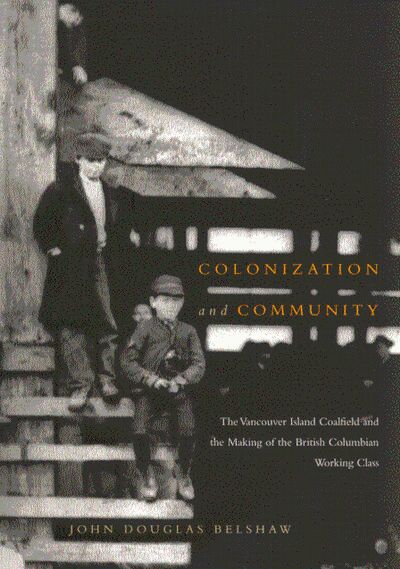
Colonization and Community
In Colonization and Community John Belshaw takes a new look at British Columbia's first working class, the men, women, and children beneath and beyond the pit-head. Beginning with an exploration of emigrant expectations and ambitions, he investigates working conditions, household wages, racism, industrial organization, gender, schooling, leisure, community building, and the fluid identity of the British mining colony, the archetypal west coast proletariat. By connecting the story of Vancouver Island to the larger story of Victorian industrialization, he delineates what was distinctive and what was common about the lot of the settler society. Belshaw breaks new ground, challenging the easy assumptions of transferred British political traditions, analyzing the colonial at the household level, and revealing the emergent communities of Vancouver Island as the cradle of British Columbian working-class culture.
eBook

Where mountains meet the sea : an illustrated history of the District of North Vancouver
\"Where Mountains Meet the Sea commemorates the 125th anniversary of the District of North Vancouver's incorporation as a municipality. Combining hundreds of illustrations with the personal accounts of residents and a lively text, the book presents the story of North Vancouver in all its colour and complexity. Instead of a conventional chronological narrative, Where Mountains Meet the Sea divides the story of North Vancouver's development into three major parts: 1) the origins of the community, its First Nations residents and the development of its waterfront; 2) the political and cultural evolution of the community; and 3) the development of the mountain resorts and the creation of the many parks which characterize the North Shore. From the District's auspicious beginnings with the sawmill at Moodyville dominating the industry of Burrard Inlet, through the postwar population boom that saw the municipality evolve from a suburb of Vancouver into a bustling community in its own right, to the District's rich legacy of outdoor recreation, the text, residents' anecdotes and photographs create a vivid portrait of the development of a thriving community. Each section of the book is richly illustrated in full colour with biographies, eyewitness memories, artifacts from the collection of the North Vancouver Museum and Archives, historic photographs, maps and charts.\"-- Provided by publisher.
Book

The New African Diaspora in Vancouver
The New African Diaspora in Vancouvermaps out how African immigrants negotiate these multiple dimensions of local exclusion while at the same time creating new spaces of belonging and emerging collective identity.
eBook

Haunting Vancouver : a nearly true history
Fascinating and humorous stories of the inception and development of Vancouver. Includes inspiring stories of the people who shaped the landscape of the city such as China-born Chang Toy who rebelled against the city planners and built the famous Sam Kee Building in Chinatown, the narrowest commercial building in the world.
Book

Colonization and Community
In the nineteenth century coal-miners imported from Europe, Asia, and eastern North America burrowed beneath the Vancouver Island towns of Nanaimo, Wellington, and Cumberland. No group was as numerous and influential in this enterprise as the hundreds of British immigrants who traveled half-way around the world to take up back-breaking work in the most remote colony in the Empire. What drew the British miners and their families to the north Pacific? Why did they set aside six months to journey to a colony about which they knew little? Once they reached Vancouver Island, what did they make of it and what did they make it into? And how did they re-make themselves in the process?.
eBook

Planning on the edge : Vancouver and the challenges of reconciliation, social justice, and sustainable development
\"Vancouver is one of the most intensely studied medium-sized cities in the world and heralded everywhere as a model for sustainable development. In Planning on the Edge, nationally and internationally renowned planning scholars, activists, and Indigenous leaders assess whether the city's reputation is warranted. While recognizing the many successes of the 'Vancouverism' model, the contributors acknowledge that the forces of globalization and speculative property development have increased social inequality and housing insecurity since the 1980s in the city and the region. To determine the city's prospects for overcoming these problems, they look at city planning from all angles and perspectives, including planning for the Indigenous population, environmental and disaster planning, housing and migration, and transportation and water management. Together, they provide a comprehensive and integrative profile of Vancouver's development history and planning record. By looking at policies at the local, provincial, and federal levels and taking reconciliation with Indigenous peoples into account, Planning on the Edge highlights the kinds of policies and practices needed to reorient Vancouver's development trajectory along a more environmentally sound and equitable path.\"-- Provided by publisher.
Book

Sovereign Screens
While Indigenous media have gained increasing prominence around the world, the vibrant Aboriginal media world on the Canadian West Coast has received little scholarly attention. As the first ethnography of the Aboriginal media community in Vancouver,Sovereign Screensreveals the various social forces shaping Aboriginal media production including community media organizations and avant-garde art centers, as well as the national spaces of cultural policy and media institutions.
Kristin L. Dowell uses the concept of visual sovereignty to examine the practices, forms, and meanings through which Aboriginal filmmakers tell their individual stories and those of their Aboriginal nations and the intertribal urban communities in which they work. She explores the ongoing debates within the community about what constitutes Aboriginal media, how this work intervenes in the national Canadian mediascape, and how filmmakers use technology in a wide range of genres-including experimental media-to recuperate cultural traditions and reimagine Aboriginal kinship and sociality. Analyzing the interactive relations between this social community and the media forms it produces,Sovereign Screensoffers new insights into the on-screen and off-screen impacts of Aboriginal media.
eBook

Vancouver in the seventies : photos from a decade that changed the city
\"Vancouver in the Seventies presents 149 exclusive photos from the Vancouver Sun's extensive collection along with fascinating essays.\"-- Provided by publisher.
Book

Municipalities and Multiculturalism
The Canadian model of diversity management is considered a success in the international community, yet the methods by which these policies are adopted by local governments have seldom been studied. Municipalities and Multiculturalism explores the role of the municipality in integrating immigrants and managing the ethno-cultural relations of the city.
Throughout the study, Kristin R. Good uses original interviews with close to 100 local leaders of eight municipalities in Toronto and Vancouver, two of Canada's most diverse urban and suburban areas. Grounded by Canada's official multiculturalism policies, she develops a typology of responsiveness to immigrants and ethno-cultural minorities and offers an explanation for policy variations among municipalities.
Municipalities and Multiculturalism is an important examination of the differing diversity management methods in Canadian cities, and ultimately contributes to debates concerning the roles that municipal governments should play within Canada's political system.
eBook