
Catalogue Search | MBRL


Are you sure you want to remove the book from the shelf?

{{itemTitle}}
925
result(s) for
"Venice (Italy)"
Sort by:

The Venetians : a new history : from Marco Polo to Casanova
\"Illuminates the character of the Republic during [Venice's golden age] by shining a light on some of the most celebrated personalities of European history--Petrarch, Marco Polo, Galileo, Titian, Vivaldi, Casanova. Frequently, though, these emblems of the city found themselves at odds with the Venetian authorities who prized stability above all else, and were notoriously suspicious of any 'cult of personality.' Was this very tension perhaps the engine for the Republic's unprecedented rise?\"--Dust jacket flap.
Book

Green Worlds of Renaissance Venice
From celebrated gardens in private villas to the paintings and sculptures that adorned palace interiors, Venetians in the sixteenth century conceived of their marine city as dotted with actual and imaginary green spaces. This volume examines how and why this pastoral vision of Venice developed.
Drawing on a variety of primary sources ranging from visual art to literary texts, performances, and urban plans, Jodi Cranston shows how Venetians lived the pastoral in urban Venice. She describes how they created green spaces and enacted pastoral situations through poetic conversations and theatrical performances in lagoon gardens; discusses the island utopias found, invented, and mapped in distant seas; and explores the visual art that facilitated the experience of inhabiting verdant landscapes. Though the greening of Venice was relatively short lived, Cranston shows how the phenomenon had a lasting impact on how other cities, including Paris and London, developed their self-images and how later writers and artists understood and adapted the pastoral mode.
Incorporating approaches from eco-criticism and anthropology, Green Worlds of Renaissance Venice greatly informs our understanding of the origins and development of the pastoral in art history and literature as well as the culture of sixteenth-century Venice. It will appeal to scholars and enthusiasts of sixteenth-century history and culture, the history of urban landscapes, and Italian art.
eBook

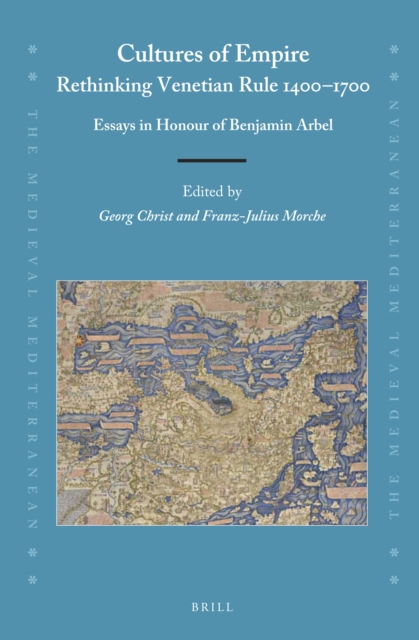
Cultures of Empire: Rethinking Venetian Rule, 1400-1700
This book investigates perceptions, modes, and techniques of Venetian rule in the early modern Eastern Mediterranean (1400-1700). Against the backdrop of the controversial notion of the Venetian realm as a colonial empire, essays from a range of specialists examine how Venice negotiated control over the territories, resources, and traditions of different empires (Byzantine, Roman, Mamluk, Ottoman) while developing its own claims of authority. Focusing in particular on questions of belonging and status in the Venetian overseas territories, the volume incorporates observations on the daily realities of Venetian rule: how did Venice negotiate claims of authority in light of former and ongoing imperial belongings? What was the status of colonial subjects and ships in the metropolis and in foreign territories? In what ways did Venice accept and continue old forms of imperial belonging? Did subordinate entities join in a shared communal identity? The volume opens new perspectives on Venetian rule at the crossroads of empire and early modern statehood: a polity negotiating and entangling empire. Contributors are Housni Alkhateeb Shehada, Georg Christ, Giacomo Corazzol, Nicholas Davidson, Renard Gluzman, Deborah Howard, David Jacoby (z''l), Marianna Kolyvà, Franz-Julius Morche, Reinhold C. Mueller, Monique O'Connell, Gerassimos D. Pagratis, Tassos Papacostas, Maria Pia Pedani (†), Dorit Raines, and E. Natalie Rothman.
eBook

Venice day by day
10 favorite moments -- The best full-day tours -- The best special-interest tours -- The best neighborhood walks -- The best shopping -- The best of the outdoors -- The best dining -- The best nightlife -- The best arts & entertainment -- The best lodging -- The best day trips & excursions -- The savvy traveler.
Book

Sacred plunder : Venice and the aftermath of the Fourth Crusade
In Sacred Plunder, David Perry argues that plundered relics, and narratives about them, played a central role in shaping the memorial legacy of the Fourth Crusade and the development of Venice's civic identity in the thirteenth century. After the Fourth Crusade ended in 1204, the disputes over the memory and meaning of the conquest began. Many crusaders faced accusations of impiety, sacrilege, violence, and theft. In their own defense, they produced hagiographical narratives about the movement of relics—a medieval genre called translatio—that restated their own versions of events and shaped the memory of the crusade. The recipients of relics commissioned these unique texts in order to exempt both the objects and the people involved with their theft from broader scrutiny or criticism. Perry further demonstrates how these narratives became a focal point for cultural transformation and an argument for the creation of the new Venetian empire as the city moved from an era of mercantile expansion to one of imperial conquest in the thirteenth century.
eBook

Fodor's 25 best. Venice
Top 25 Must-See Sights Best bets for dining, lodging, sightseeing. Plus a full-color pullout map. Everything you need to experience Venice. Top lodging and dining picks for every budget All the legendary sights, from the Piazza San Marco to the Grand Canal Traditional trattorias, seafood specialists, pizzerias, wine bars, and gelaterie Centuries of churches: Renaissance, Gothic, and the Byzantine domes of the Basilica di San Marco Side trips to the islands of Murano, Burano, and Torcello Decadent shopping for Murano glass, Carnevale masks, and jewelry.
Book
Aldus Manutius
A fresh reading of Aldus Manutius, preeminent in the history of the printed book. Aldus Manutius is perhaps the greatest figure in the history of the printed book: in Venice, Europe's capital of printing, he invented the italic type and issued more first editions of the classics than anyone before or since, as well as Hypnerotomachia Poliphili, the most beautiful and mysterious printed book of the Italian Renaissance. This is the first monograph in English on Aldus Manutius in over forty years. It shows how Aldus redefined the role of a book printer, from mere manual laborer to a learned publisher. As a consequence, Aldus participated in the same debates as contemporaries such as Leonardo da Vinci and Erasmus of Rotterdam, making this book an insight into their world too.
eBook

Venice : city of pictures
Leading art critic Martin Gayford takes us on a visual journey through the past five centuries of the city known as \"La Serenissima,\" the Most Serene. Venice was a major center of art in the Renaissance: the city where the medium of oil on canvas became the norm. Nowhere else has been depicted by so many great painters in so many diverse styles and moods. Nor is the story over. This is a unique and compelling portrait of Venice that will delight lovers of the city and lovers of its art. -- Adapted from book jacket.
Book

Marriage, Manners and Mobility in Early Modern Venice
Throughout history, marriage has been used as a method of creating and strengthening bonds between elites and the societies over which they ruled. Nowhere is this more apparent than in early modern Venice, where members of the patriciate looked to marital alliances with outsider brides to help maintain their position and social distinction in a fluid society. This book explores the parameters of upward social mobility, contemporary evaluations of social status and moral behaviour, and the place of marriage and concubinage within patrician society. Drawing heavily on the records of the Avogaria di Comun, which had the task of examining the social backgrounds and moral reputations of women from outside the patriciate who wished to marry patricians, this study provides a fascinating reconstruction of Venetian society as it was seen by individuals at every level.
eBook