
Catalogue Search | MBRL


Are you sure you want to remove the book from the shelf?

{{itemTitle}}
45,822
result(s) for
"Verb"
Sort by:


Typology of Pluractional Constructions in the Languages of the World
The aim of this book is to give the first large-scale typological investigation of pluractionality in the languages of the world. Pluractionality is defined as the morphological modification of the verb to express a plurality of situations that can additionally involve a plurality of participants and/or spaces. Based on a 246-language sample, the main characteristics of pluractionality are described and discussed throughout the book. Firstly, a description of the functions that pluractional markers cross-linguistically express is presented and the relationships occurring among them are explained through the semantic map model. Then, the marking strategies that languages display to express such functions are illustrated and some issues concerning the formal identification are briefly discussed as well. The typological generalizations are corroborated showing how pluractional markers work in three specific languages (Akawaio, Beja, Maa). In conclusion, the theoretical conceptualization of pluractionality is discussed referring to the Radical Construction Grammar approach.
eBook


Vietnamese Serial Verb Constructions: Toward Demystifying Verb-Formation Constructions
This paper reviews existing definitions of serial verb constructions (SVCs) and highlights the divergent approaches adopted by linguists in conceptualizing and identifying SVCs across languages. Grounded in Vietnamese grammar-particularly its topic-comment theory-and informed by native speakers’ cognitive frameworks, the study establishes SVC properties that resonate with the internal logic of the Vietnamese language. By aligning cross-linguistic theoretical models with indigenous grammatical intuition, the paper clarifies how Vietnamese speakers distinguish SVCs, both conceptually and functionally. Drawing upon a set of eight proposed properties, the paper categorizes Vietnamese serial verb constructions into two distinct types: non-lexicalized SVCs and lexicalized SVCs. It further demystifies the differences between SVCs and other superficially similar but structurally distinct constructions, including non-lexical autonomous verbal constructions, lexicalized verbal constructions, verb-verb predicate-argument constructions, causative-resultative constructions, and motion verb-directional preposition constructions.
Journal Article


Frame-constructional verb classes : change and theft verbs in English and German
While verb classes are a mainstay of linguistic research, the field lacks consensus on precisely what constitutes a verb class. This book presents a novel approach to verb classes, employing a bottom-up, corpus-based methodology and combining key insights from Frame Semantics, Construction Grammar, and Valency Grammar. On this approach, verb classes are formulated at varying granularity levels to adequately capture both the shared semantic and syntactic properties unifying verbs of a class and the idiosyncratic properties unique to individual verbs. In-depth analyses based on this approach shed light on the interrelations between verbs, frame-semantics, and constructions, and on the semantic richness and network organization of grammatical constructions.This approach is extended to a comparison of Change and Theft verbs, revealing unexpected lexical and syntactic differences across semantically distinct classes. Finally, a range of contrastive (German-English) analyses demonstrate how verb classes can inform the cross-linguistic comparison of verbs and constructions.
eBook


What is “residual verb second”? And what does Romance have to do with it?
This paper aims to clarify a point of persistent confusion in the literature: namely, the status of residual verb second. We approach this from both a terminological and typological perspective. Terminologically, traditional usage of residual V2 in the literature has conflated two different senses (one formal, and one historical); we argue that it is essential to keep these two senses separate. We propose a distinction between partial V2 and residual V2 within the general typology of verb second. Following a formal definition of V2 from the recent literature, we define partial-V2 systems as involving genuine instances of V2 that are limited to nondeclarative environments in a given language (e.g. English). By contrast, we (re)define residual V2 as describing purely vestigial structures that do not qualify as formally V2 in the synchronic grammar of a given language, despite their historical origins in an earlier stage in which the language had true V2. In this respect, almost all modern Romance languages provide clear examples of residual V2: the syntax of these languages is only historically related to V2, with all formal traces of V2 having been long lost, even in nondeclaratives. With these clarifications in place, we propose an updated typology of V2 systems, conceiving of it as a spectrum of degrees from partial V2 through strict V2 (as measured by the set of formally-V2 environments that a given language allows).
Journal Article
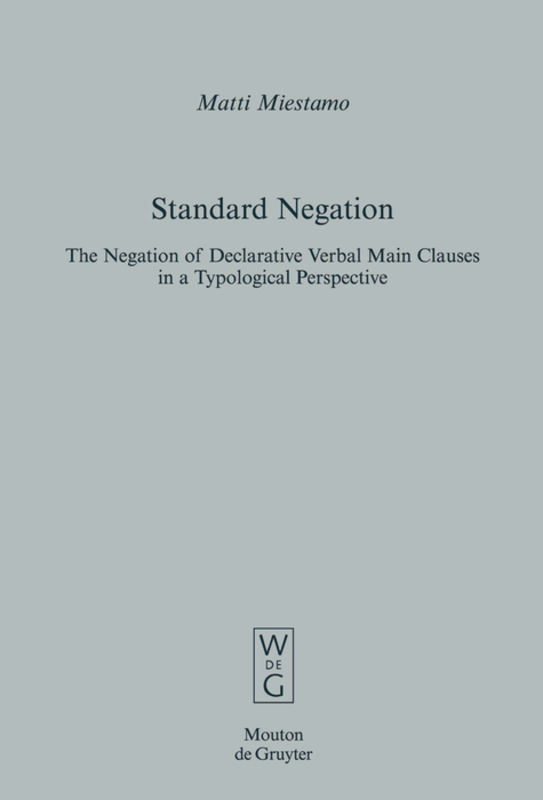
Standard Negation
This book is the first cross-linguistic study of clausal negation based on an extensive and systematic language sample. Methodological issues, especially sampling, are discussed at length. Standard negation – the basic structural means languages have for negating declarative verbal main clauses – is typologized from a new perspective, paying attention to structural differences between affirmatives and negatives. In symmetric negation affirmative and negative structures show no differences except for the presence of the negative marker(s), whereas in asymmetric negation there are further structural differences, i.e. asymmetries. A distinction is made between constructional and paradigmatic asymmetry; in the former the addition of the negative marker(s) is accompanied by further structural differences in comparison to the corresponding affirmative, and in the latter the correspondences between the members of (verbal etc.) paradigms used in affirmatives and negatives are not one-to-one. Cross-cutting the constructional-paradigmatic distinction, asymmetric negation can be further divided into subtypes according to the nature of the asymmetry. Standard negation structures found in the 297 sample languages are exemplified and discussed in detail. The frequencies of the different types and some typological correlations are also examined. Functional motivations are proposed for the structural types – symmetric negatives are language-internally analogous to the linguistic structure of the affirmative and asymmetric negatives are language-externally analogous to different asymmetries between affirmation and negation on the functional level. Relevant diachronic issues are also discussed. The book is of interest to language typologists, descriptive linguists and to all linguists interested in negation.
eBook