
Catalogue Search | MBRL


Are you sure you want to remove the book from the shelf?

{{itemTitle}}
171
result(s) for
"Verbot"
Sort by:


Interface-engineering enhanced light emission from Si/Ge quantum dots
Si quantum dots (QDs) have a significant improvement in luminous efficiency compared with bulk Si, achieved by alleviating the forbiddance of no-phonon Γ-Γ radiative transition determined by the law of momentum conservation. Two divergent mechanisms have been proposed to account for the breakdown of momentum conservation in Si QDs, one is due to the space-confinement-induced spread of k-space wave functions associated with Heisenberg uncertainty principle Δr · Δk > 1/2, and the other is due to the interface-effect-induced intervalley mixing between indirect and direct bandgap states. Both mechanisms could cause a small overlap of the electron and hole wave functions in k-space and make vertical transitions allowed, which leads to the zero-phonon light emission. In this work, we unravel the hierarchical relationship between these two primary mechanisms in the process of zero-phonon light emission from indirect bandgap QDs, by performing semiempirical pseudopotential calculation including many-body interaction on the room-temperature luminescent properties of a series of Si, Ge, and Ge/Si core/shell QDs. We show that the space confinement mechanism is dominant in both Si and Ge indirect bandgap QDs, and the interface-induced intervalley coupling mechanism plays a minor role. While in Ge/Si core/shell QDs, the interface-induced intervalley coupling mechanism has a more pronounced contribution to enhanced light emission, implying one can further enhance light emission via engineering interface based on the intervalley coupling mechanism. Given this, we further engineer the Ge QD interface by bringing four motifs of Si/Ge multiple layers from previously inverse designed Si/Ge superlattices and core/shell nanowires for light emitters. We show that two out of four motifs always give rise to two orders of magnitude enhancement in light emission relative to the Ge and Si QDs. We demonstrate that the interface engineering can enhance light emission in indirect bandgap QDs substantially and regulate the intervalley coupling mechanism as the primary factor over the space confinement mechanism in breaking the momentum conservation law.
Journal Article

The role of chatterbots in enhancing tourism: a case study of Penang tourism spots
Chatterbots have been widely used as a tool for conversational booking assistance mainly for hotels such as the Expedia. This paper extends the use of chatterbot beyond booking by presenting the proof of concept of a chatterbot expert system called the VIZARD. The proposed VIZARD is developed using an expert system shell called verbot. The core of Vertbot 5 is the natural language processing (NLP) engine based on pattern matching. The core Verbot 5 engine is responsible for finding matches to a given user input string and firing the appropriate rule. The findings from the user acceptance test concluded that majority of the respondents agreed that the VIZARD expert system stands at an unbiased state while being more aligned on supporting the usefulness of the system.
Journal Article

Forbidden : receiving Pope Francis's condemnation of nuclear weapons
Moral theologians, defense analysts, conflict scholars, and nuclear experts imagine a world free from nuclear weapons
At a 2017 Vatican conference, Pope Francis condemned nuclear weapons. This volume, issued after the 60th anniversary of the Cuban Missile Crisis, presents essays from moral theologians, defense analysts, conflict transformation scholars, and nuclear arms control experts, with testimonies from witnesses. It is a companion volume to A World Free from Nuclear Weapons: The Vatican Conference on Disarmament (Georgetown University Press, 2020).
Chapters from the perspectives of missile personnel and the military chain of command, industrialists and legislators, and citizen activists show how we might achieve a nuclear-free world. Key to this transition is the important role of public education and the mobilization of lay movements to raise awareness and effect change. This essential collection prepares military professionals, policymakers, everyday citizens, and the pastoral workers who guide them, to make decisions that will lead us to disarmament.
eBook

Gibt es ein Recht auf ein Kind?
Wünsche verwandeln sich in unserer Gesellschaft mitunter in vermeintliche Rechtsansprüche; aus einem gehegten, innigen Kinderwunsch wird ein gebieterisch eingefordertes „Recht auf ein (eigenes) Kind“, das dann noch bestimmten Anforderungen genügen soll. Der Beitrag untersucht, welche Grundrechte in welcher Dimension hier ins Feld geführt werden können und wie weit sie tragen. Abschließend wird die Frage behandelt, ob und gegebenenfalls welche Rechte umgekehrt ein Kind in Bezug auf Eltern und Familie geltend machen kann.
Journal Article

Sacrificium Intellectus?
Christian theology conceives of ‘sacrificium intellectus’ to account for the message of Saint Paul that he will “take every thought captive to obey Christ” (2 Corinthians 10:5). Human insight gives way to the revealed truths of religion. In modern western cultures to explain the natural world has become the domain of science, and the imposition of collective rules of how we should live was shifted to democratically elected parliaments. In Germany legislation of bioethical issues is often justified with reasons that violate standards of cognitive rationality. Is this another case of sacrificium intellectus? The Federal Constitutional Court refrains from the control of legislative arguments by conceding a broad margin of appreciation for the legislator. People have, however, a right to justification; they must not be subjected to arbitrary legal power. While the practice of democratic rule may seldom comply with the expectations of ‘government by discussion’, it is neither likely to gain acceptance as ‘government without discussion’. To impose legal force on the basis of false arguments and unsound reasoning is not a legitimate sacrificium intellectus, it is an intellectual scandal.
Journal Article

Israeli Settlements and Unlawful Population Transfer into Occupied Territory — with Special Focus on “Indirect Transfers” According to Article 8 (2) (b) (viii) of the ICC Statute
International law prohibits the transfer of population into occupied territory. As there is no provision defining the term nor jurisprudence interpreting it, the precise and correct meaning of the prohibition has been highly debated. The prohibition was first stipulated in Article 49 (6) GC IV and is echoed in Article 8 (2) (b) (viii) ICC Statute by mainly using the same wording. However, in contrast to the convention-based norm, Article 8 (2) (b) (viii) ICC Statute additionally specifies that any transfer, “directly or indirectly”, constitutes a violation of international law. The inclusion of these words gives further rise to the challenge of interpreting this provision. By scrutinising the Israeli settlement project, the article therefore aims at identifying which state conduct amounts to a ‘population transfer’ with an emphasis on the specific forms of ‘indirect population transfers’.
Das Völkerrecht verbietet die Überführung von Teilen der eigenen Zivilbevölkerung durch die Besatzungsmacht in von ihr besetztes Gebiet. Da der Begriff der Bevölkerungsüberführung in keiner Vorschrift definiert ist und auch keine Erläuterung durch die völkerrechtliche Rechtsprechung erfahren hat, ist umstritten, welche Verhaltensweisen hiervon erfasst sind. Das Verbot wurde erstmals in Artikel 49 Abs. 6 der IV. Genfer Konvention kodifiziert und findet sich mit weitgehend identischem Wortlaut in Artikel 8 Abs. 2 lit. b (viii) IStGH-Statut wieder. Neu ist indes die Ergänzung der Tathandlung der Überführung durch die Worte „direkt oder indirekt“. Der Beitrag soll daher im Lichte des israelischen Siedlungsbaus untersuchen, welche staatlichen Verhaltensweisen unter den Tatbestand fallen, wobei der Schwerpunkt auf Formen der indirekten Bevölkerungsüberführung liegt.
Journal Article
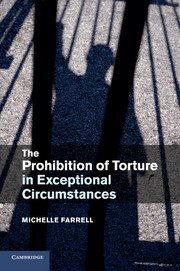
The Prohibition of Torture in Exceptional Circumstances
Can torture be justified in exceptional circumstances? In this timely work, Michelle Farrell asks how and why this question has become such a central debate. She argues that the ticking bomb scenario is a fiction which blinds us to the reality of torture and investigates what it is that that scenario fails to represent. Farrell aims to reframe how we think about torture, and critically reflects on the historical and contemporary approaches to its use in exceptional situations. She demonstrates how torture, from its use in Algeria to the 'War on Terror', has been misrepresented, and appraises the legalist, extra-legalist and absolutist assessments of exception to the torture prohibition. Employing Giorgio Agamben's theory of the state of exception as a foil, Farrell deconstructs these approaches and goes on to propose her own theory of exceptional torture.
eBook

Wege des völkerrechtlichen Umgangs mit Kampfdrohnen
Due to both the growing number of military operations carried out by unmanned combat air vehicles (UCAVs) and the increase in production of UCAVs, a response of the international community is imperative. But what is the adequate reaction on this futuristic drone technology? After pointing out the danger of the trend to full autonomy of UCAVs and existing initiatives against such a development, this paper turns the spotlight to Public International Law and the question whether a general prohibition of UCAV missions already exists. Furthermore, it describes effective steps for the inclusion of UCAVs in existing treaty regimes like the Treaty on Conventional Armed Forces in Europe, the Missile Technology Control Regime and the Arms Trade Treaty. The article concludes that disarmament measures and arms control instruments already exist. They only have to be used by the international community to guarantee operative global control of UCAVs.
Journal Article
Israeli Settlements and Unlawful Population Transfer into Occupied Territory — with Special Focus on “Indirect Transfers” According to Article 8 (2) (b) (viii) of the ICC Statute
International law prohibits the transfer of population into occupied territory. As there is no provision defining the term nor jurisprudence interpreting it, the precise and correct meaning of the prohibition has been highly debated. The prohibition was first stipulated in Article 49 (6) GC IV and is echoed in Article 8 (2) (b) (viii) ICC Statute by mainly using the same wording. However, in contrast to the convention-based norm, Article 8 (2) (b) (viii) ICC Statute additionally specifies that any transfer, “directly or indirectly”, constitutes a violation of international law. The inclusion of these words gives further rise to the challenge of interpreting this provision. By scrutinising the Israeli settlement project, the article therefore aims at identifying which state conduct amounts to a ‘population transfer’ with an emphasis on the specific forms of ‘indirect population transfers’.
Das Völkerrecht verbietet die Überführung von Teilen der eigenen Zivilbevölkerung durch die Besatzungsmacht in von ihr besetztes Gebiet. Da der Begriff der Bevölkerungsüberführung in keiner Vorschrift definiert ist und auch keine Erläuterung durch die völkerrechtliche Rechtsprechung erfahren hat, ist umstritten, welche Verhaltensweisen hiervon erfasst sind. Das Verbot wurde erstmals in Artikel 49 Abs. 6 der IV. Genfer Konvention kodifiziert und findet sich mit weitgehend identischem Wortlaut in Artikel 8 Abs. 2 lit. b (viii) IStGH-Statut wieder. Neu ist indes die Ergänzung der Tathandlung der Überführung durch die Worte „direkt oder indirekt“. Der Beitrag soll daher im Lichte des israelischen Siedlungsbaus untersuchen, welche staatlichen Verhaltensweisen unter den Tatbestand fallen, wobei der Schwerpunkt auf Formen der indirekten Bevölkerungsüberführung liegt.
Journal Article