
Catalogue Search | MBRL


Are you sure you want to remove the book from the shelf?

{{itemTitle}}
669
result(s) for
"Versification."
Sort by:


Pushkin’s Rhyming
The culmination of four decades of work by J. Thomas Shaw, this fully searchable e-book carefully analyzes, both chronologically and by genre, Alexander Pushkin’s use of rhyme to show how meaning shifts in tandem with formal changes. Comparing Pushkin’s poetry with that of Konstantin Nikolaevich Batiushkov (1787–1855) and Evgeny Abramovich Baratynsky (1800–1844), Shaw considers, among other topics, what is exact and inexact in “exact” rhyme, how the grammatical characteristics of rhymewords affect the reader’s percepetion of the poem and its rhyme, and how the repetition of a rhyming word can also change meaning. Each of the five chapters analyzes in detail a distinct aspect of rhyme and provides rich resources for future scholars in the accompanying tables of data. The extensive back matter in the book includes a glossary, abbreviations list, bibliography, and indexes of poems cited, names, and rhyme types and analyses.
eBook

The rise and fall of meter
Why do we often teach English poetic meter by the Greek terms iamb and trochee? How is our understanding of English meter influenced by the history of England's sense of itself in the nineteenth century? Not an old-fashioned approach to poetry, but a dynamic, contested, and inherently nontraditional field, \"English meter\" concerned issues of personal and national identity, class, education, patriotism, militarism, and the development of English literature as a discipline.The Rise and Fall of Metertells the unknown story of English meter from the late eighteenth century until just after World War I. Uncovering a vast and unexplored archive in the history of poetics, Meredith Martin shows that the history of prosody is tied to the ways Victorian England argued about its national identity. Gerard Manley Hopkins, Coventry Patmore, and Robert Bridges used meter to negotiate their relationship to England and the English language; George Saintsbury, Matthew Arnold, and Henry Newbolt worried about the rise of one metrical model among multiple competitors. The pressure to conform to a stable model, however, produced reactionary misunderstandings of English meter and the culture it stood for. This unstable relationship to poetic form influenced the prose and poems of Robert Graves, Siegfried Sassoon, Wilfred Owen, W. B. Yeats, Ezra Pound, and Alice Meynell. A significant intervention in literary history, this book argues that our contemporary understanding of the rise of modernist poetic form was crucially bound to narratives of English national culture.
eBook

Understanding French verse : a guide for singers
This guide is aimed at singers & singing teachers interested in French song repertoire. In a clear & concise way, using examples from well-known song settings, it sets out the basics of French versification, showing how an understanding of verse techniques can enhance the interpretation of the French 'mélodie'.
Book

Talking the Walk & Walking the Talk: A Rhetoric of Rhythm
This book argues that we should regard walking and talking in a single rhythmic vision. In doing so, it contributes to the theory of prosody, our understanding of respiration and looking, and, in sum, to the particular links, across the board, between the human characteristics of bipedal walking and meaningful talk. The author first introduces the philosophical, neurological, anthropological, and aesthetic aspects of the subject in historical perspective, then focuses on rhetoric and introduces a tension between the small and large issues of rhythm. He thereupon turns his attention to the roles of breathing in poetry--as a life-and-death matter, with attention to beats and walking poems. This opens onto technical concepts from the classical traditions of rhetoric and philology. Turning to the relationship between prosody and motion, he considers both animals and human beings as both ostensibly able-bodied creatures and presumptively disabled ones. Finally, he looks at dancing and writing as aspects of walking and talking, with special attention to motion in Arabic and Chinese calligraphy. The final chapters of the book provide a series of interrelated representative case studies.
eBook

Rhyme's reason : a guide to English verse
Poet John Hollander surveys the schemes, patterns, and forms of English verse in this classic text, illustrating each variation with an original and witty self-descriptive example. In new essays for this fourth edition, J.D. McClatchy and Richard Wilbur each offer a personal take on why the book has played such an important role in the education of young poets and student scholars.
Book
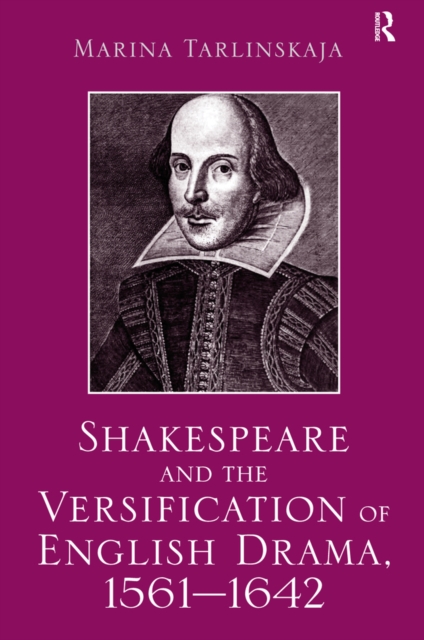
Shakespeare and the Versification of English Drama, 1561-1642
Surveying the development and varieties of blank verse in the English playhouses, this book is a natural history of iambic pentameter in English. The main aim of the book is to analyze the evolution of Renaissance dramatic poetry. Shakespeare is the central figure of the research, but his predecessors, contemporaries and followers are also important: Shakespeare, the author argues, can be fully understood and appreciated only against the background of the whole period. Tarlinskaja surveys English plays by Elizabethan, Jacobean and Caroline playwrights, from Norton and Sackville’s Gorboduc to Sirley’s The Cardinal. Her analysis takes in such topics as what poets treated as a syllable in the 16th-17th century metrical verse, the particulars of stressing in iambic pentameter texts, word boundary and syntactic segmentation of verse lines, their morphological and syntactic composition, syllabic, accentual and syntactic features of line endings, and the way Elizabethan poets learned to use verse form to enhance meaning. She uses statistics to explore the attribution of questionable Elizabethan and Jacobean plays, and to examine several still-enigmatic texts and collaborations. Among these are the poem A Lover's Complaint, the anonymous tragedy Arden of Faversham, the challenging Sir Thomas More, the later Jacobean comedy The Spanish Gypsy, as well as a number of Shakespeare’s co-authored plays. Her analysis of versification offers new ways to think about the dating of plays, attribution of anonymous texts, and how collaborators divided their task in co-authored dramas.
1 Why Study Versification? Versification Analysis; Tests
2 How It All Began: From Surrey's Aeneid to Marlowe's Tamburlaine
3 Early Elizabethan Playwrights: Kyd, Marlowe, Greene, Peele, Early Shakespeare. 2, 3 Henry VI and Arden of Faversham
4 Shakespeare's Versification: Evolution. Co-Authored Plays. The Poem A Lover's Complaint
5 Jacobean and Caroline Playwrights: From Shakespeare to Shirley
6 Conclusions: Shakespeare and Versification, 1540s - 1640s
Appendix A: Verse Form and Meaning: Rhythmical Italics
Appendix B: General Tables B.1 - B.16
Marina Tarlinskaja is Research Professor of Linguistics at the University of Washington, USA.
eBook

Seamus Heaney's rhythmic contract
\"While glosses on Heaney's verse forms figure more or less in critical accounts of his poetry, this is the first book to take the craft of his art as its focus. Setting out a historically informed approach to poetic form, the book places Heaney's developing versification in the context of mid-century Anglo-American theories of metre and rhythm\"--Provided by publisher.
Book

Authors, Audiences, and Old English Verse
Authors, Audiences, and Old English Versere-examines the Anglo-Saxon poetic tradition from the eighth to the eleventh centuries and reconsiders the significance of formulaic parallels and the nature of poetic authorship in Old English.
eBook