
Catalogue Search | MBRL


Are you sure you want to remove the book from the shelf?

{{itemTitle}}
7,564
result(s) for
"Vertebrates Reproduction."
Sort by:


Thyrotrophin in the pars tuberalis triggers photoperiodic response
Molecular mechanisms regulating animal seasonal breeding in response to changing photoperiod are not well understood. Rapid induction of gene expression of thyroid-hormone-activating enzyme (type 2 deiodinase,
DIO2
) in the mediobasal hypothalamus (MBH) of the Japanese quail (
Coturnix japonica
) is the earliest event yet recorded in the photoperiodic signal transduction pathway. Here we show cascades of gene expression in the quail MBH associated with the initiation of photoinduced secretion of luteinizing hormone. We identified two waves of gene expression. The first was initiated about 14 h after dawn of the first long day and included increased thyrotrophin (TSH) β-subunit expression in the pars tuberalis; the second occurred approximately 4 h later and included increased expression of
DIO2
. Intracerebroventricular (ICV) administration of TSH to short-day quail stimulated gonadal growth and expression of
DIO2
which was shown to be mediated through a TSH receptor–cyclic AMP (cAMP) signalling pathway. Increased TSH in the pars tuberalis therefore seems to trigger long-day photoinduced seasonal breeding.
Spring in their step
In spring, many animals start to become reproductively active. They are generally responding to the longer day lengths at this time of the year, but the molecular pathways that mediate the response are not fully understood. Experiments in the Japanese quail, a well established model for studying photoperiodism, have identified the expression of the thyroid-stimulating hormone thyrotrophin in the pars tuberalis, part of the anterior lobe of the pituitary gland, as a critical event in triggering this photoperiodic response. Two waves of gene expression are involved, the first at about 14 hours after dawn on the first 'long' day, and a second a few hours later.
This paper examines the changes in gene expression during the first exposure to a long day (such as those found in spring) in Japanese quails and find that two waves of genes are induced as part of the photoperiodic response. This paper also identifies thyrotrophin expression in the pars tuberalis as a critical event in triggering this photoperiodic response.
Journal Article

Identification of Germline Stem Cells in the Ovary of the Teleost Medaka
Germline stem cells continually produce sperm in vertebrate testes, whereas there is no direct evidence showing that germline stem cells are present in adult vertebrate ovaries. By using transgenic methods and clonal analysis, we identified germline stem cells that supported oogenesis and the production of offspring in the ovaries of adult medaka fish. Early-stage germ cells were localized in clusters along interwoven threadlike cords of sox9b-expressing somatic cells (termed germinal cradles) where the germ cells developed. Germline stem cells gave rise to germ cells that divided to produce cysts, which then underwent cell death or separated to form follicles. Our results provide insight into the germline stem cell biology of medaka and provide a model system for studying vertebrate stem cell niches.
Journal Article

Molecular Identification and Functional Characterization of the Kisspeptin/Kisspeptin Receptor System in Lower Vertebrates
The KISS1 gene encodes the kisspeptin neuropeptide, which activates the KISS1 receptor (KISS1R; G protein-coupled receptor 54; GPR54) and participates in neuroendocrine regulation of GnRH secretion. To study the physiological function(s) and evolutionary conservation of KISS1, we cloned opossum, Xenopus, and zebrafish kiss1 cDNAs. Processing zebrafish, Xenopus, or opossum KISS proteins would liberate a carboxy-terminal amidated peptide with 52, 54, or 53 amino acid residues, respectively. Phylogenetic analysis of all known vertebrate KISS1 peptides showed clear clustering of the sequences according to canonical vertebrate classes. The zebrafish kiss1 gene consists of two exons and one intron. Real-time PCR analysis of two kiss1R cloned from zebrafish brain found expression of kiss1, kiss1ra, and kiss1rb, with kiss1ra--more similar to other piscine Kiss1 receptors--highly expressed in the gonads and kiss1rb in other nonbrain tissues. In females kiss1 mRNA levels gradually increased during the first few weeks of life to peak in fish with ovaries containing mature oocytes, while in males kiss1 mRNA levels peaked after 6 wk postfertilization when the testes exhibited initial stages of spermatogenesis and decreased after puberty. Zebrafish kiss1ra and kiss1rb were expressed differentially with similar patterns in both genders. These results indicate that the Kiss1/Kiss1r system may participate in puberty initiation in fish as well. Like human KISS1R, Kiss1ra transduces its activity via the PKC pathway, whereas Kiss1rb does so via both PKC and PKA pathways. The human KISS1R was highly activated by both huKISS10amide and zfKISS10amide, whereas both zebrafish Kiss1 receptor types were less sensitive to amidation.
Journal Article
Rainbow trout gonadal masculinization induced by inhibition of estrogen synthesis is more physiological than masculinization induced by androgen supplementation
The present study was designed to obtain new insights into fish gonadal sex differentiation by comparing the effects of two different masculinizing treatments on some candidate gene expression profiles. Masculinization was induced in rainbow trout, Oncorhynchus mykiss, genetic all-female populations using either an active fish androgen (11betaAnd, 11-betahydroxyandrostenedione) or an aromatase inhibitor (ATD, 1,4,6-androstatriene-3,17-dione). The expression profiles of 100 candidate genes were obtained by real-time RT-PCR, and 46 profiles displayed a significant differential expression between control populations (males and females) and ATD/11betaAnd-treated populations. These expression profiles were grouped in four temporally correlated expression clusters. Among the common responses shared by the two masculinizing treatments, the inhibition of some early female differentiating genes (cyp19a1, foxI2a, fst, and fshb) appears to be crucial for effective masculinization, suggesting that these genes act together via a short regulation loop to maintain high sex-specific ovarian expression of cyp19a1. This simultaneous down-regulation of female-specific genes could be triggered by some testicular genes, such as dmrt1, nr0b1 (also known as dax1), and pdgfra, which are quickly up-regulated by the two masculinizing treatments. In contrast to 11betaAnd, ATD quickly restored the expression levels of steroidogenesis related genes (cyp11b2.1, cyp11b2.2, hsd3b1, cyp17a, star, and nr5a1) and some Sertoli cell markers (sox9a2 and amh) to the expression levels observed during control testicular differentiation. This demonstrates that these genes are probably not needed for active masculinization and that the inhibition of endogenous estrogen synthesis produces a much more complete and specific testicular pattern of gene expression than that observed following androgen-induced masculinization.
Journal Article
Male Attractiveness and Differential Testosterone Investment in Zebra Finch Eggs
Good-genes hypotheses of sexual selection predict that offspring fathered by preferred males should have increased viability resulting from superior genetic quality. Several studies of birds have reported findings consistent with this prediction, but maternal effects are an important confounding variable. Those studies that have attempted to control for maternal effects have only considered differential maternal investment after egg laying. However, female birds differentially deposit testosterone in the eggs, and this influences the development of the chick. This study shows that female birds deposit higher amounts of testosterone and 5α-dihydrotestosterone in their eggs when mated to more attractive males.
Journal Article
Molecular Mechanisms Determining Sperm Motility Initiation in Two Sparids (Sparus aurata and Lithognathus mormyrus)
Molecular mechanisms involved in sperm motility initiation in two sparids (Sparus aurata and Lithognathus mormyrus) have been studied. Our comparative study demonstrates that osmolality is the key signal in sperm motility activation in both species, whereas K+ and Ca2+ do not have any role. The straight-line velocity that resulted, however, was significantly different when measured in sperm activated with non-ionic and/or calcium-free solutions with respect to that measured in seawater-activated sperm. In both species, motility initiation depends on cAMP-dependent protein phosphorylation. The phosphorylation/dephosphorylation patterns that resulted in gilthead and striped sea bream were quite different. In gilthead sea bream, the phosphorylated proteins have molecular weights of 174, 147, 138, 70, and 9-15 kDa, whereas the dephosphorylated proteins have molecular weights of 76, 57, and 33 kDa. In striped sea bream, phosphorylation after sperm motility activation occurred on proteins of 174, 147, 103, 96, 61, 57, and 28 kDa, whereas only one protein of 70 kDa resulted from dephosphorylation. Matrix-assisted laser desorption ionization-time of flight analyses allowed identification of the following proteins: In gilthead sea bream, the 9-15 kDa proteins that were phosphorylated after motility activation include an A-kinase anchor protein (AKAP), an acetyl-coenzyme A synthetase, and a protein phosphatase inhibitor, and in striped sea bream, 103- and 61-kDa proteins that were phosphorylated after motility activation were identified as a phosphatase (myotubularin-related protein 1) and a kinase (DYRK3), respectively.
Journal Article
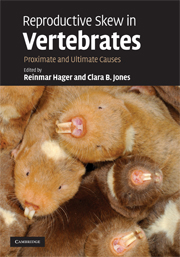
Reproductive Skew in Vertebrates
Reproductive skew is the study of how reproduction is partitioned in animal societies. In many social animals reproduction is shared unequally and leads to a reproductive skew among group members. Skew theory investigates the genetic and ecological factors causal to the partitioning of reproduction in animal groups and may yield fundamental insights into the evolution of animal sociality. This book brings together new theory and empirical work, mostly in vertebrates, to test assumptions and predictions of skew models. It also gives an updated critical review of skew theory. The team of leading contributors cover a wide range of species, from insects to humans, and discuss both ultimate (evolutionary) and proximate (immediate) factors influencing reproductive skew. Academic researchers and graduate students alike with an interest in evolution and sociality will find this material stimulating and exciting.
eBook
Dual Roles of cyp19a1a in Gonadal Sex Differentiation and Development in the Protandrous Black Porgy, Acanthopagrus schlegeli
Protandrous black porgy fish, Acanthopagrus schlegeli, have a striking life cycle, with male sex differentiation at the juvenile stage, a bisexual gonad during first 2 yr of life, and a male-to-female sex change (with vitellogenic oocytes) at 3 yr of age. The present study investigated the role of aromatase (cyp19a1a/Cyp19a1a) in gonadal development in this species, especially in relation to sexual differentiation and sex change. Fish of various ages were treated with estradiol (E₂) or aromatase inhibitor (AI) to determine whether manipulation of the hormonal environment has an impact on these processes. We report an integrative immunohistochemical, cellular, and molecular data set describing these interesting phenomena. During male sex differentiation, high levels of cyp19a1a/Cyp19a1a expression were observed in the undifferentiated gonad (4 mo of age), in marked contrast to the low cyp19a1a/Cyp19a1a levels detected in the differentiated testis at the age of 5-6 mo. A low dose of E₂ (0.25 mg/kg feed) stimulated testicular growth and function in sexually differentiated fish, whereas a high dose of E₂ (6 mg/kg feed) induced female development. Furthermore, administration of AI suppressed male development and promoted female sexual differentiation. An increased number of figla transcripts (an oocyte-specific gene) were observed prior to cyp19a1a expression, concomitant with the development of oogonia and early primary oocytes in the ovaries of both E₂- and AI-treated groups. Immunohistochemical Pcna staining showed that the regression of testicular tissue occurred prior to the development of ovarian tissue in both E₂- and AI-induced females. The importance of cyp19a1a in female development was further demonstrated by the increase in cyp19a1a transcripts during the naturally occurring sex change. Transcripts of foxl2 increased in the gonads of 2- to 3-yr-old black porgy during the early stages of the natural sex change, followed by a gradual elevation of cyp19a1a levels. The levels of both genes peaked in the resulting ovarian tissue. Thus, cyp19a1a/Cyp19a1a plays dual roles in the gonadal development, namely, in testicular development during the initial period of sexual differentiation and later in ovarian development during the natural sex change.
Journal Article
