
Catalogue Search | MBRL


Are you sure you want to remove the book from the shelf?

{{itemTitle}}
58
result(s) for
"Violence Social aspects United States History 20th century."
Sort by:

Blood, sweat, and fear : violence at work in the North American auto industry, 1960-80
\"Going postal. We think of the rogue employee who snaps. But in Blood, Sweat, and Fear, Jeremy Milloy demonstrates that workplace violence never occurs in isolation. Using violence as a lens, he provides fresh and original insights into the everyday workings of capitalism, class conflict, race, and gender in the United States and Canada of the late twentieth century, bringing historical perspective to contemporary debates about North American violence. Blood, Sweat, and Fear is the first full-length historical exploration of the origins and effects of individual violence in the automotive industry. Milloy's gripping analysis spans 1960 to 1980, when North American auto plants were routinely the sites of fights, assaults, and even murders. He argues that the high levels of violence were primarily the result of workplace conditions - including on-the-job exploitation, racial tension, bureaucratization, and hypermasculinity - that made fear and loathing a shop-floor reality long before mass shootings attracted media attention in the 1980s. Workplace violence is typically the domain of management studies and psychology, but while we pass legislation and adopt best practices, the problem continues. Milloy's explosive book reveals that workplace violence has been a constant aspect of class conflict - and that our understanding needs to go deeper\"-- Provided by publisher.
Book

Represent and Destroy
In the global convulsions in the aftermath of World War II, one dominant world racial order broke apart and a new one emerged. In Represent and Destroy, Jodi Melamed portrays the postwar racial break as a transition from white supremacist modernity to a formally antiracist liberal capitalist modernity in which racial violence works normatively by policing representations of difference.
eBook


Intimate Enemies
In the aftermath of a civil war, former enemies are left living side by side-and often the enemy is a son-in-law, a godfather, an old schoolmate, or the community that lies just across the valley. Though the internal conflict in Peru at the end of the twentieth century was incited and organized by insurgent Senderistas, the violence and destruction were carried out not only by Peruvian armed forces but also by civilians. In the wake of war, any given Peruvian community may consist of ex-Senderistas, current sympathizers, widows, orphans, army veterans-a volatile social landscape. These survivors, though fully aware of the potential danger posed by their neighbors, must nonetheless endeavor to live and labor alongside their intimate enemies. Drawing on years of research with communities in the highlands of Ayacucho, Kimberly Theidon explores how Peruvians are rebuilding both individual lives and collective existence following twenty years of armed conflict.Intimate Enemiesrecounts the stories and dialogues of Peruvian peasants and Theidon's own experiences to encompass the broad and varied range of conciliatory practices: customary law before and after the war, the practice ofarrepentimiento(publicly confessing one's actions and requesting pardon from one's peers), a differentiation between forgiveness and reconciliation, and the importance of storytelling to make sense of the past and recreate moral order. The micropolitics of reconciliation in these communities present an example of postwar coexistence that deeply complicates the way we understand transitional justice, moral sensibilities, and social life in the aftermath of war. Any effort to understand postconflict reconstruction must be attuned to devastation as well as to human tenacity for life.
eBook

The harvest of American racism : the political meaning of violence in the summer of 1967
\"In the summer of 1967, in response to violent demonstrations that rocked 164 cities across the U.S., the National Advisory Commission on Civil Disorders, commonly known as the Kerner Commission, was formed. As part of its work, the Commission employed social scientists to research the root causes of the disturbances, including the role that law enforcement played. Chief among its research projects was a study of 23 American cities, headed by social psychologist Robert Shellow. Shellow's social scientists worked from the vast material brought back by teams of Commission investigators who fanned out across those cities, conducting interviews and gathering data. An early draft of the scientists' analysis was delivered on November 22, 1967. Their report, titled \"The Harvest of American Racism: The Political Meaning of Violence in the Summer of 1967\" provoked the Commission's staff by uncovering political causes for the unrest; the team of researchers was fired, and the controversial report remained buried at the LBJ Presidential Library until now. The first publication of the Harvest report half a century later reveals that many of the issues it describes are still with us, including how cities might more effectively and humanely react to groups and communities in protest.\"--Provided by publisher.
BOOK
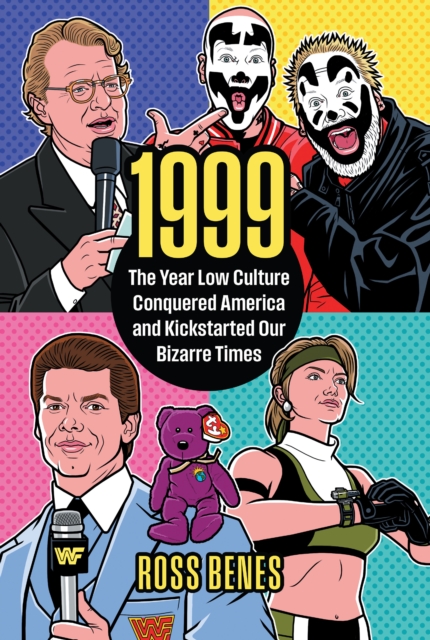
1999
From pro wrestling and Pokémon to Insane Clown Posse
and Jerry Springer, this look at the low culture of the late
’90s reveals its profound impact and how it continues to
affect our culture and society today.
The year 1999 was a high-water mark for popular culture.
According to one measure, it was the “best movie year
ever.” But as journalist Ross Benes shows, the end of the
’90s was also a banner year for low culture. This was the
heyday of Jerry Springer, Jenna Jameson, and Vince McMahon, among
many others. Low culture had come into its own and was poised for
world domination. The reverberations of this takeover continue to
shape American society.
During its New Year’s Eve countdown, MTV entered 1999
with Limp Bizkit covering Prince’s famous anthem to the new
year. The highlights of the lowlights continued when WCW and WWE
drew 35 million American viewers each week with sex appeal and
stories about insurrections. Insane Clown Posse emerged from the
underground with a Woodstock set and platinum records about magic
and murder. Later that year,
Dance Dance Revolution debuted in North America and
Grand Theft Auto emerged as a major video game
franchise. Beanie Babies and Pokémon so thoroughly seized
the wallets and imagination of collectors that they created
speculative investment bubbles that anticipated the faddish
obsession over nonfungible tokens (NFTs). The trashy talk show
Jerry Springer became daytime TV’s most-watched
program and grew so mainstream that
Austin Powers ,
Sabrina the Teenage Witch ,
The Wayans Bros. ,
The Simpsons , and
The X-Files incorporated Springer into their own plots
during the late ’90s. Donald Trump even explored a
potential presidential nomination with the Reform Party in 1999
and wanted his running mate to be Oprah Winfrey, whose own talk
show would make Dr. Oz a household name.
Benes shows us how so
many of the strangest features of culture in 1999 predicted and
influenced American life today. This wild ride through pop
culture uncovers the connections between the kayfabe of WWE and
the theatrics of politics, between the faddish obsession with
Beanie Babies and with NFTs, between faithful fans and political
loyalists, between violent video games and society’s
scapegoats, and much more.
1999 is not just a nostalgic look at the past. It is
also a window into our contentious present.
eBook

From the Land of Shadows : War, Revolution, and the Making of the Cambodian Diaspora
\"In a century of mass atrocities, the Khmer Rouge regime marked Cambodia with one of the most extreme genocidal instances in human history. What emerged in the aftermath of the regime's collapse in 1979 was a nation fractured by death and dispersal. It is estimated nearly one-fourth of the country's population perished from hard labor, disease, starvation, and executions. Another half million fled their ancestral homeland, with over one hundred thousand people finding refuge in America. From The Land of Shadows surveys the Cambodian diaspora and the struggle to understand and make meaning of this historical trauma. Drawing on over 250 interviews with survivors across the United States as well as in France and Cambodia, Khatharya Um places these accounts in conversation with studies of comparative revolutions, totalitarianism, transnationalism, and memory works to illuminate the pathology of power as well as the impact of auto-genocide on individual and collective healing. Exploring the interstices of home and exile, forgetting and remembering, From the Land of Shadows follows the ways in which Cambodian individuals and communities seek to rebuild connections frayed by time, distance, and politics in the face of this injurious history\"--From publisher's website.
Book

Mourning in America
Recent years have brought public mourning to the heart of American politics, as exemplified by the spread and power of the Black Lives Matter movement, which has gained force through its identification of pervasive social injustices with individual losses. The deaths of Sandra Bland, Michael Brown, Freddie Gray, Trayvon Martin, Tamir Rice, Walter Scott, and so many others have brought private grief into the public sphere. The rhetoric and iconography of mourning has been noteworthy in Black Lives Matter protests, but David W. McIvor believes that we have paid too little attention to the nature of social mourning-its relationship to private grief, its practices, and its pathologies and democratic possibilities.
InMourning in America, McIvor addresses significant and urgent questions about how citizens can mourn traumatic events and enduring injustices in their communities. McIvor offers a framework for analyzing the politics of mourning, drawing from psychoanalysis, Greek tragedy, and scholarly discourses on truth and reconciliation.Mourning in Americaconnects these literatures to ongoing activism surrounding racial injustice, and it contextualizes Black Lives Matter in the broader politics of grief and recognition. McIvor also examines recent, grassroots-organized truth and reconciliation processes such as the Greensboro Truth and Reconciliation Commission (2004-2006), which provided a public examination of the Greensboro Massacre of 1979-a deadly incident involving local members of the Communist Workers Party and the Ku Klux Klan.
eBook

The broken country : on trauma, a crime and the continuing legacy of Vietnam
The Broken Country uses a violent incident that took place in Salt Lake City, Utah, in 2012 as a springboard for examining the long-term cultural and psychological effects of the Vietnam War. To make sense of the shocking and baffling incident--in which a young homeless man born in Vietnam stabbed a number of white men purportedly in retribution for the war--Paisley Rekdal draws on a remarkable range of material and fashions it into a compelling account of the dislocations suffered by the Vietnamese and also by American-born veterans over the past decades. She interweaves a narrative about the crime with information collected in interviews, historical examination of the arrival of Vietnamese immigrants in the 1970s, a critique of portrayals of Vietnam in American popular culture, and discussions of the psychological consequences of trauma. This work allows us to better understand transgenerational and cultural trauma and advances our still complicated struggle to comprehend the war.
Book

Kingdom to Commune
American religious pacifism is usually explained in terms of its practitioners' ethical and philosophical commitments. Patricia Appelbaum argues that Protestant pacifism, which constituted the religious center of the large-scale peace movement in the United States after World War I, is best understood as a culture that developed dynamically in the broader context of American religious, historical, and social currents.Exploring piety, practice, and material religion, Appelbaum describes a surprisingly complex culture of Protestant pacifism expressed through social networks, iconography, vernacular theology, individual spiritual practice, storytelling, identity rituals, and cooperative living. Between World War I and the Vietnam War, she contends, a paradigm shift took place in the Protestant pacifist movement. Pacifism moved from a mainstream position to a sectarian and marginal one, from an embrace of modernity to skepticism about it, and from a Christian center to a purely pacifist one, with an informal, flexible theology.The book begins and ends with biographical profiles of two very different pacifists, Harold Gray and Marjorie Swann. Their stories distill the changing religious culture of American pacifism revealed inKingdom to Commune.
eBook